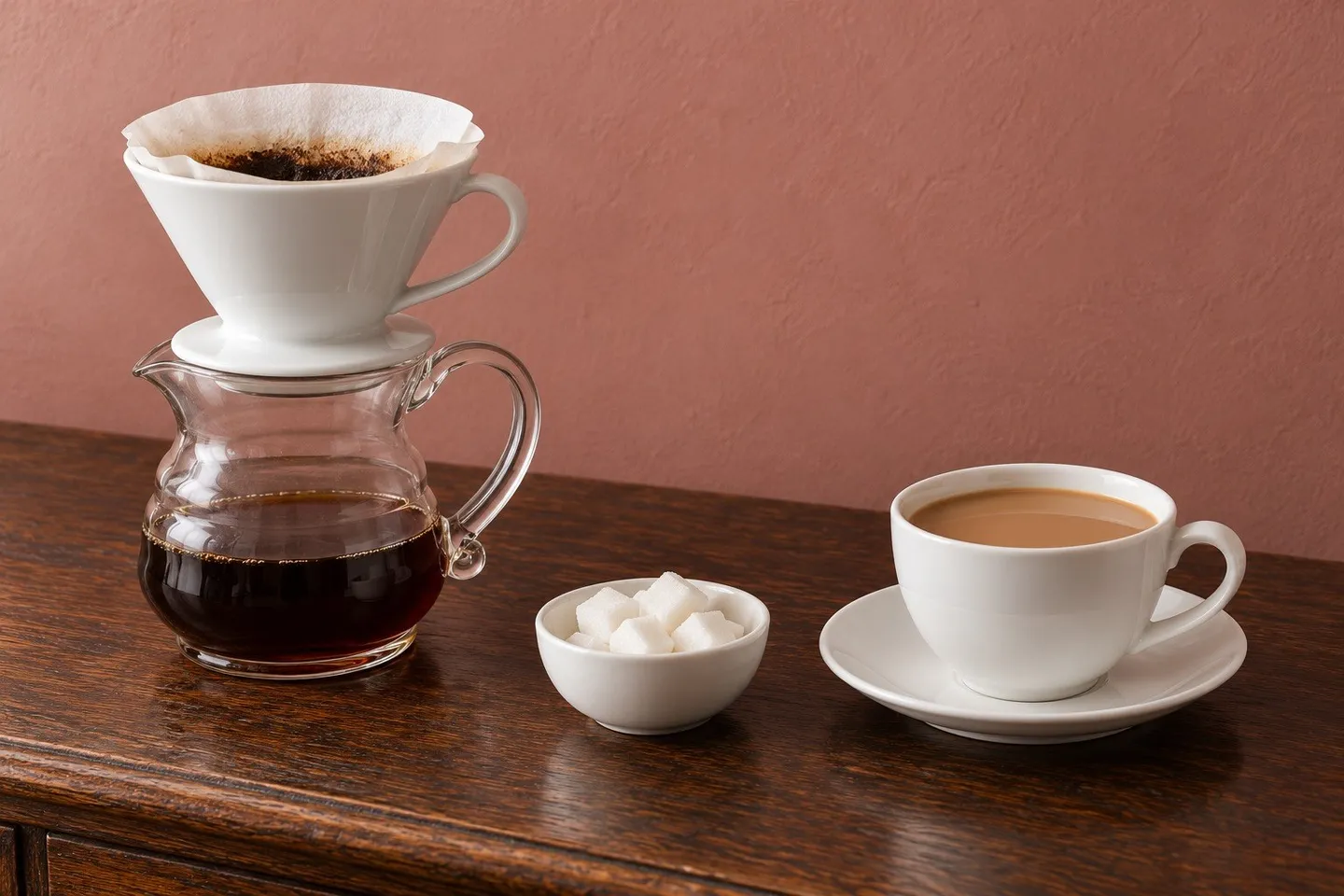
Fannie Farmer’s Filtered Coffee with Cut Sugar and Cream
Reader ratingsFine-ground coffee in a strainer, boiling water poured on by degrees and the pot covered between pours, served at once over cut sugar and cream: drip coffee from the 1896 Boston Cooking-School Cook Book.
- Recipe makes
- About 2 1/2 cups, 4 small cups
- Prep
- Cook
- Total
Includes boiling the water and about 5 minutes for it to filter through in several pours.
Filtered coffee with cream in a white porcelain cup, beside the dripper on its jug and a bowl of cut sugar.
The story behind the recipe
Filtered coffee in 1896 was drip coffee: finely ground coffee held in a strainer while boiling water was poured on a little at a time and left to run through. Fannie Farmer gives it first among the coffees in The Boston Cooking-School Cook Book, one cup of coffee to six of water, and serves it “at once with cut sugar and cream.”
The cleaner, costlier cup
Farmer admits it was not the usual way. “Commonly speaking, boiled coffee is preferred, and is more economical for the consumer,” she writes, and her boiled coffee, printed just below, needs an egg, shell and all, stirred into the grounds to settle them. Filtered coffee needed no egg, only a pot with “a strainer to hold coffee without allowing grounds to mix with infusion,” and she notes that “various kinds of coffee-pots are on the market” for it. Grinding followed the method: fine for filtered, coarse or medium for boiled.
Her pages on buying coffee are a warning to shoppers. Coffee was “often adulterated with chiccory, beans, peas, and various cereals,” and she gives a cold-water test much like the one the Victorians used against chicory in the coffee: add cold water to the suspect coffee, and “chiccory will sink; pure coffee will float.” Labels misled too. “Strange as it may seem to the consumer,” she writes, “all coffee sold as Java does not come from the island of Java.” For “average taste” she recommends two parts Java to one of Mocha.
Read more about this recipe
Making it today
A paper filter in a modern dripper does what her strainer pot did. Weighed, a cup of fine-ground coffee is roughly 80 to 90 grams, our estimate rather than Farmer’s, which puts her proportion near 60 grams to the liter, a shade stronger than the Specialty Coffee Association’s 55. That is ordinary filter strength, and far stronger than the thin boiled cups of Dufour’s 1685 coffee. Sugar and cream are optional, but if you take them, follow her order: in the cup first, because “there will be perceptible difference if cream is added last.” Coffee also closed the menu of a 1912 New York dinner that ended in a diplomatic protest, in A Coffee Row at a 1912 Diplomatic Dinner.
Filtered Coffee.
(French or Percolated.)
1 cup coffee (finely ground). 6 cups boiling water.
Various kinds of coffee-pots are on the market for making filtered coffee. They all contain a strainer to hold coffee without allowing grounds to mix with infusion. Some have additional vessel to hold boiling water, upon which coffee-pot may rest.
Place coffee in strainer, strainer in coffee-pot, and pot on the range. Add gradually boiling water, and allow it to filter. Cover between additions of water. If desired stronger, re-filter. Serve at once with cut sugar and cream.
Put sugar and cream in cup before hot coffee. There will be perceptible difference if cream is added last. If cream is not obtainable, scalded milk may be substituted, or part milk and part cream may be used, if a diluted cup of coffee is desired.

Recipe makes: About 2 1/2 cups, 4 small cups
Ingredients
For About 2 1/2 cups, 4 small cups. Quantities are shown as written.
Quantities as written here, for About 2 1/2 cups, 4 small cups.
- Finely ground coffee1/2 cup
- Boiling water3 cups
- Sugar cubes (optional)4
- Light cream (optional)1/2 cup
Measurement notes
Ingredients as written here
- 1/2 cup finely ground coffee
- 3 cups boiling water
- 4 sugar cubes (optional)
- 1/2 cup light cream (optional)
Equipment
 Coffee grinder, unless the coffee is bought ground
 Kettle
 Coffee dripper and paper filters
 Heatproof jug or bowl
Instructions
Fill the kettle for the boiling water and bring it to a full boil, and warm the cups with a little hot water from the tap.
Set the coffee dripper with a paper filter on the heatproof jug and put in the finely ground coffee.
Pour on just enough boiling water to wet the coffee, and let it drain through.
Add the rest of the water in four or five pours (our count), letting each filter through before the next, and cover the dripper with a saucer between pours to keep the heat in.
Empty the cups and share the sugar cubes and light cream between them, if you take them; the cream amount is ours.
Pour the hot coffee over the sugar and cream and serve at once.
Nutrition
75calories per serving
- Recipe makes
- About 2 1/2 cups, 4 small cups
- Servings
- 4
Estimated from USDA FoodData Central values for brewed coffee, light cream and granulated sugar, for one of four cups with a sugar cube and 2 tablespoons of cream.
Recipe notes
When adjusting quantities
Keep Farmer’s proportion of 1 part ground coffee to 6 parts water by volume. A large (4-cup) dripper holds this batch; brew larger amounts in two lots.
Notes
Quantities mentioned in these notes don’t change when you adjust the batch.
Grind fine, as for a drip pot, but not to the powder sold for Turkish coffee, which clogs a paper filter. If the water stops running, stir the grounds gently with a spoon.
For a stronger cup, Farmer pours the coffee back through the grounds once more. It loses heat on the way, so warm the jug gently on the stove afterward if you do it, without letting it boil.
Her substitutes for cream are scalded milk, or part milk and part cream “if a diluted cup of coffee is desired.” Whole milk heated until small bubbles form at the edge of the pan does the same job today.
Scaling changes the ingredients only; glassware, ice and timings need their own judgment. To adapt this recipe further, try the recipe tool at TuneMyRecipe (opens in a new tab), our sister site.
Sources and attribution
Fannie Merritt Farmer, The Boston Cooking-School Cook Book (Boston: Little, Brown, 1896), “Filtered Coffee (French or Percolated)”, p. 41
Recipe details
- Drink
- Alcohol-free
- Drink family
- Hot Drinks
- Region
- American
- Era
- 19th century
- Source decade
- 1890s
- Difficulty
- Easy
- Occasion
- Dry January