A Coffee Row at a 1912 Diplomatic Dinner
Sherry, Roederer 1904 and coffee at the Waldorf Astoria in May 1912, and the Brazilian ambassador who used it to protest a US suit over São Paulo coffee.
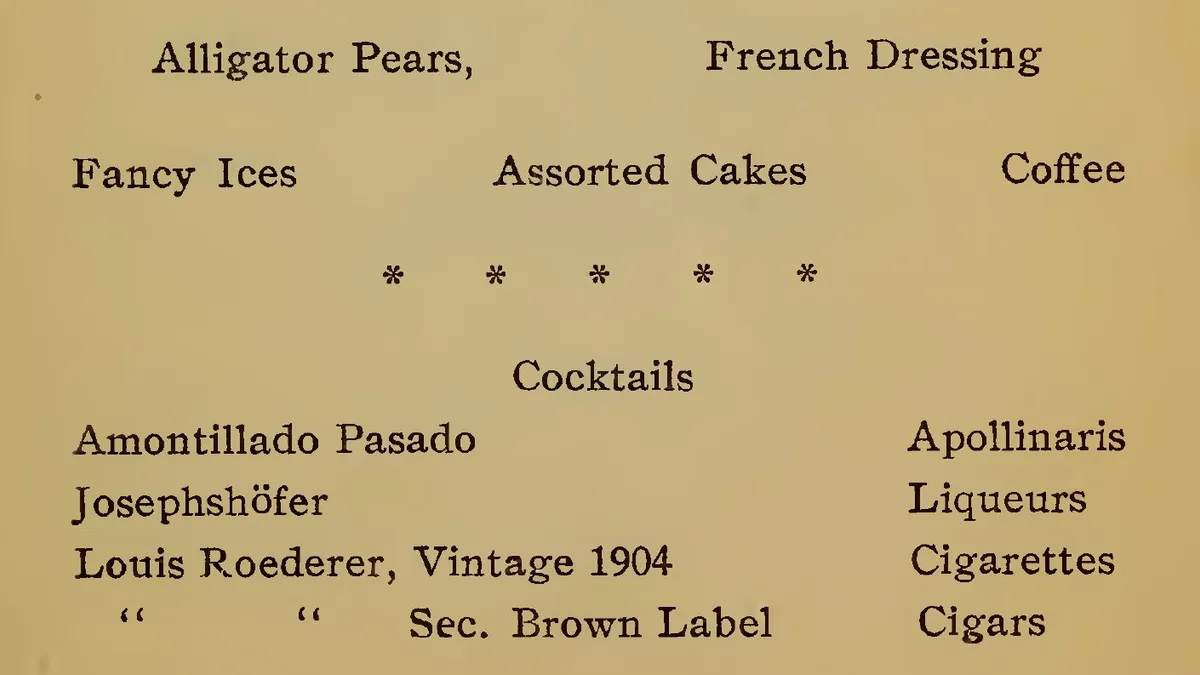
Coffee caused a row because, nine days before the dinner, the United States government had sued in New York over Brazilian coffee. At the Pan American Society’s dinner at the Waldorf Astoria on May 27, 1912, coffee closed the menu, after the fancy ices and assorted cakes. Brazil’s ambassador, Domício da Gama, was one of the speakers, and he used his turn to protest against the suit, brought against the agents selling the stock of coffee that the state of São Paulo had bought up to prop up prices. A financial weekly printed part of his speech; the diplomatic letters that followed show a settlement that took eleven more months and came with conditions.
Coffee, last on the card
The society printed a souvenir booklet of the evening, now in the Library of Congress. Its menu runs from “Grape Fruit with Maraschino Cherries” and sorrel soup through sea bass, filet mignon and squab chicken to avocados, here “Alligator Pears,” with French dressing. Then one line: “Fancy Ices,” “Assorted Cakes,” “Coffee.”
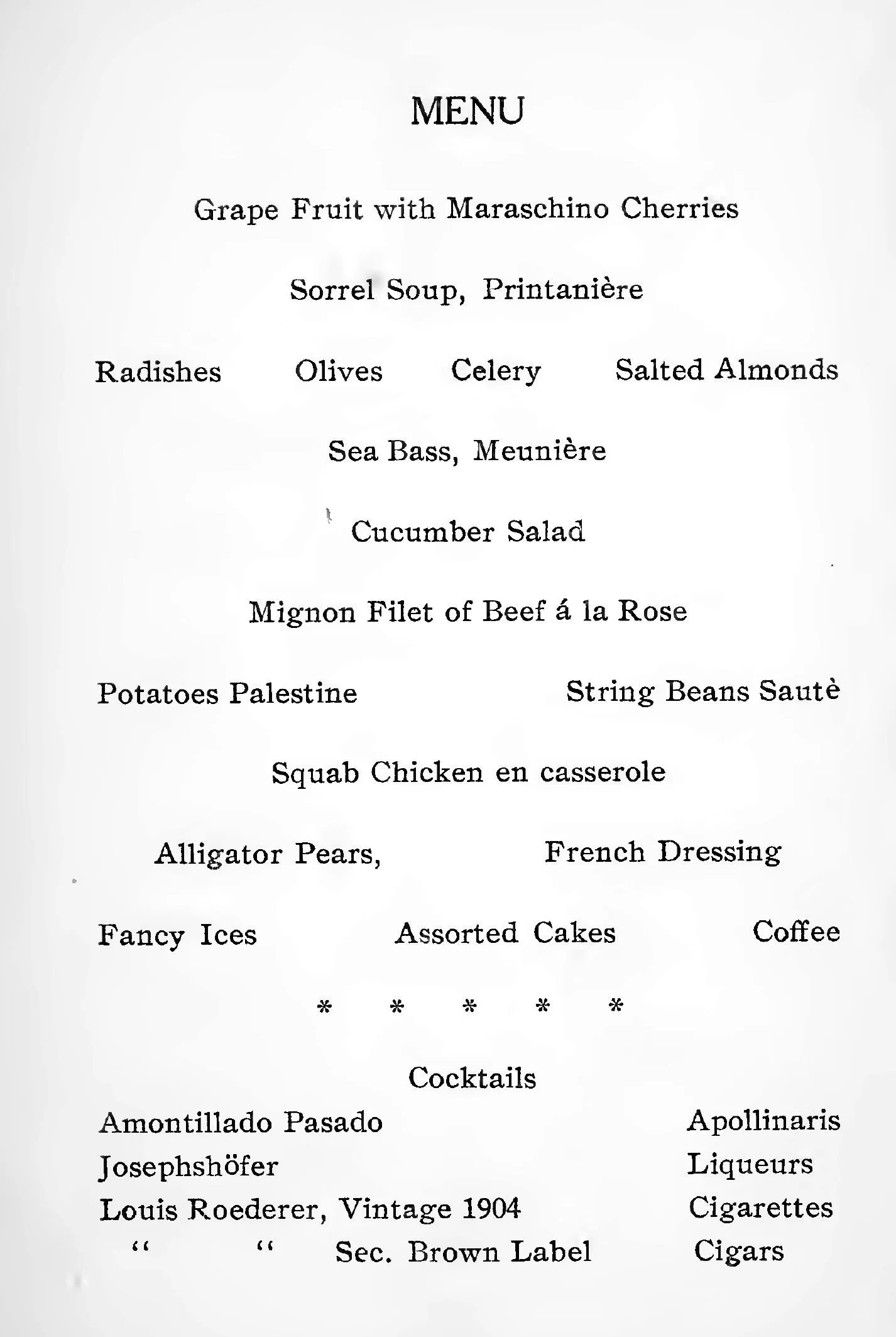 The menu of the Pan American Society’s dinner at the Waldorf Astoria, May 27, 1912, from the society’s booklet (New York, 1912). Library of Congress.
Below a row of asterisks come the drinks. “Cocktails,” with no names. “Amontillado Pasado,” a sherry. “Josephshöfer.” “Louis Roederer, Vintage 1904,” and a second Roederer, “Sec. Brown Label.” In a column of their own, “Apollinaris,” the bottled mineral water, then “Liqueurs,” “Cigarettes,” “Cigars.” The wines get a producer and a vintage; the coffee gets one word. The card doesn’t say where the beans came from, how the coffee was made, or what anyone actually drank.
A New York bar manual of 1900, Harry Johnson’s, gives one way the sherry on that list was mixed: a Sherry Cocktail of sherry, maraschino and bitters stirred on shaved ice. Johnson’s is a bartender’s manual; nothing ties it to the Waldorf’s bar.
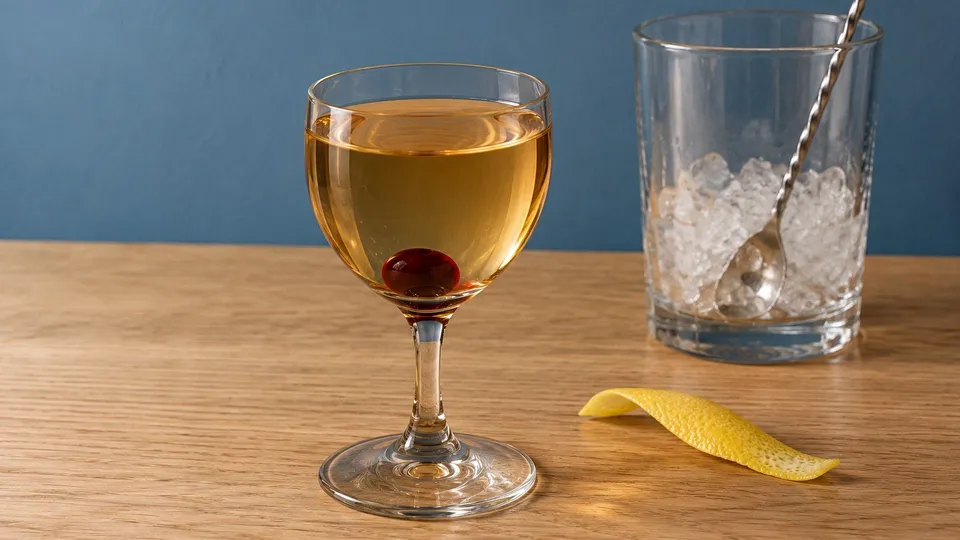 Make it todaySherry Cocktail, Sherry with Maraschino and Bitters
A society with no political policy
The host was barely three months old. The booklet dates the society’s founding to February 15, 1912, at a meeting at the Chamber of Commerce in New York, and lists its aims: acquaintance between “the representative men” of the United States and Latin America, hospitality to Latin American visitors, and other steps “involving no political policy.”
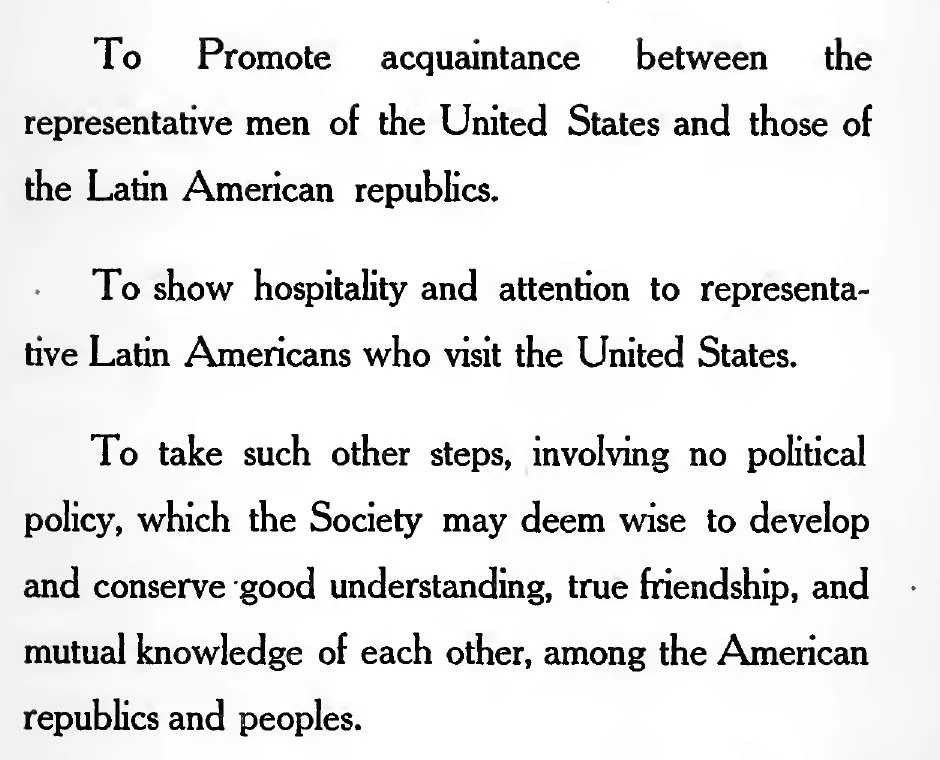 The society’s aims, from its booklet for the dinner of May 27, 1912 (New York, 1912).
The dinner honored the US secretary of state, Philander C. Knox, and the Latin American diplomats who formed the governing board of the Pan American Union. The booklet’s title leaf names them country by country, with a footnote that “Paraguay at present has no Diplomatic Mission.” Henry White was to preside. The printed program gave Knox “Pan America,” da Gama “South America,” and Mexico’s Manuel S. Calero “Latin America in North America.” Knox and da Gama were also the society’s two honorary presidents.
The suit behind the cup
Brazil was the great coffee grower of the age; Fannie Farmer’s Boston cookbook of 1896 says it “produces about two-thirds the coffee used.” After an abnormal crop, São Paulo bought up a stock of coffee in 1906, in da Gama’s later words “with the object of stopping a continuous depreciation,” and sold it off over the following years. This was called valorization. Part of the stock sat in New York warehouses.
The Department of Justice had been asking questions since July 1911. In a report of September 6, 1911, its investigator, William T. Chantland, treated the scheme as a harm to American coffee drinkers and recommended a suit, with seizure of the coffee. No court had ruled on it. On May 18, 1912, the attorney general filed in the federal court in New York, under the Sherman antitrust law, against Hermann Sielcken and the other members of São Paulo’s valorization committee. The Brazilian embassy, da Gama wrote, learned of it from “the papers of the 19th instant.”
What the ambassador said
The Commercial and Financial Chronicle of June 1 reported that da Gama, at a banquet “on Monday” given by “the newly established Pan-American Society of the United States, voiced a very strong protest.” It printed his remarks only “in part.”
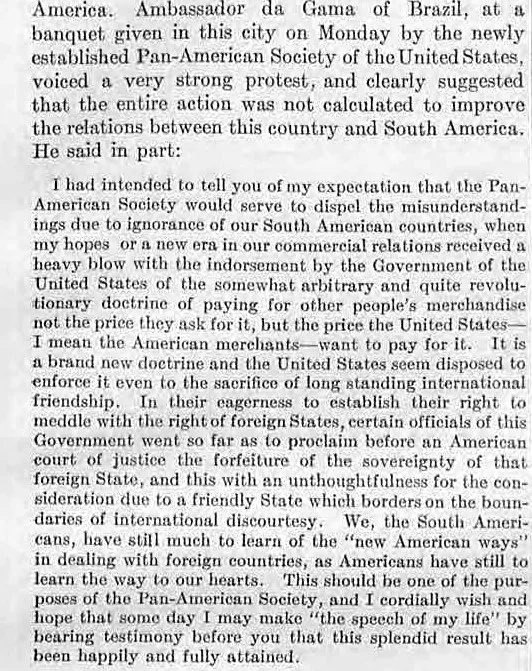 The Commercial and Financial Chronicle (New York), June 1, 1912, p. 1471. Federal Reserve Bank of St. Louis, FRASER.
He had meant, he said, to speak of hopes for “a new era in our commercial relations,” but they had “received a heavy blow.” He named “the somewhat arbitrary and quite revolutionary doctrine of paying for other people’s merchandise not the price they ask for it, but the price the United States—I mean the American merchants—want to pay for it.” Officials, he added, had claimed in court that a foreign state forfeited its sovereignty, “with an unthoughtfulness for the consideration due to a friendly State which borders on the boundaries of international discourtesy.” He closed hoping that some day he might make “the speech of my life,” bearing witness that those hopes had been “happily and fully attained.”
The Chronicle also reported, on the page before, that on the Tuesday after the dinner a federal appeals court refused the government’s request to impound the coffee until the case was decided.
Instructions may have been waiting for him. The historian Tereza Cristina Nascimento França, in a 2007 thesis, reproduces telegrams of May 25 and 26, one advising him to avoid the coffee question, and writes that he missed them after a trip to Long Island. França’s account rests on Foreign Ministry archive copies; on her reading he spoke without having seen them.
Letters after the dinner
Three days later da Gama put his case to Knox in writing. Knox, he recalled, had promised a year earlier to tell him the inquiry’s results. Instead the embassy had read of the suit in the newspapers. “The jurisdiction of an American tribunal over the acts of a foreign sovereign State can not be admitted,” he wrote, and he asked that the president be told, “with a view to its discontinuance and proper reparation.”
Knox answered on June 8. He had “no recollection” of the conversation, but “no doubt” he had made the promise, and the State Department itself, he wrote, had “no official information of the so-called coffee suit” until after the ambassador had heard of it from Justice. He declined to argue the larger points. A footnote in the published correspondence records that President Taft received da Gama on June 4.
A settlement with conditions
The suit didn’t stop that summer. On November 9, 1912, the State Department cabled, in the paraphrase of the telegram that the published correspondence prints, that the attorney general would “abandon further proceedings” if the whole stock in New York, “about 932,000 bags,” was sold in the open market, free of restrictions, by April 1, 1913. In December Brazil’s foreign minister gave written assurances and asked that neither government announce the settlement, for fear of what an official statement would do to São Paulo’s growers and merchants. On December 18 Knox wrote that the hearing would be held in abeyance, provided Sielcken withdrew his own motion for a hearing.
By da Gama’s memorandum of March 31, 1913, the committee had announced in January that it had sold the New York coffee to eighty roasters in twenty states. He still had to ask for the case to be dismissed. On April 22 the new secretary of state, William Jennings Bryan, replied that the attorney general found the ambassador’s statement sufficient and had told the district attorney in New York to withdraw the suit, while refusing any promise about future cases. Brazil’s president told his Congress on May 3 that the proceedings had been “happily ended.”
Brazilian historians have written about the speech, and nothing in the record shows that it won the outcome. The letters show a quarrel over who should have been warned, and a deal over how 932,000 bags would be sold.
The coffee on the card stayed one word. Our filtered coffee follows the drip method Farmer printed sixteen years before the dinner, a long way from the boiled cups of 1685, and keeps her one firm rule: sugar and cream go into the cup before the hot coffee, or there “will be perceptible difference.”
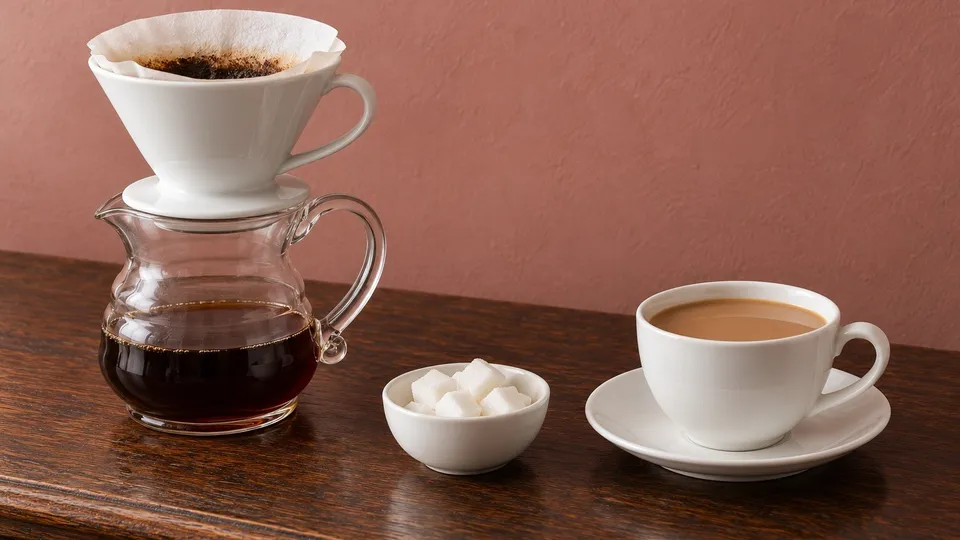 Always alcohol-freeFannie Farmer’s Filtered Coffee with Cut Sugar and Cream
For what was on the plate, our sister site The Forgotten Menu has the menu of the 1912 Pan American Society dinner (opens in a new tab).
Sources
- Dinner in Honor of the Honorable the Secretary of State of the United States and Their Excellencies … by the Pan American Society of the United States, May 27th, 1912, at the Waldorf Astoria (New York, 1912), unnumbered leaves: event, menu, speakers, officers, the society and its aims. Library of Congress, digitized by the Internet Archive (dinnerinhonorofs00pana).
- The Commercial and Financial Chronicle (New York), June 1, 1912, pp. 1470–1471. Federal Reserve Bank of St. Louis, FRASER.
- Papers Relating to the Foreign Relations of the United States, 1913 (Washington: Government Printing Office, 1920), documents 35–39, 45, 48, 50 and 56–58, pp. 39–67, Office of the Historian edition.
- Fannie Merritt Farmer, The Boston Cooking-School Cook Book (Boston: Little, Brown, 1896), pp. 39–41.
- Harry Johnson, New and Improved Illustrated Bartenders’ Manual (New York, 1900), p. 248.
- Tereza Cristina Nascimento França, Self Made Nation: Domício da Gama e o pragmatismo do bom senso, doctoral thesis, Universidade de Brasília, 2007, pp. 307–314.
- Norma Breda dos Santos, “Coffee, Ships, and Peace: Brazilian and US Diplomacy at the 1919 Paris Peace Conference,” Revista Brasileira de Política Internacional 67, no. 1 (2024), pp. 7–8.