Clear Jelly Lemonade with Seville and Sweet Oranges
Reader ratingsOrange and lemon peel steeped four hours, sugar syrup and fresh juice, run through a jelly bag until bright: Mrs. Rundell’s 1813 party lemonade, alcohol-free.
- Recipe makes
- About 1.9 liters, 10 small glasses
- Prep
- Cook
- Total
Includes 4 hours for the peel to steep; the syrup cools at the same time. Straining until clear can take another 15 minutes.
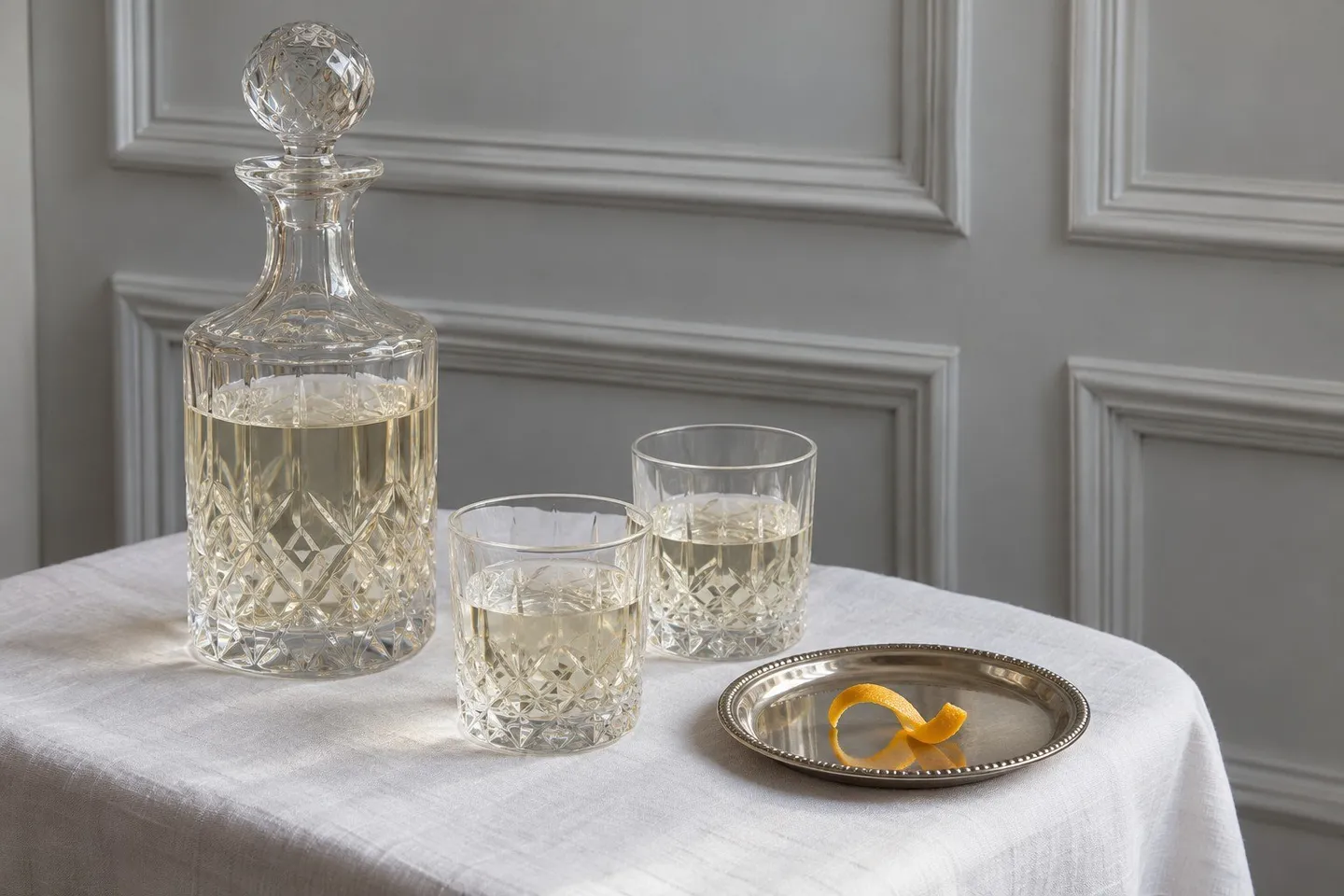
Clear orange-and-lemon lemonade in a glass decanter and small cut-glass tumblers, with a twist of orange peel on a silver tray.
The story behind the recipe
This lemonade is named for its looks. Maria Rundell called it “Lemonade that has the flavour and appearance of Jelly,” and the point of it is clarity: a peel infusion, sugar syrup and fresh orange and lemon juice run through a jelly bag until the drink is as bright as a wine jelly. It does not set. As printed it is alcohol-free.
Added by 1813
Rundell’s A New System of Domestic Cookery first came out in 1806, “By a Lady,” and changed from one edition to the next. This recipe is not in the first edition or in the Philadelphia printing of 1807. It appears in John Murray’s London “New Edition, Corrected” of 1813, on page 230. Above it on the same page is an older party lemonade, cleared with boiling milk, which in 1813 asks for “eight of the rinds” of two dozen lemons where the earlier printings have eighteen, most likely a slip by the printer.
Two kinds of orange go in. Seville oranges, the bitter kind, give only their peel. Sweet oranges, which Rundell calls China oranges, give their juice. Her “orange-water,” added “if you like the flavour,” is most likely orange-flower water, which she names in full elsewhere in the book.
Read more about this recipe
Sugar and the jelly bag
A pound and a quarter of loaf sugar comes to about 150 grams per liter of finished lemonade before the fruit adds its own; a modern cola has about 105 to 110 grams. Rundell still allows “if wanted, more sugar,” so the drink was meant to be rich. The card keeps her amount; 225 grams makes a lighter version. Her pints and quarts were wine measure, the size of today’s US pint and quart, and the recipe here is half her batch.
The jelly bag is the one piece of period equipment that matters. A sieve lined with a wet coffee filter or two layers of muslin does the same work; the first runnings come through cloudy, and pouring them back through a few times leaves the lemonade clear. Rundell says “It will keep well if corked.” Fresh, unpasteurized juice is safer kept in the fridge and drunk within three days.
It is the opposite of the lemonade James Grant was handed at Almack’s, “sour as vinegar”; the whole scene is in What Did People Drink in the Regency? For a plainer jug from half a century later, Mrs. Beeton’s lemonade pours boiling water over sugar rubbed on lemons.
Lemonade that has the flavour and appearance of Jelly.
Pare two Seville oranges and six lemons as thin as possible, and steep them four hours in a quart of hot water. Boil a pound and a quarter of loaf-sugar in three pints of water, and skim it. Add the two liquors to the juice of six China oranges, and twelve lemons; stir the whole well, and run it through a jelly-bag till clear. Then add a little orange-water, if you like the flavour, and, if wanted, more sugar. It will keep well if corked.

Recipe makes: About 1.9 liters, 10 small glasses
Ingredients
For About 1.9 liters, 10 small glasses. Quantities are shown as written.
Quantities as written here, for About 1.9 liters, 10 small glasses.
- Seville orange, for the peel1
- Unwaxed lemons6
- Sweet oranges3
- Just-boiled water, for the peel475 ml
- Sugar285 g
- Water, for the syrup710 ml
- Orange-flower water (optional)1/2 metric tsp (5 ml per tsp)
Measurement notes
Ingredients as written here
- 1 Seville orange, for the peel
- 6 unwaxed lemons
- 3 sweet oranges
- 475 ml just-boiled water, for the peel
- 285 g sugar
- 710 ml water, for the syrup
- 1/2 tsp orange-flower water (optional)
Equipment
 Vegetable peeler
 Kettle
 Heatproof bowl or jug
 Saucepan
 Citrus juicer
 Large jug
 Jelly bag or sieve lined with muslin
 Clean glass bottle
Instructions
With a vegetable peeler, pare the peel thinly from the Seville orange and half of the unwaxed lemons, leaving the white pith behind. Put the peel in a heatproof bowl or jug.
Pour the just-boiled water over the peel, cover and leave to steep at room temperature for 4 hours.
Meanwhile, put the sugar and the water for the syrup in a saucepan and bring to the boil, stirring until the sugar has dissolved. Boil for 2 minutes, then leave to cool.
Shortly before the steeping time is up, juice all the lemons and the sweet oranges. Strain out the pips and pulp.
Strain the peel infusion into a large jug, discarding the peel. Add the juice and the cooled syrup and stir well.
Pour the lemonade through a jelly bag, or a sieve lined with a wet coffee filter or a double layer of muslin, into a clean jug. Pour the first cloudy runnings back through and repeat until the lemonade runs clear.
Stir in the orange-flower water, if using. Taste, and add a little more sugar only if it needs it.
Bottle the lemonade, chill it and serve cold in small glasses. Keep it in the fridge and drink it within 3 days.
Nutrition
130calories per serving
- Recipe makes
- About 1.9 liters, 10 small glasses
- Servings
- 10
Roughly estimated from USDA FoodData Central values for granulated sugar, orange juice and lemon juice, for one of ten 180 ml glasses.
Recipe notes
When adjusting quantities
This is half of Rundell’s batch. Double every amount for her full quantity, about 3.8 liters.
Notes
Quantities mentioned in these notes don’t change when you adjust the batch.
Seville oranges are in season in about January and February. Out of season, use the peel of 1 ordinary orange and 1 more lemon in place of the Seville peel; it will be a little less bitter.
For a less sweet lemonade, start with 225 g of sugar and add more at the end only if wanted, as Rundell suggests.
The juice volume is an estimate, since fruit varies. If your 6 lemons and 3 oranges give much less than 530 ml, squeeze another lemon.
Rundell’s quart is a wine quart of about 946 ml and her pint about 473 ml, the size of US measures today. This version halves her batch: 475 ml of water for the peel, 710 ml for the syrup and 285 g of sugar.
Scaling changes the ingredients only; glassware, ice and timings need their own judgment. To adapt this recipe further, try the recipe tool at TuneMyRecipe (opens in a new tab), our sister site.
Sources and attribution
[Maria Eliza Rundell], A New System of Domestic Cookery, a new edition, corrected (London: John Murray, 1813), p. 230
See the original pages (scan at Internet Archive) (opens in a new tab)
Recipe details
- Drink
- Alcohol-free
- Drink family
- Sodas & Soft Drinks
- Region
- British
- Era
- 19th century
- Base
- Fruit & juice
- Difficulty
- Easy
- Occasion
- Summer party
- Season
- Summer