Lemonade in a Minute, Kitchiner’s Instant Lemon Syrup
Reader ratingsCitric acid dissolved in sugar syrup with lemon zest, bottled, and stirred into cold water two tablespoons to the pint: William Kitchiner’s instant lemonade of 1817.
- Recipe makes
- About 245 ml syrup, enough for 8 pint glasses
- Prep
- Cook
- Total
Includes 10 minutes for the lemon zest to steep in the warm syrup.
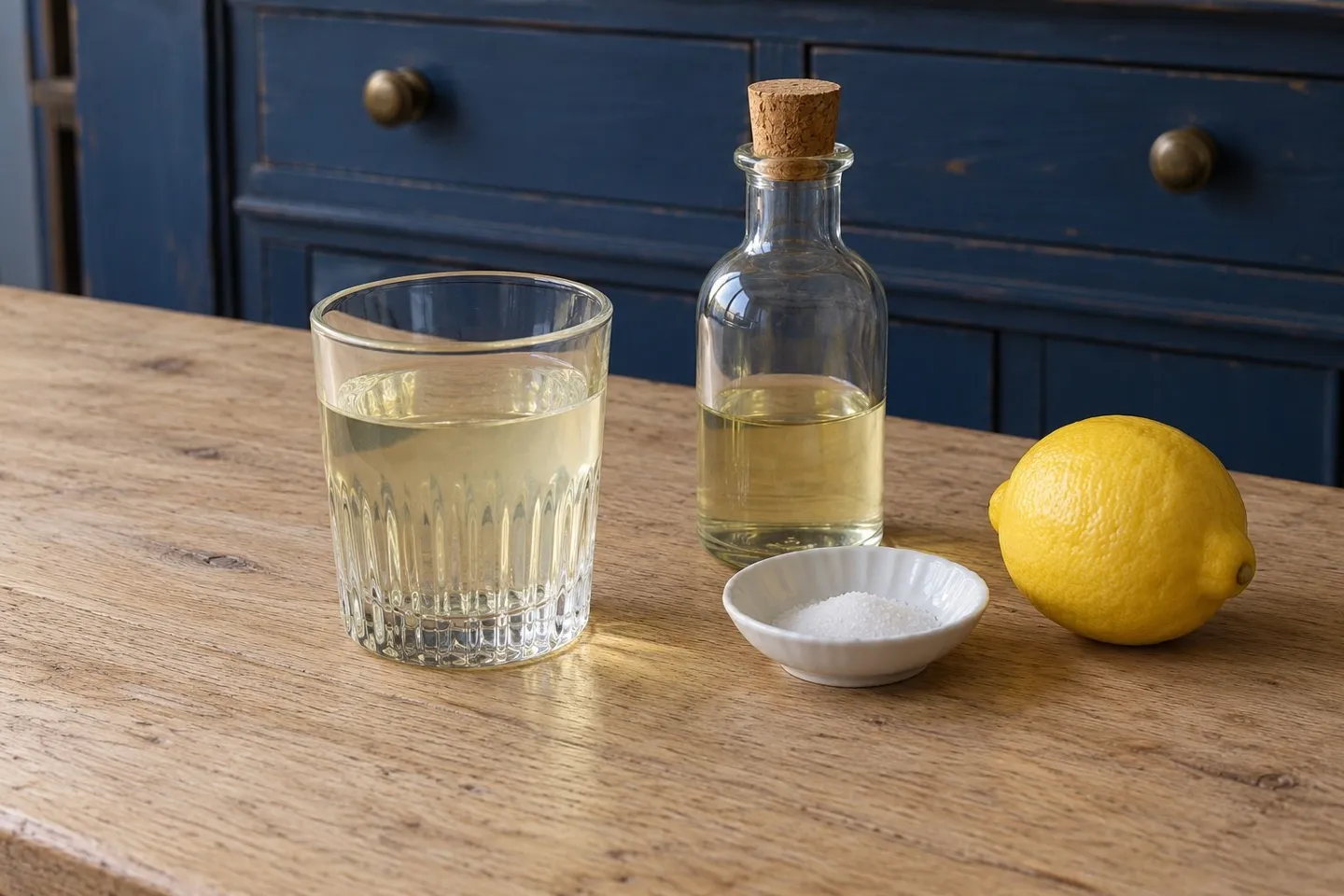
Pale straw lemonade in a fluted glass beside the corked bottle of lemon syrup, a dish of citric acid crystals and a lemon.
The story behind the recipe
Lemonade in a Minute is a lemon syrup sharpened with citric acid, kept in a bottle and stirred into cold water when it’s wanted. William Kitchiner printed it in 1817, in the first edition of Apicius Redivivus; or, The Cook’s Oracle: three quarters of an ounce of crystallized lemon acid dissolved in a pint of syrup, and two tablespoons of that in a pint of water. Made as here, it is alcohol-free.
A drinks cabinet on one page
The syrup was Kitchiner’s own No. 475, Clarified Syrup: a pound and three quarters of lump sugar to a pint of cold spring water, cleared with a little beaten egg white and skimmed as it boiled until no more scum rose. Bottled, he wrote, “it will keep for months, and is an elegant article on the sideboard for sweetenings.” For flavor the lemonade took a few drops of his No. 408, an essence of lemon oil dissolved in strong spirit.
The page that holds the lemonade is a small drinks cabinet. No. 476 is capillaire, which for Kitchiner meant his clarified syrup with a wineglass of curaçao in it. Then comes the lemonade, which “will immediately produce the most agreeable sherbet,” and No. 478 adds rum or brandy to it to make punch on the spot. No. 479 is shrub, “this very palatable but seductive liquor.” Kitchiner’s acid came as crystals, to be pounded to powder; it is the same citric acid sold in food-grade form today.
Read more about this recipe
Light by modern taste
His proportions make a light drink. Each pint glass gets about 1.3 grams of citric acid and 24 grams of sugar, which works out at roughly half the sweetness of a modern homemade lemonade and much less sharpness. The card keeps his strength as printed; stir in more syrup if you want it stronger. The spirit in his essence came to a trace, well under 0.01% ABV in the glass, and this version swaps it for lemon zest steeped in the warm syrup, which keeps the drink at zero. The egg white cleared the impure loaf sugar of 1817; modern white sugar dissolves clear without it.
The ballroom lemonade it competed with, and the complaints about it, are in What Did People Drink in the Regency? The slow way to the same drink, four years earlier, was Rundell’s clear jelly lemonade, fresh juice run through a jelly bag until bright.
Clarified Syrup. (No. 475.)
Put a pound and three quarters (avoirdupois) of fine lump sugar into a clean stewpan, that is well tinned, with one pint of cold spring water, and set it over a moderate fire: beat about the sixth part of the white of an egg with a tablespoonful of cold water; put it to the sugar before it gets warm, and stir it well together. Watch it, and when it boils take off the scum; and keep it boiling till no scum rises: when it is perfectly clear, run it through a silk sieve, or a clean napkin: put it into a close stopped bottle; it will keep for months, and is an elegant article on the sideboard for sweetenings.
Lemonade in a Minute. (No. 477.)
Dissolve three quarters of an ounce (avoirdupois) of pulverized crystallized lemon acid (with a few drops of quintessence of lemon-peel, No. 408,) in a pint of clarified syrup. Two tablespoonsful of this in a pint of water will immediately produce the most agreeable sherbet; the addition of rum or brandy will convert this into
Punch directly. (No. 478.)

Recipe makes: About 245 ml syrup, enough for 8 pint glasses
Ingredients
For About 245 ml syrup, enough for 8 pint glasses. Quantities are shown as written.
Quantities as written here, for About 245 ml syrup, enough for 8 pint glasses.
- Sugar200 g
- Water120 ml
- Unwaxed lemon, for the zest1
- Food-grade citric acid11 g
- Cold water, to serve
Measurement notes
Ingredients as written here
- 200 g sugar
- 120 ml water
- 1 unwaxed lemon, for the zest
- 11 g food-grade citric acid
- cold water, to serve
Equipment
 Kitchen scale that weighs to 1 g
 Small saucepan
 Fine grater or zester
 Fine sieve
 Clean bottle for the syrup
 Tumbler
Instructions
Put the sugar and water in a small saucepan over medium heat and stir until the sugar has dissolved and the syrup is clear. Bring it just to the boil, then take the pan off the heat.
Finely grate the zest of the unwaxed lemon into the hot syrup and leave it to steep for 10 minutes.
Weigh the citric acid and stir it into the warm syrup until it has completely dissolved.
Strain the syrup through a fine sieve into a clean bottle. Leave it to cool, close it and keep it in the fridge.
For each drink, stir about one part syrup into sixteen parts cold water, two spoonfuls to a pint glass as Kitchiner had it. Add more syrup to taste.
Nutrition
100calories per serving
- Recipe makes
- About 245 ml syrup, enough for 8 pint glasses
- Servings
- 8
Estimated from USDA FoodData Central values for granulated sugar, for one pint glass made with 30 ml of syrup; citric acid and zest add almost nothing.
Recipe notes
When adjusting quantities
This makes half of Kitchiner’s pint of syrup. Keep 11 g of citric acid to every 200 g of sugar when you scale.
Notes
Quantities mentioned in these notes don’t change when you adjust the batch.
Buy food-grade citric acid and weigh it, since a spoonful of fine powder varies a good deal. It is a permitted food additive in the US, where the FDA affirms it as generally recognized as safe (21 CFR 184.1033), and in the EU and UK as E330.
Kitchiner’s pint was a wine pint of about 473 ml. His clarified syrup, 1¾ lb of sugar to a pint of water, makes about a quart; a quarter of that recipe, 200 g of sugar in 120 ml of water, gives about 245 ml, half his pint of syrup. His ¾ oz of citric acid, halved to match, is about 11 g.
The syrup keeps for about a month in the fridge. Kitchiner’s “for months” was for his plain clarified syrup, without the zest.
For a stronger, more modern lemonade, use 3 to 4 tbsp of syrup per pint of water.
Scaling changes the ingredients only; glassware, ice and timings need their own judgment. To adapt this recipe further, try the recipe tool at TuneMyRecipe (opens in a new tab), our sister site.
Sources and attribution
[William Kitchiner], Apicius Redivivus; or, The Cook’s Oracle (London: S. Bagster, 1817), No. 477, with Clarified Syrup, No. 475
Recipe details
- Drink
- Alcohol-free
- Drink family
- Shrubs, Syrups & Cordials
- Region
- British
- Era
- 19th century
- Base
- Fruit & juice
- Difficulty
- Easy
- Season
- Summer