Bontekoe’s Weak Tea, the Dutch Doctor’s Way from 1686
Reader ratingsA small strong pot of green tea, a little poured into each cup and filled up with hot water until the tea just tastes: tea as Cornelis Bontekoe wanted it.
- Recipe makes
- 4 small cups, about 140 ml each
- Prep
- Cook
- Total
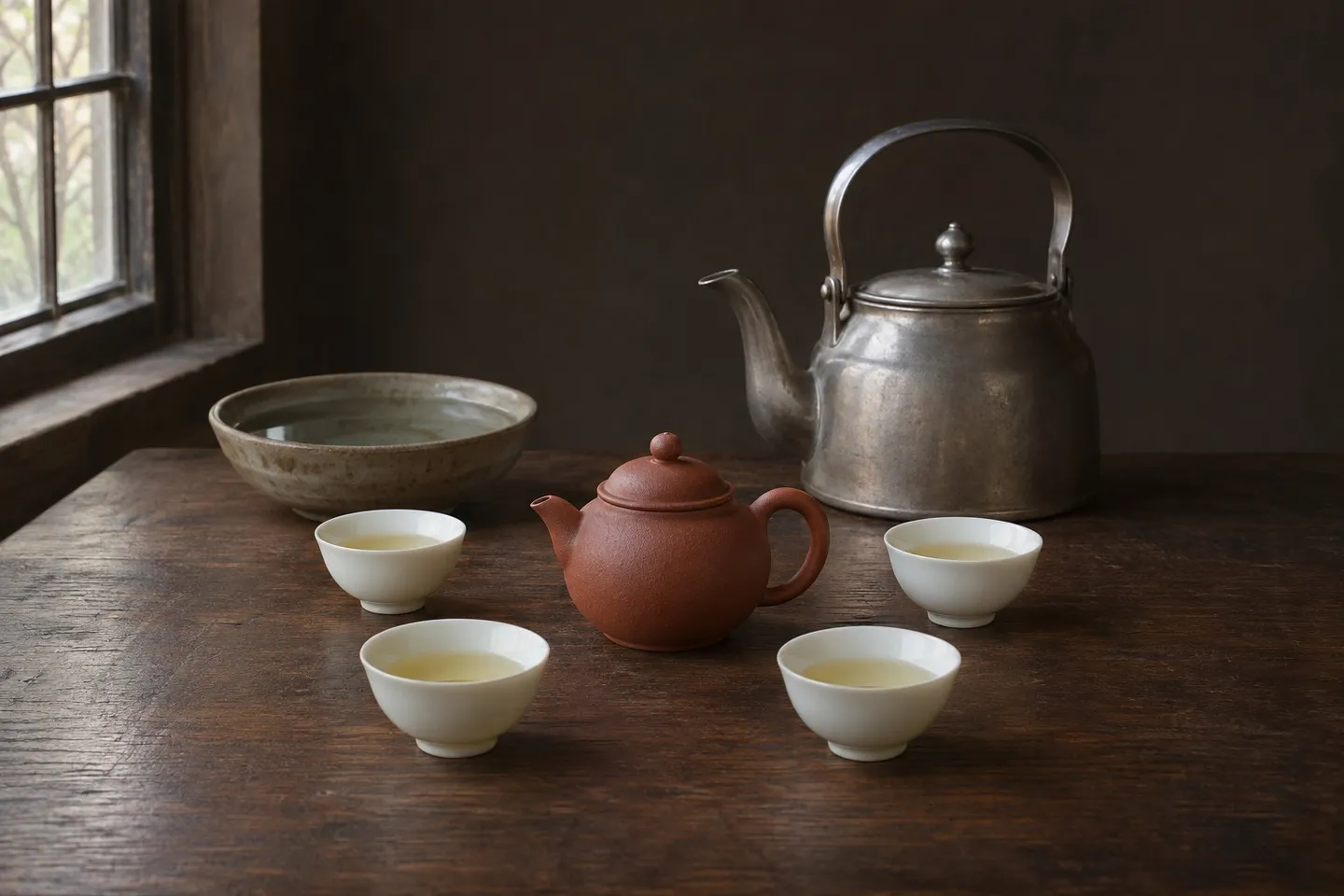
Pale tea in small porcelain cups around a red earthenware pot and a pewter water kettle.
The story behind the recipe
Cornelis Bontekoe made his tea twice: once strong in a small pot, and again in each cup, where a little of that extract met a lot of hot water. The Dutch doctor’s rule was to add water until “one just tastes the taste of the tea,” with no bitterness and no need for sugar. In his chapter on making tea, he calls this “the simple and right preparation.”
A pot and a row of cups
Bontekoe died in 1685, and his Gebruik en Mis-bruik van de Thee, “Use and Misuse of Tea,” came out the next year. By then, he writes, tea had so many lovers in the Dutch Republic that “in most houses of any standing” it was a disgrace not to drink it. His steeping pot could be pewter, red earthenware or Delft porcelain, rinsed with hot water first. The cups were porcelain. A bowl of clean water stood beside them so each drinker could rinse his cup before the pourer filled it again.
He wanted the water itself boiled for about a quarter of an hour, since unboiled water was in his view heavy on the stomach. He was firm that the last of the kettle should never be drunk, because it was always “slimy, heavy and sandy.” Good tea, he says, looks green or pale in the cup, and a pot left steeping too long turned “yellow, red, russet and unpleasant.”
Read more about this recipe
Making it today
Bontekoe gives no weights, cup sizes or minutes, so all of the numbers here are ours. The small pot holds 3 grams of green tea in 150 ml of water for two minutes, which gives a strong extract. Each small cup then takes about two tablespoons of it, topped up with hot water and tasted. His test is the one that counts: stop when the tea is only just there. A modern kettle doesn’t need a quarter of an hour on the boil, so we bring the water to the boil once. The cup has no sugar, because he wanted sugar and sweetmeats banished from the tea table, and he never mentions milk. The doctor himself, his 200 cups and the pewter pot with taps are in The Doctor Who Wanted His Tea Weak.
To drink tea with order, profit, taste and health, one puts a little of it in a steeping pot (be it of pewter, of red earthenware, or of Delft porcelain), first rinsed quite clean with a little hot water, then pours the water on it, and covering the pot at once, lets it rest a little, so that the water has color and taste: then one pours of this extract, or of this tincture, through the spout of the pot, a little into a porcelain cup, or into as many cups as there are drinkers, and with clean water one fills them up nearly to the brim.
One must then always mix the extract of the tea with so much water that one just tastes the taste of the tea, without the bitterness putting us off, or needing sugar to sweeten it.

Recipe makes: 4 small cups, about 140 ml each
Ingredients
My drinksFor 4 small cups, about 140 ml each. Quantities are shown as written.
Quantities as written here, for 4 small cups, about 140 ml each.
- Green tea leaves3 g
- Water600 ml
Measurement notes
Ingredients as written here
- 3 g green tea leaves
- 600 ml water
Equipment
 Kettle
 Small teapot with a lid
 4 small cups or tea bowls
 Bowl of clean water, for rinsing the cups
Instructions
Bring the water to a boil and pour a little into the teapot to warm it, then pour it away.
Put the green tea leaves in the pot, pour on a quarter of the just-boiled water and put the lid on at once.
Leave it for 2 minutes, no longer, so the extract stays green-gold.
Pour a little of the extract into each cup, about a quarter of the pot to each, then fill the cups nearly to the brim with the hot water left in the kettle.
Taste a cup. If you can taste more than a hint of tea, or any bitterness, pour some of it out and fill it up with more hot water. Drink it hot, blowing on it two or three times.
For a second round, rinse the cups in the bowl of clean water, pour a little more boiling water onto the leaves in the pot, and make the cups again the same way, while the leaves still color the water.
Nutrition
2calories per serving
- Recipe makes
- 4 small cups, about 140 ml each
- Servings
- 4
Estimated from USDA FoodData Central values for brewed green tea, unsweetened, for one 140 ml cup.
Recipe notes
When adjusting quantities
About 1 g of tea and 150 ml of water per small cup. The strength in each cup is set by tasting, not by the recipe.
Notes
Quantities mentioned in these notes don’t change when you adjust the batch.
Changes from the source: the amounts of tea and water, the two-minute steep and the two tablespoons of extract a cup are all our choices, since Bontekoe gives none. We boil the water once instead of for a quarter of an hour. He doesn’t name a kind of tea, but he wanted it green or pale in the cup, so we use a green tea.
His daily rule was eight or ten of these small cups twice a day, and he gives no cup size. A modern cup is bigger than a seventeenth-century tea bowl, so we suggest 140 ml.
For the strong, sweet opposite, the Victorian Coffee-Tavern Tea steeps for ten minutes.
Scaling changes the ingredients only; glassware, ice and timings need their own judgment. To adapt this recipe further, try the recipe tool at TuneMyRecipe (opens in a new tab), our sister site.
Sources and attribution
Cornelis Bontekoe, Gebruik en Mis-bruik van de Thee, ed. Steven Blankaart (The Hague: Pieter Hagen; Amsterdam: Jan ten Hoorn, 1686), “Hoe men de Thee toebereit” and “Of’t goed is Thee sterk te drinken”, pp. 91–95; our translation
Recipe details
- Drink
- Alcohol-free
- Drink family
- Hot Drinks
- Region
- Dutch
- Era
- 17th century
- Difficulty
- Easy