Bochet, the Burnt-Honey Mead of Paris, about 1393
Reader ratingsHoney boiled until it puffs and smokes, then diluted, spiced with ginger, long pepper and grains of paradise and fermented with beer yeast: the bochet of the Ménagier de Paris.
- Recipe makes
- About 3.4 liters, 10 bottles of 330 ml
- Prep
- Cook
- Total
Brew day is about 3 hours with cooling. It ferments 3 to 5 weeks, then rests about 6 weeks in the bottle, our choice since the source bottles it after a few days.
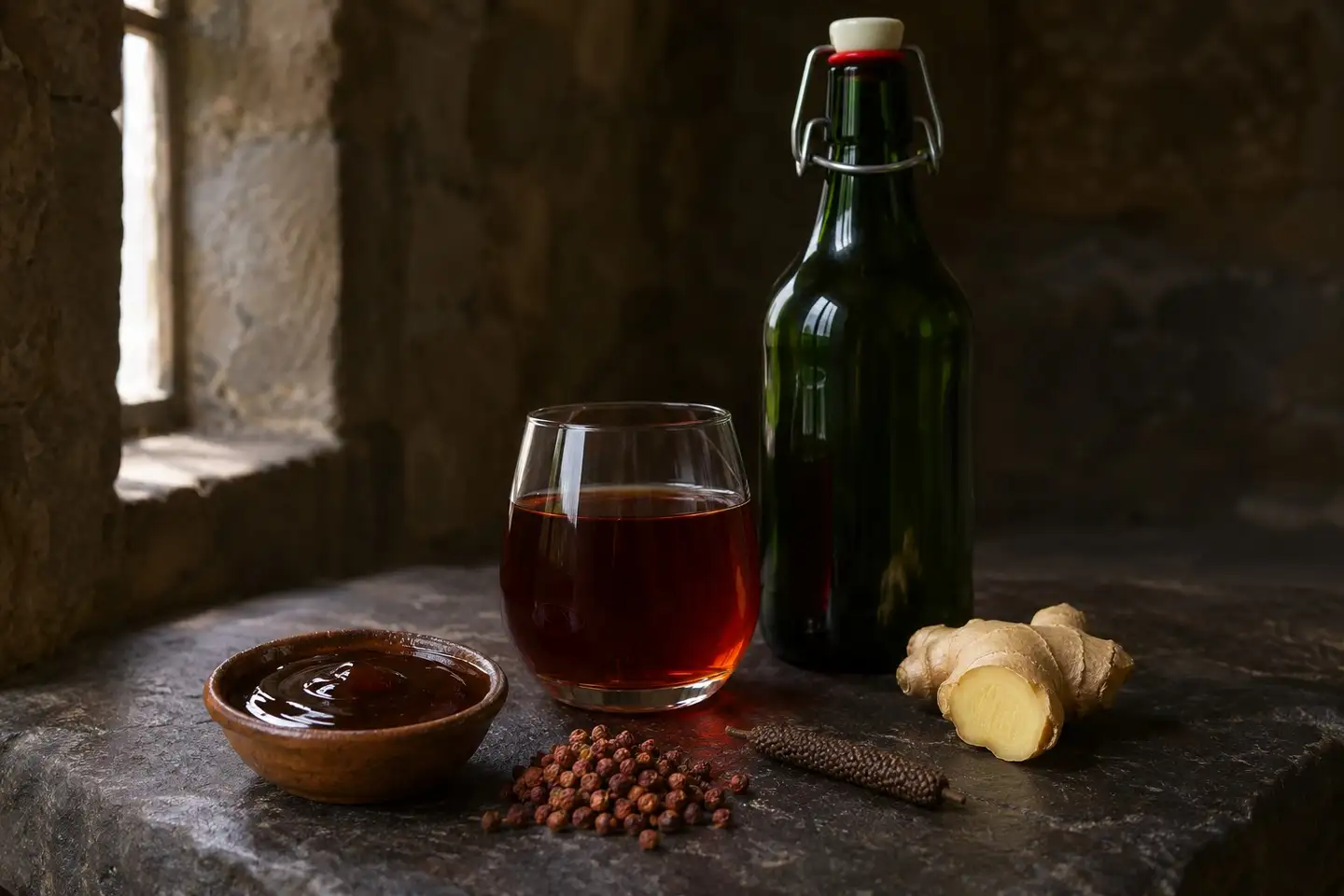
Bochet in a glass, with a swing-top bottle, caramelized honey and the spices: grains of paradise, long pepper and ginger.
The story behind the recipe
Bochet is mead made with burnt honey. Before any water goes in, the honey is boiled on its own and stirred until it swells, throws up little bubbles that burst, and gives off “un petit de fumée aussi comme noire,” a little smoke that looks almost black. Only then is it diluted, boiled down, cooled and set to ferment. The recipe is in Le Ménagier de Paris, an anonymous Paris household book written about 1393, and the honey’s browning is the whole point of it.
Beer yeast, bread leaven and a spice bag used four times
The Ménagier ferments it in a barrel with “une choppine de leveçon de cervoise,” which the 1846 editor, Jérôme Pichon, read as beer yeast, “car c’est ce qui le fait piquant,” the book goes on: that is what gives it its prickle. Bread leaven, the book says, would taste just as good but make the color duller. For a really good bochet, an ounce each of ginger, long pepper and grains of paradise, with fewer cloves, goes into a cloth bag in the barrel. After two or three days, once it tastes of the spices and prickles enough, the bag is squeezed out and moved to the next barrel. The same spices, the book says, will serve three or four times.
Read more about this recipe
Making it today
The book makes six sextiers from six pints of honey. A dictionary of 1606 counts eight pints to the Paris sextier, so we read it as one part honey to eight of finished bochet: 475 ml of honey for a 4.5 liter demijohn. We take the honey to a deep amber with a toasted smell and stop short of black smoke, which is safer and less bitter. The spices are a gram each, our choice, with wine yeast in place of beer barm. By our arithmetic it ferments out at about 7% ABV, a little less if the browning has used up some of the sugar. Whether medieval people drank water at all, and what they drank instead, is in Did Medieval People Really Drink Beer Instead of Water?. Bochet’s place among later meads, from Digby’s closet to a Kentucky cider mead, is in What Was Mead?
To go with it, our sister site The Forgotten Menu has pipefarces, cheese fritters from the same Ménagier de Paris (opens in a new tab).
Bochet. Pour faire six sextiers de bochet, prenez six pintes de miel bien doulx, et le mettez en une chaudière sur le feu et le faites boulir, et remuez si longuement que il laisse à soy croistre, et que vous véez qu’il gette bouillon aussi comme petites orines qui se creveront, et au crever getteront un petit de fumée aussi comme noire : et lors faites-le mouvoir, et lors mettez sept sextiers d’eaue et les faites tant boulir qu’ils reviengnent à six sextiers, et tousjours mouvoir. Et lors le mettez en un cuvier pour refroidier jusques à tant qu’il soit ainsi comme tiède; et lors le coulez en un sas, et après le mettez en un tonnel et y mettez une choppine de leveçon de cervoise, car c’est ce qui le fait piquant, (et qui y mettroit levain de pain, autant vauldroit pour saveur, mais la couleur en seroit plus fade,) et couvrez bien et chaudement pour parer. Et se vous le voulez faire très bon, si y mettez une once de gingembre, de poivre long, graine de paradis et cloux de giroffle autant de l’un que de l’autre, excepté des cloux de giroffle dont il y aura le moins, et les mettez en un sachet de toile et gettez dedans. Et quant il y aura esté deux ou trois jours et le bochet sentira assez les espices et il piquera assez, si ostez le sachet et l’espraignez et le mettez en l’autre baril que vous ferez. Et ainsi vous servira bien celle pouldre jusques à trois ou quatre fois.
In our English: “To make six sextiers of bochet, take six pints of very sweet honey, put it in a kettle on the fire and boil it, and stir it until it stops rising and you see it throw up bubbles like little globules that burst, and as they burst give off a little smoke that looks almost black; then stir it, and then add seven sextiers of water and boil them until they come back to six sextiers, always stirring. Then put it in a tub to cool until it is lukewarm; then strain it through a sieve, put it in a cask and add a choppine of beer yeast, for that is what makes it sharp (bread leaven would do as well for flavor, but the color would be duller), and cover it well and warmly to work. If you want it very good, put in an ounce of ginger, long pepper, grains of paradise and cloves, as much of one as of another, except the cloves, of which there should be fewer, put them in a cloth bag and throw it in. When it has been there two or three days and the bochet tastes enough of the spices and is sharp enough, take out the bag, squeeze it and put it in the next cask you make. That powder will serve you well up to three or four times.”

Original: About 3.4 liters, 10 bottles of 330 ml
Ingredients
My drinksFor About 3.4 liters, 10 bottles of 330 ml. Quantities are shown as written.
Quantities as written here, for About 3.4 liters, 10 bottles of 330 ml.
- Runny honey475 ml
- Water4.4 l
- Dried ginger1 g
- Long pepper, cracked1 g
- Grains of paradise, cracked1 g
- Cloves2
- Yeast nutrient1 metric tsp (5 ml per tsp)
- Dried champagne yeast5 g
Measurement notes
Ingredients as written here
- 475 ml runny honey
- 4.4 l water
- 1 g dried ginger
- 1 g long pepper, cracked
- 1 g grains of paradise, cracked
- 2 whole cloves
- 1 tsp yeast nutrient
- 5 g dried champagne yeast
Equipment
 Large heavy saucepan
 Wooden spoon
 Instant-read thermometer
 Muslin
 Fine sieve
 Funnel
 Glass demijohn with an airlock, 4.5 liters
 Hydrometer
 No-rinse sanitizer
 Siphon tube
 Swing-top bottles or jugs
Instructions
Clean the demijohn, airlock, funnel, siphon tube and bottles well, without soap, and sanitize them with a no-rinse brewing sanitizer, following its label. Sanitize a square of muslin and tie the dried ginger, long pepper, grains of paradise and whole cloves in it.
Pour the runny honey into the large heavy saucepan; it should fill no more than a fifth of the pan, because it foams up. Heat it over medium heat, stirring all the time with the wooden spoon. It will rise, then fall back and boil with large bursting bubbles.
Keep stirring until the honey turns a deep amber, like dark maple syrup, and smells toasted, 10 to 20 minutes. If it starts to smoke, take it off the heat at once. Don’t let it blacken.
Take the pan off the heat and let the honey cool to below 194 °F (90 °C). Standing back from the pan, pour in a cupful of the water, stirring; it will spit and foam. Add the rest of the water a little at a time, stirring until all the honey has dissolved.
Bring it to a gentle boil and simmer for 15 minutes, skimming off any foam.
Cover the pan and stand it in a sink of cold water, changing the water as it warms, until it is at 68 °F (20 °C).
Pour it through the sieve and funnel into the demijohn, up to its shoulder. Add the bag of spices, the yeast nutrient and the dried champagne yeast. Fit the airlock and set the demijohn somewhere at 64 to 70 °F (18 to 21 °C).
After 2 days, smell it at the airlock. Take the spice bag out by day 3 at the latest and throw it away.
Leave it until fermentation has finished, usually 3 to 5 weeks. Check with the hydrometer: when two readings taken a week apart are the same, and at 1.000 or below, it is done.
Siphon the bochet into beer-grade swing-top bottles, made to hold pressure, leaving the yeast sediment behind, and close them. Add no sugar.
Keep the bottles somewhere cool for about 6 weeks before drinking. Serve it cool, in small glasses.
Nutrition
140calories per serving
- Servings
- 10
Estimated from the planned starting gravity (about 1.050) and a dry finish, with the standard brewers’ calorie formula, for one 330 ml bottle.
Recipe notes
When adjusting quantities
Keep the honey at one eighth of the finished volume, the Ménagier’s six pints of honey to six sextiers of bochet. The yeast and nutrient are for one 4.5 liter demijohn.
Notes
Quantities mentioned in these notes don’t change when you adjust the batch.
Changes from the source: the one-in-eight honey ratio rests on a later dictionary’s count of pints to the sextier, so it is our reading, not a sure medieval measure. We stop the honey at deep amber instead of black smoke, use wine yeast and nutrient instead of beer yeast, use a gram of each spice instead of an ounce, take the bag out after three days and throw it away, and wait for a finished ferment instead of the book’s two or three days.
The darker the honey, the more bitter and the less sweet the bochet. A first batch at deep amber is the safe place to start. Hot honey burns badly, so keep children away from the stove and use a pan with plenty of room.
Bottling before fermentation has finished is what makes bottles burst. Wait for the steady hydrometer readings. For a honey drink without alcohol, see Spiced Honey Water from Digby’s 1669 Mead.
Storage
Keep the bottles somewhere cool and dark and drink them within a year. Once a bottle is open, keep it in the fridge and finish it within a few days.
Scaling changes the ingredients only; glassware, ice and timings need their own judgment. To adapt this recipe further, try the recipe tool at TuneMyRecipe (opens in a new tab), our sister site.
Sources and attribution
Le Ménagier de Paris, about 1393, ed. Jérôme Pichon (Paris: Imprimerie de Crapelet, 1846), vol. II, “Bochet,” pp. 238–239
Recipe details
- Drink family
- Wine, Beer & Mead
- Region
- French
- Era
- Medieval
- Difficulty
- Advanced