Aunt Sammy’s Tomato Cocktail, a 1931 First Course
Reader ratingsFresh tomatoes cooked with celery and green pepper, sieved, then sharpened with catsup, onion and horseradish and chilled: the USDA’s 1931 first course in a small glass.
- Recipe makes
- About 4 cups, 8 small glasses
- Prep
- Cook
- Total
Includes at least 2 hours in the fridge to chill.
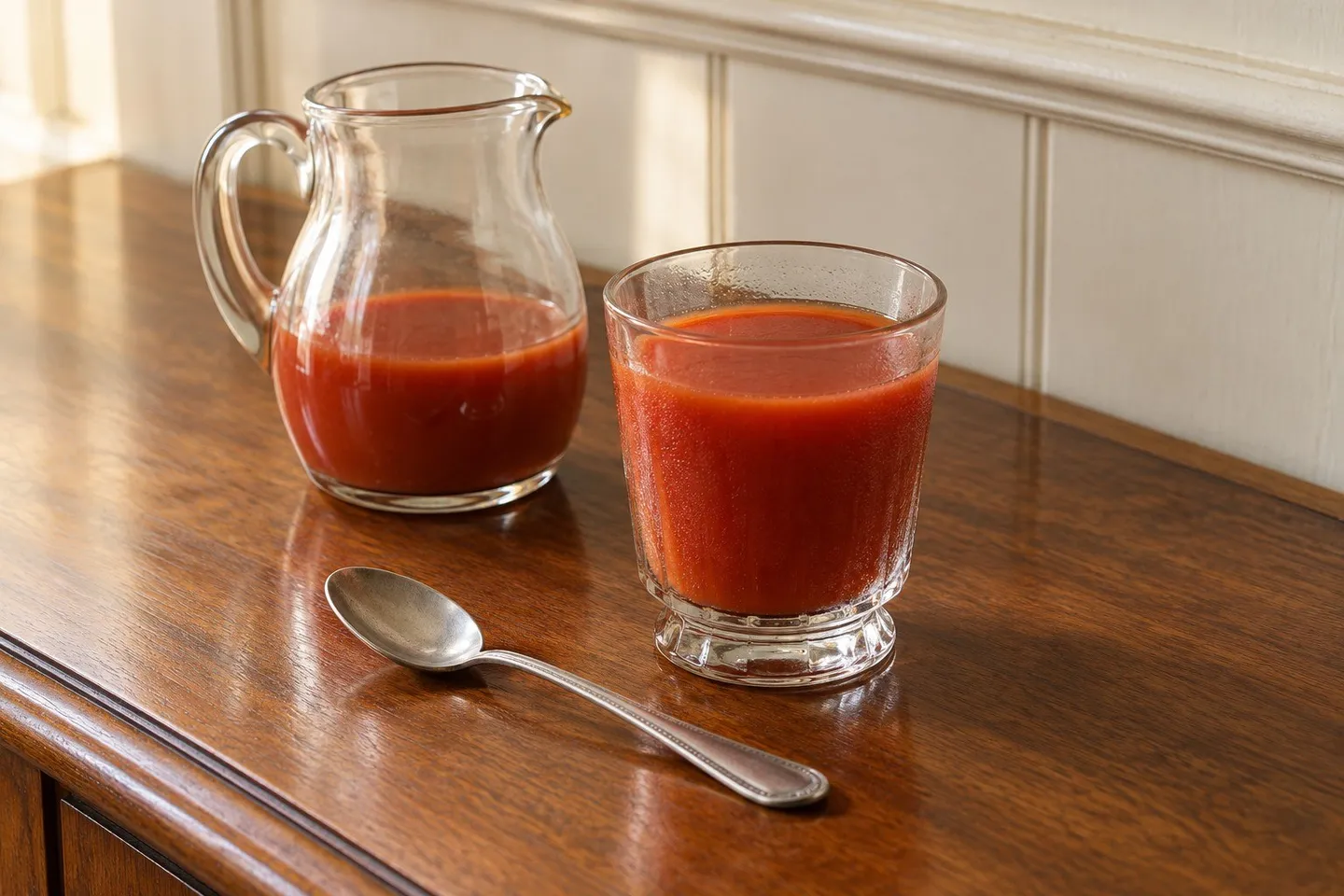
Tomato cocktail in a small footed tumbler on the sideboard, with the rest of the batch in a glass jug.
The story behind the recipe
The U.S. Department of Agriculture put this tomato cocktail in its own cookbook in 1931, a savory, cold glass meant to open a meal. Aunt Sammy’s Radio Recipes Revised, written at the Bureau of Home Economics by Ruth Van Deman and Fanny Walker Yeatman, ends the recipe with its purpose: “use as the first course at dinner or a luncheon.” The book’s first Christmas dinner menu begins with it, ahead of the roast turkey and the plum pudding.
A first course from a can
The Bureau built its cocktail on canned tomatoes, cooked briefly with celery, green pepper and salt and pressed through a sieve fine enough to keep back the seeds, so the glass held juice and pulp together. Catsup, onion pulp and horseradish went in after the sieve, then the jug went “in a cold place to chill.” The pulp settles as it stands, which is why the book says to beat it before pouring. Within a few years the same department’s radio broadcasters were telling listeners that tomato juice had become a habit across the country; What Was a Tomato Juice Cocktail? follows its rise from the canneries.
Read more about this recipe
Fresh tomatoes, less salt
We make it from fresh ripe tomatoes, the way the department’s 1934 radio script told listeners to start their own juice. Fresh tomatoes need a little longer in the pan than canned ones to collapse. The salt is our change. With the catsup on top, the book’s amount salts the juice more heavily than the same Bureau advised in 1934, when it asked for half to one teaspoon a quart, so we use a little less and leave the rest to taste.
Horseradish and onion give the cold glass its bite. Celery is a common allergen, so mention it to guests. A plain glass seasoned to order is the other way to serve it, as in our chilled tomato juice seasoned at the table, and for another soft drink that borrowed a bar name, try the grape juice highball.
Tomato Cocktail
1 quart canned tomatoes. 2 stalks celery, chopped. ½ green pepper, chopped. 1½ teaspoons salt. 1 teaspoon onion pulp. 1 teaspoon horseradish. 2 tablespoons tomato catsup.
Boil the tomatoes, celery, pepper, and salt for about 5 minutes, and rub through a sieve fine enough to keep back the seeds. To the tomato juice and pulp add the catsup, onion, and horseradish, stir well, and put in a cold place to chill. Beat before serving, pour into small glasses, and use as the first course at dinner or a luncheon.

Recipe makes: About 4 cups, 8 small glasses
Ingredients
For About 4 cups, 8 small glasses. Quantities are shown as written.
Quantities as written here, for About 4 cups, 8 small glasses.
- Ripe tomatoes, cored and cut in pieces2.5 lb
- Celery, chopped2 stalks
- Green bell pepper, chopped1/2
- Fine salt1 tsp
- Tomato ketchup2 tbsp
- Finely grated onion, with its juice1 tsp
- Prepared horseradish1 tsp
Measurement notes
Ingredients as written here
- 2 1/2 lb ripe tomatoes, cored and cut in pieces
- 2 celery stalks, chopped
- 1/2 green bell pepper, chopped
- 1 tsp fine salt
- 2 tbsp tomato ketchup
- 1 tsp finely grated onion, with its juice
- 1 tsp prepared horseradish
Equipment
 Stainless steel or enameled saucepan with a lid
 Fine sieve or food mill
 Large bowl
 Jug with a lid
 Small glasses, about 4 fl oz
Instructions
Cut out any green or bruised parts of the ripe tomatoes, then put them in a stainless steel or enameled saucepan with the celery stalks, green bell pepper and fine salt. Do not use copper, brass or iron, which dull the color and flavor.
Cover and bring to a simmer over medium heat, then cook gently, stirring now and then, for about 10 minutes, until the tomatoes have collapsed and the celery is soft.
Press everything through a fine sieve or food mill into a large bowl, scraping the pulp from the underside. Throw away the skins, seeds and fibers left behind.
Stir in the tomato ketchup, finely grated onion and prepared horseradish. Pour into a jug, cover and refrigerate for at least 2 hours, until very cold.
Whisk or stir hard just before serving, taste, and add a pinch more salt if you like. Pour into small glasses and serve as a first course.
Nutrition
35calories per serving
- Recipe makes
- About 4 cups, 8 small glasses
- Servings
- 8
Estimated from USDA FoodData Central values for raw tomatoes, celery, green bell pepper, ketchup, onion and prepared horseradish, for one 1/2-cup glass.
Recipe notes
When adjusting quantities
Scale everything together; taste for salt after chilling.
Notes
Quantities mentioned in these notes don’t change when you adjust the batch.
Aunt Sammy’s quart of canned tomatoes weighs a little under 2 pounds. The 2 1/2 pounds of fresh tomatoes here is our estimate, allowing for cores, skins and seeds; the yield of about 4 cups is our estimate too and depends on how juicy the tomatoes are.
The book’s 1 1/2 teaspoons of salt is about 9 g in a quart. Our 1 teaspoon is about 6 g, close to the 1934 Bureau leaflet’s advice of “½ of 1 per cent (by weight).” Add the other half teaspoon if you want the 1931 taste.
“Onion pulp” is onion grated to a wet pulp, juice and all. Prepared horseradish, the kind sold in a jar with vinegar, is our reading of the book’s “horseradish.”
Cool the cooked tomatoes quickly and refrigerate within 2 hours. Drink within 3 days; the recipe is not meant for canning or for keeping in the cupboard.
Storage
Keep covered in the fridge and drink within 3 days. This is a fresh drink, not a canning recipe.
Scaling changes the ingredients only; glassware, ice and timings need their own judgment. To adapt this recipe further, try the recipe tool at TuneMyRecipe (opens in a new tab), our sister site.
Sources and attribution
Ruth Van Deman and Fanny Walker Yeatman, Aunt Sammy’s Radio Recipes Revised (Washington: U.S. Department of Agriculture, Bureau of Home Economics, 1931), pp. 60–61
Recipe details
- Drink
- Alcohol-free
- Drink family
- Sodas & Soft Drinks
- Region
- American
- Source decade
- 1930s
- Base
- Fruit & juice
- Difficulty
- Easy
- Occasion
- ChristmasDinner partyDry January