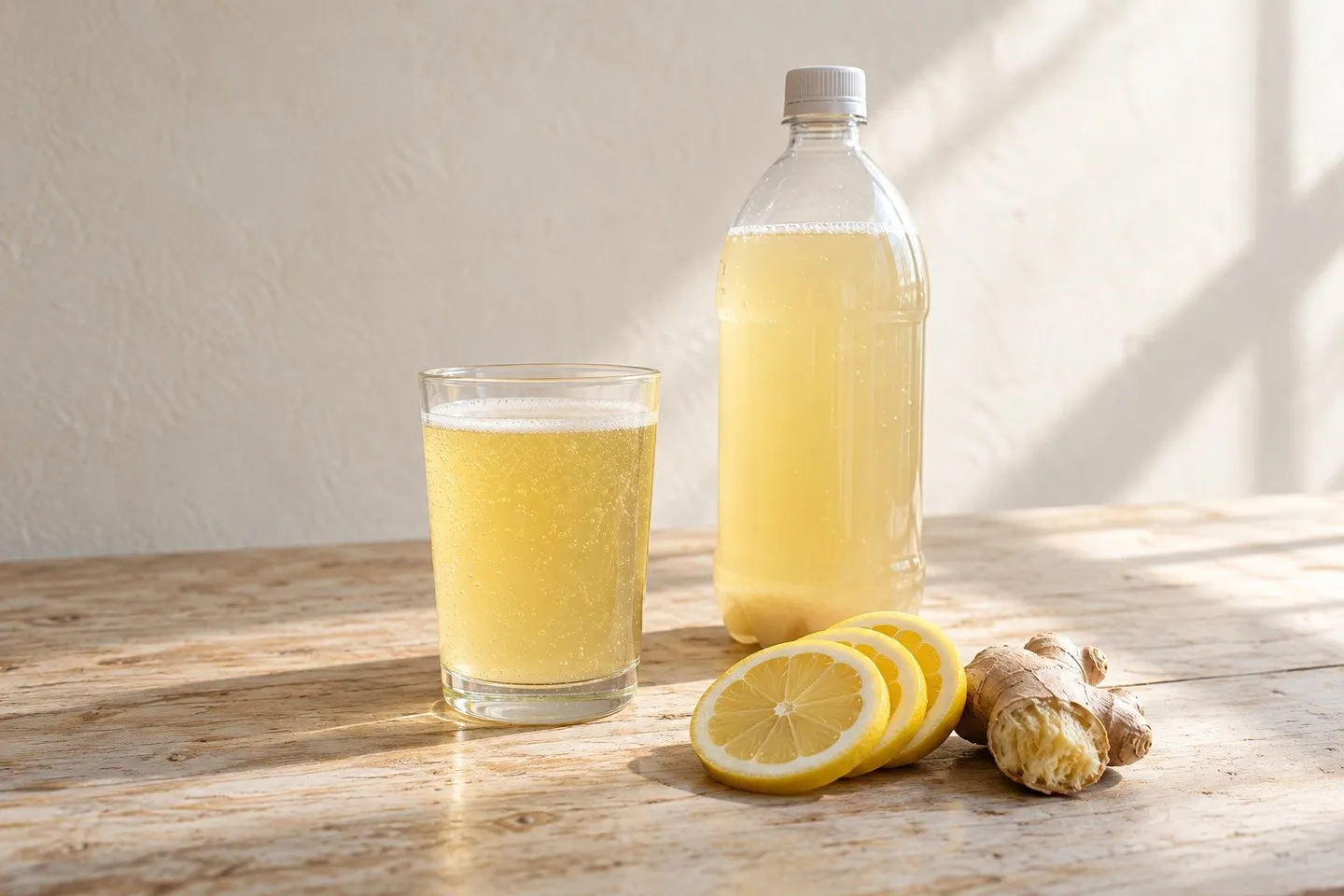
Lemon Beer, the Overnight Ginger and Lemon Brew
Reader ratingsBoiling water poured over a sliced lemon, bruised ginger and sugar, started with yeast and bottled the next day: the simplest brewed drink in Albert Hopkins’s 1919 Home Made Beverages, at half a gallon.
- Recipe makes
- About 1.8 liters, 6 glasses
- Prep
- Total
About two days: 12 to 20 hours working in the bowl, as Hopkins directs, then 12 to 24 hours in the bottle until firm, then the fridge. Hands-on time is about a quarter of an hour.
A glass of pale, cloudy lemon beer with a capped bottle, a sliced lemon and a piece of ginger root.
The story behind the recipe
Lemon beer is a quick brewed soft drink: boiling water over a sliced lemon, ginger and sugar, started with yeast and bottled within a day. This one comes from Albert A. Hopkins’s Home Made Beverages, published in New York in 1919, where it sits in a chapter headed “Non-Alcoholic Beers.” It is one of the shortest recipes there, five ingredients and two lines, and it says it is “ready to be bottled” after 12 to 20 hours.
A beer without malt or hops
There is no grain in it and no hops. “Beer” here meant what it meant in ginger beer and root beer: a sweet, flavored water left to work with yeast until it sparkled. Hopkins’s book, from the Scientific American’s own publishing house, gives two lemon beers side by side. The first, ours, is made in a bowl and bottled. The second goes into a keg with a pint of syrup and half a pint of yeast, and is “ready for use in 24 hours. If bottled, tie down the corks.”
That warning about the corks is the honest part. A drink that is still working when it is bottled goes on making gas, and some of the sugar becomes alcohol. Whether these chapter-titled “non-alcoholic” beers really were alcohol-free is the subject of What Were Victorian Non-Alcoholic Beers?, which first walked through this recipe.
Read more about this recipe
Making it today
Our batch is half of his, about two liters of water. Hopkins asks for a teacupful of yeast, which in 1919 meant liquid yeast from a brewer or a home starter; a quarter teaspoon of dried yeast does the same work in a batch this size, a little more slowly. His “bruised ginger” was dried ginger root, crushed, and a piece of fresh ginger crushed with the flat of a knife gives a brighter taste. Either works. We bottle in plastic soda bottles, not glass, and the fridge does the job his tied-down corks did.
The result is pale, cloudy and lightly sparkling, sharp with lemon and warm with ginger. For a drink with the same lemon and ginger and no yeast at all, the alcohol-free ginger beer, the fountain way is mixed from a syrup and soda water and stays at zero. Another bottled small beer, older and darker, is Spruce Beer from an 1804 New York Handbill.
Lemon Beer
1.—Boiling water, 1 gal.; lemon, sliced, 1; bruised ginger, 1 oz.; yeast, 1 teacupful; sugar, 1 lb. Let it stand 12 to 20 hours and it is ready to be bottled.
2.—Put in a keg 1 gal. of water, 1 sliced lemon, 1 tablespoon ginger, 1 pt. syrup, ½ pt. yeast. Ready for use in 24 hours. If bottled, tie down the corks.

Recipe makes: About 1.8 liters, 6 glasses
Ingredients
For About 1.8 liters, 6 glasses. Quantities are shown as written.
Quantities as written here, for About 1.8 liters, 6 glasses.
- Boiling water1.9 l
- Lemon, sliced1/2
- Fresh ginger, bruised15 g
- Sugar225 g
- Dried yeast1/4 metric tsp (5 ml per tsp)
Measurement notes
Ingredients as written here
- 1.9 l boiling water
- 1/2 lemon, sliced
- 15 g fresh ginger, bruised
- 225 g sugar
- 1/4 tsp dried yeast
Equipment
 Large heatproof bowl or pan
 Sieve
 Funnel
 Plastic soda bottles, enough for 2 liters
Instructions
Put the sliced lemon, the bruised fresh ginger and the sugar in the bowl, pour on the boiling water and stir until the sugar has dissolved.
Leave it until it is just lukewarm, about 30 °C. This takes about 2 hours.
Sprinkle on the dried yeast and stir it in. Cover the bowl with a clean cloth and leave it in a room at about 20 to 24 °C for 12 to 20 hours, until small bubbles rise when you tap the bowl.
Strain it and pour it through the funnel into the plastic bottles, filling each only to the shoulder. Screw the caps on tight.
Leave the bottles at room temperature for 12 to 24 hours, until they are firm when squeezed, then put them in the fridge.
Drink it cold within three or four days. Open the bottles slowly over the sink.
Nutrition
125calories per serving
- Recipe makes
- About 1.8 liters, 6 glasses
- Servings
- 6
Roughly estimated from the sugar in the recipe, assuming about a tenth of it ferments, for one 300 ml glass.
Recipe notes
When adjusting quantities
This is half of Hopkins’s batch, which was a gallon of water, one lemon, an ounce of ginger and a pound of sugar.
Notes
Quantities mentioned in these notes don’t change when you adjust the batch.
Changes from the source: half of Hopkins’s quantities. His gallon is the US gallon, about 3.8 liters, his ounce about 28 g and his pound about 454 g; half of those are 1.9 liters, 14 g (rounded to 15) and 227 g (225). A quarter teaspoon of dried yeast stands in for half his teacupful of liquid yeast. Fresh ginger in place of dried root, the temperatures, the time in the bottle, plastic bottles and the fridge are ours. Hopkins gives no bottle time or storage advice for this recipe.
Strength is an estimate; we have not measured it. The batch holds about 120 g of sugar a liter, so if all of it fermented the drink could pass 7 percent alcohol. A day of working and a cold fridge ferment only a small part of it, so expect far less, but it is not alcohol-free: it is no drink for children, for Dry January or for anyone avoiding alcohol.
Never bottle it in glass with a tight cap, never fill the bottles to the top and never leave full bottles somewhere warm. If a bottle is rock-hard, chill it well and open it slowly.
Storage
Keep the bottles in the fridge once they are firm and drink the lemon beer within three or four days. It contains live yeast and goes on making gas; squeeze a bottle now and then and loosen the cap if it is rock-hard.
Scaling changes the ingredients only; glassware, ice and timings need their own judgment. To adapt this recipe further, try the recipe tool at TuneMyRecipe (opens in a new tab), our sister site.
Sources and attribution
Albert A. Hopkins, Home Made Beverages: The Manufacture of Non-Alcoholic and Alcoholic Drinks in the Household (New York: Scientific American Publishing Co., 1919), “Lemon Beer” No. 1, p. 57
Recipe details
- Drink
- DrinkLow-alcohol
- Drink family
- Wine, Beer & Mead
- Region
- American
- Source decade
- 1910s
- Base
- Fruit & juice
- Difficulty
- Easy
- Season
- Summer