Seventeen Teas and Not Enough Teapots
Sage and balm, sassafras, strawberry leaves and more: the herb teas offered in 1774 to replace taxed tea, while some drank coffee and tea stayed on sale.
Liberty tea was never one drink. The name is a modern catch-all for what colonists brewed in place of taxed East India tea: dried sage with fresh balm, sassafras root, strawberry leaves and more, each recommended for its own reasons. A Virginia newspaper of January 1774 offered seventeen of them in a single article, and then had to answer the obvious objection, that a household would need a lot of teapots. Some drank coffee instead, and tea stayed on sale.
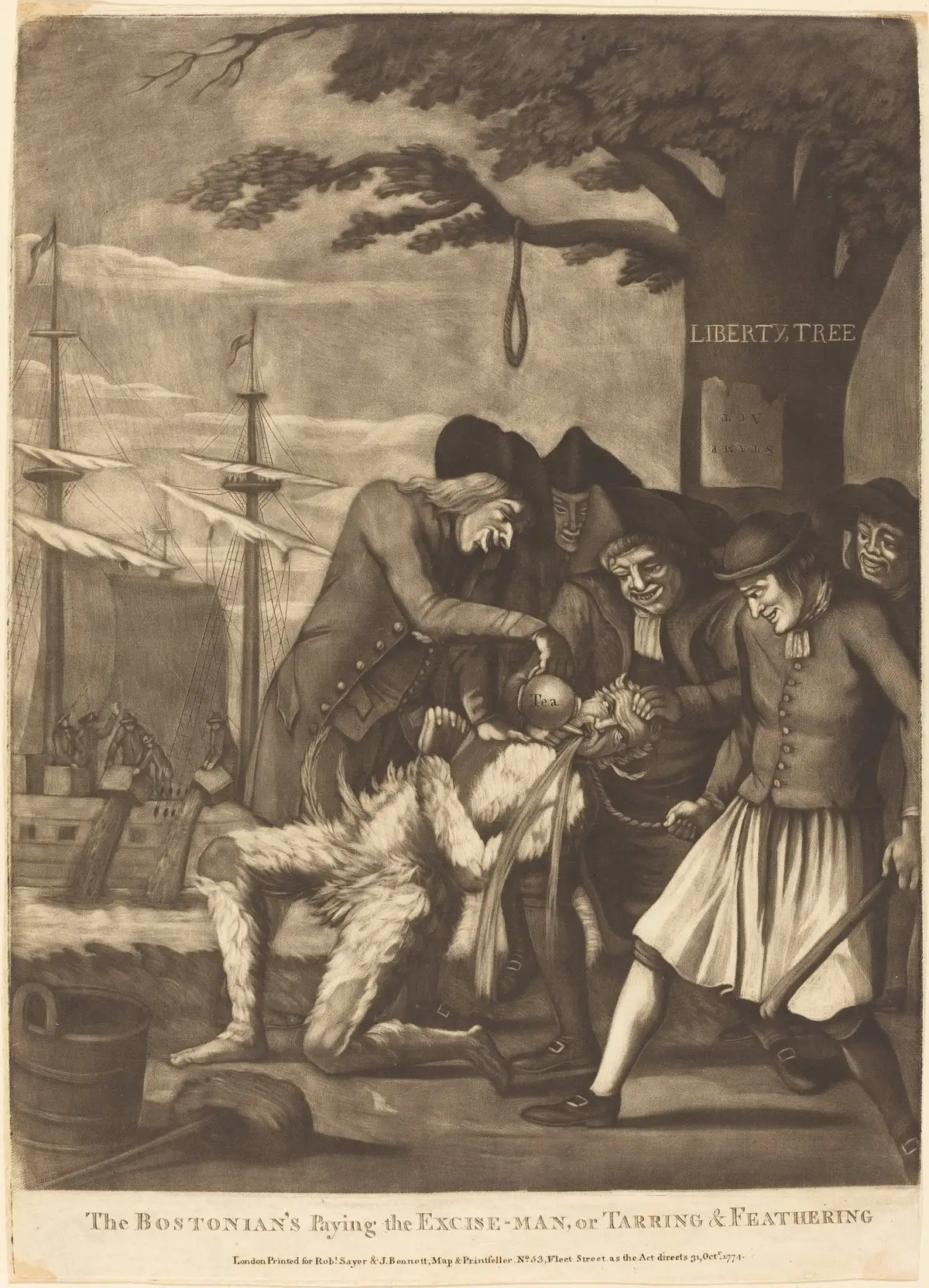
The tea in question went into Boston harbor on December 16, 1773. London’s printsellers made fun of it: the print at the top of this page, published in October 1774, has a crowd of Bostonians pouring tea down the throat of a tarred and feathered excise man while chests of tea go overboard behind them. That night marks an event, not a sudden change in what a whole country drank, and the records around it are of different kinds: advertisements, a newspaper essay, a pledge, a letter. Each tells us something different.
Herb teas before the Tea Party
The substitutes came first. In December 1767 Boston’s own printers, Edes and Gill, advertised “LABRADORE TEA, by the Hundred, Dozen or less Quantity, to be Sold at Edes and Gill’s Printing-Office,” in the Boston-Gazette. The testimonial that came with it admitted the taste was unfamiliar and asked buyers to persevere. In Salem in January 1771, Robert Bartlett’s advertisement in the Essex Gazette offered “Choice Labradore Tea, esteemed as very wholesome, & good for the Rheumatism, Spleen, and many other Disorders and Pains,—by the Dozen or single Pound.”
Those are a seller’s claims, and they show what was on offer, not how many people bought it. They also show that herb teas were on sale before the protest everyone remembers.
Seventeen teas in 1774
The fullest list we have found was printed in Williamsburg. On January 13, 1774, the Virginia Gazette of Alexander Purdie and John Dixon ran a long front-page letter signed “Philo-Aletheias.” It attacked imported tea on grounds of health and politics, then offered seventeen home-grown replacements, each matched to a different “Constitution.”
Some entries are close to instructions. Sassafras root was to be sliced thin and dried; some twigs were dried too. The fourth entry reads: “Sage and Balm Leaves (the first dry, the latter green) are gently astringent, stimulating and strengthening, excellent in Fevers, when joined with a little Lemon Juice; good for weak Stomachs, Gouts, Vertigoes, and Cachexies.” Entry fourteen was strawberry leaves with sweet brier or dog rose. The writer even allowed plain warm water with sugar and cream.
What the list doesn’t give is a recipe. There is no weight of leaves, no quantity of water and no steeping time for any of the seventeen. The health claims are his, and they are no guide to drinking herbs today.
Raspberry leaf and Labrador tea, two names often given for liberty tea now, are not on his list. That doesn’t mean nobody drank them in 1774. It means this article, the best dated source, didn’t recommend them.
Not enough teapots
Then the writer turned to a practical objection. If every member of a household was to drink the tea that suited his constitution, the table would need a pot for each. His answer:
“Water is plenty. Sideboards may be had; and, if Teapots fail, what Hardship is it for some to make their own Teas in Mugs or Tankards!”
It is a joke, but a revealing one. Giving up one tea meant taking on several, and someone still had to dry the leaves, boil the water and pour. His solution was to let people brew their own. Whether any household did, he couldn’t tell us, and neither can we.
Coffee, and tea still on sale
Coffee was the other way out. In July 1774 John Adams wrote to Abigail that an innkeeper in Falmouth, then part of Massachusetts and now in Maine, had refused him tea and offered coffee instead, and that he had drunk coffee every afternoon since. The full exchange is in What Did the Founding Fathers Drink?
Not everyone was so strict. A week after the Tea Party, on December 23, 1773, Cyrus Baldwin advertised Bohea, Souchong and Hyson tea in the Massachusetts Spy, with a note: “The above teas were imported before the East India Company’s teas arrived, or it was known that they would send any here on their own account.” The tea had a respectable history, he implied, so buying it need not trouble a patriot. The historian James Fichter, in Tea: Consumption, Politics, and Revolution, 1773–1776 (2023), separates the boycott’s public language from what people went on drinking, and argues against any wholesale turn from tea to coffee.
The pledges were public too. When fifty-one signers at Edenton, North Carolina, put their names to resolves in October 1774, they promised to keep the provincial resolutions; the printed text names no herb and describes no tea party. The best-known picture of them, A Society of Patriotic Ladies at Edenton in North Carolina, is a hostile London satire published on March 25, 1775, and its pledge “not to Conform to that Pernicious Custom of Drinking Tea” is the satirist’s wording, not the resolves’.
Making it today
The closest printed recipe to the 1774 sage and balm comes three decades later and from London. Maria Rundell’s New System of Domestic Cookery of 1806 has a “refreshing drink in a Fever” of sage and balm, with wood sorrel added:
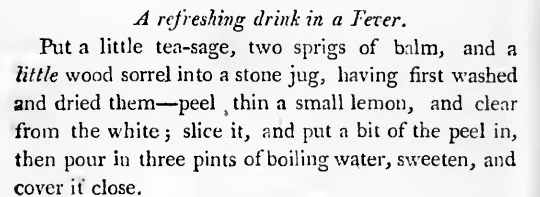 Maria Rundell, A New System of Domestic Cookery (London, 1806), p. 256. University of Leeds copy via Internet Archive, public domain.
“Put a little tea-sage, two sprigs of balm, and a little wood sorrel into a stone jug, having first washed and dried them—peel thin a small lemon, and clear from the white; slice it, and put a bit of the peel in, then pour in three pints of boiling water, sweeten, and cover it close.”
That is a later English sickroom drink, not a Boston recipe, but it shows the kind of pot the 1774 writer had in mind, and our Sage and Balm Drink makes it in a jug today. Use culinary sage and lemon balm from a grocer, never a wild plant you can’t name. For the patriot’s other choice, coffee, Dufour’s Coffee, Boiled with a Little Sugar follows a London handbook of 1685.
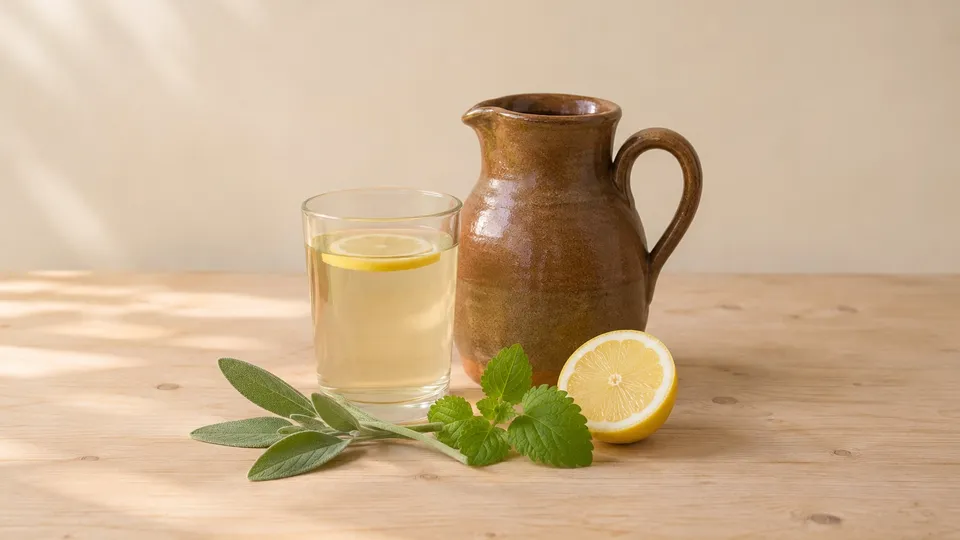 Always alcohol-freeSage and Balm Drink, Maria Rundell’s Jug from 1806
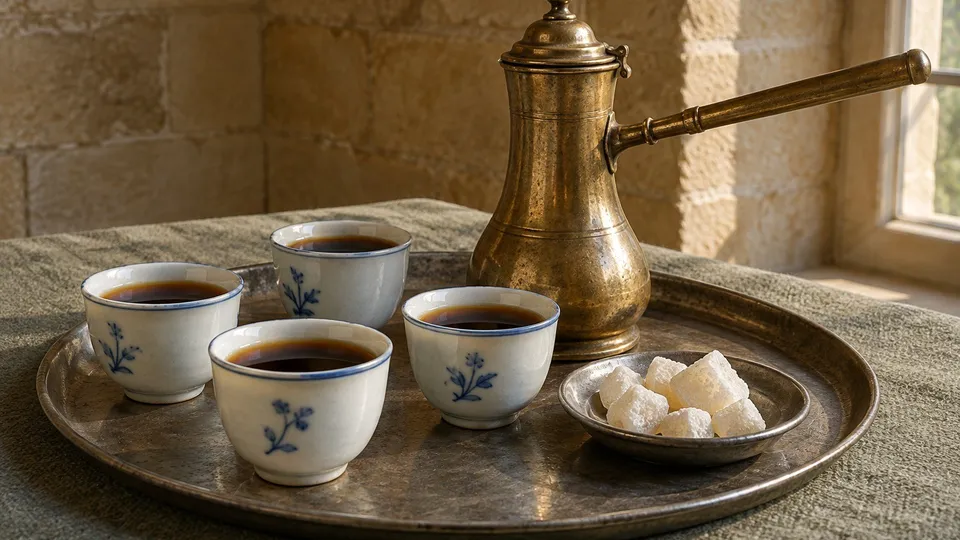 Always alcohol-freeDufour’s Coffee, Boiled with a Little Sugar
For what was on the plate, our sister site The Forgotten Menu has the Boston tea table of 1773 (opens in a new tab).
Sources
- Philo-Aletheias, letter, Virginia Gazette (Williamsburg: Purdie and Dixon), January 13, 1774, no. 1162, p. 1.
- Advertisement, Boston-Gazette, December 7, 1767; Robert Bartlett, advertisement, Essex Gazette, January 29, 1771; Cyrus Baldwin, advertisement, Massachusetts Spy, December 23, 1773, as presented by the Adverts 250 Project.
- John Adams to Abigail Adams, July 6, 1774 (second letter), Adams Family Papers, Massachusetts Historical Society.
- Edenton resolves, October 25, 1774, Virginia Gazette (Purdie and Dixon), postscript, November 3, 1774, as reproduced by the Edenton Historical Commission.
- James R. Fichter, Tea: Consumption, Politics, and Revolution, 1773–1776 (Ithaca: Cornell University Press, 2023), introduction.
- The Bostonian’s Paying the Excise-Man, or Tarring & Feathering (London: Robert Sayer and John Bennett, 1774), National Gallery of Art, Washington, 66579.
- A Society of Patriotic Ladies at Edenton in North Carolina (London: R. Sayer and J. Bennett, 1775), Library of Congress, https://www.loc.gov/item/96511606/ (opens in a new tab).
- Maria Eliza Rundell, A New System of Domestic Cookery (London: J. Murray and J. Harding, 1806), “A refreshing drink in a Fever,” p. 256.