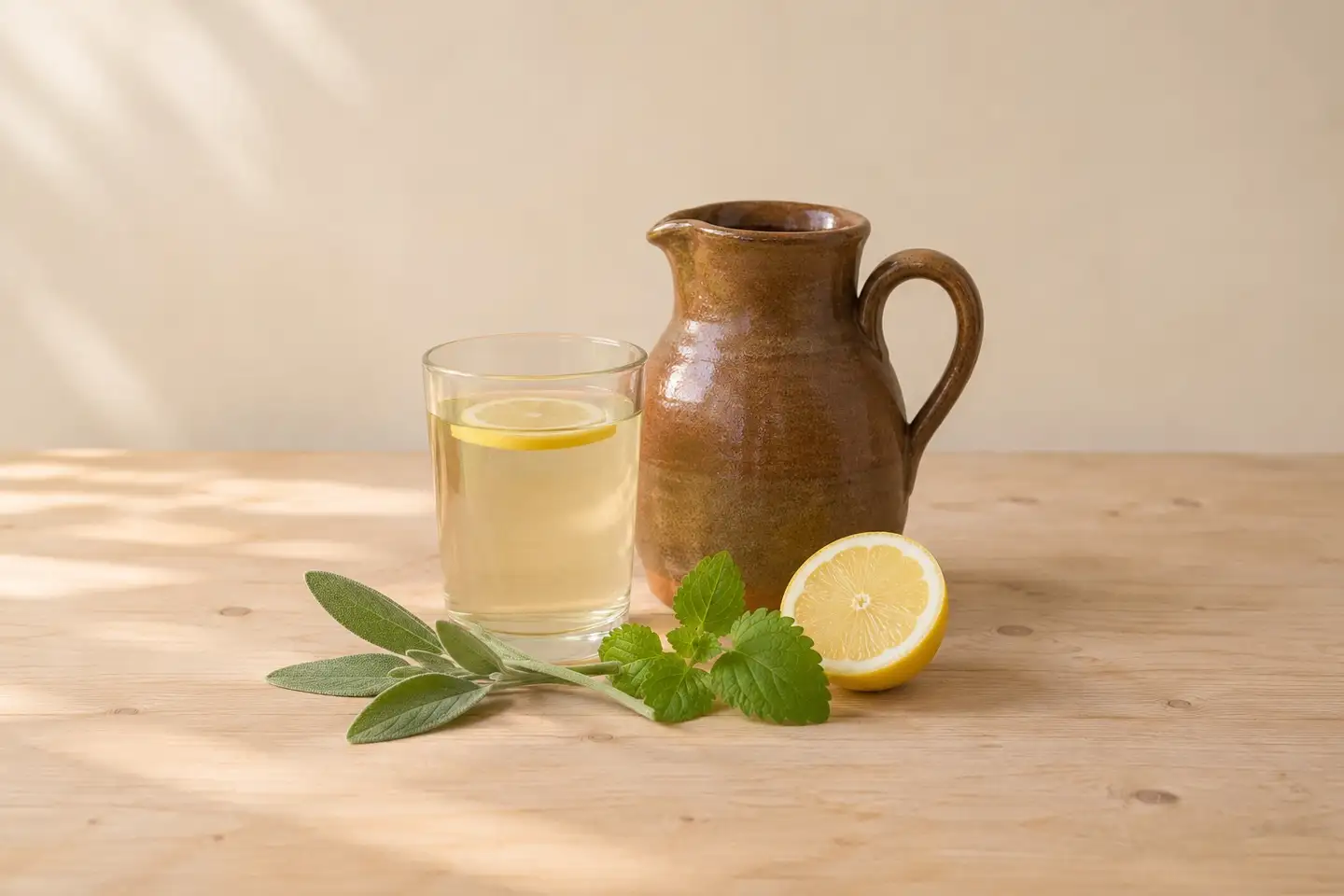
Sage and Balm Drink, Maria Rundell’s Jug from 1806
Reader ratingsSage, lemon balm and a thin-peeled lemon steeped in boiling water in a covered jug, then sweetened: an 1806 English herb drink close to the patriots’ liberty tea.
- Recipe makes
- About 1.4 liters, 6 glasses
- Prep
- Cook
- Total
Most of the time is steeping and cooling in the covered jug.
Sage and lemon balm drink in a glass beside its stoneware jug, with fresh sage, balm and lemon.
The story behind the recipe
Maria Rundell’s sage and balm drink is a herb infusion made in a jug, not a teapot: a little sage, two sprigs of balm, a little wood sorrel and a sliced lemon, with three pints of boiling water poured over and the jug covered close. Her New System of Domestic Cookery printed it in London in 1806, as a refreshing drink for a fever.
Sage and balm before Rundell
The same pair of herbs had already been recommended across the Atlantic, as a substitute for taxed East India tea. In January 1774 a writer in a Virginia newspaper listed seventeen herbs and leaves that colonists could brew instead. The fourth entry was sage and balm, “the first dry, the latter green,” and he said they worked best “joined with a little Lemon Juice.” That writer gave no quantities and no method. Rundell, thirty-two years later and in another country, gives both, and she also puts a lemon in the jug. Her recipe is the nearest printed one we have found to that patriot’s pot, and it is still an English sickroom drink, not a Boston one.
Read more about this recipe
Making it today
Rundell asks for tea-sage, which we read as ordinary garden sage, and balm, which is lemon balm. Buy both as culinary herbs; never use a wild plant you can’t name. Her wood sorrel is a small sour leaf that most cooks today would have to forage, so we make it optional and use a few leaves of culinary sorrel from a grocer for the sourness. The amounts of sage, sorrel and sugar are ours, since she gives none. Three pints were then 1.4 to 1.7 liters, depending on which pint she meant; we use 1.4. She doesn’t say whether to drink it hot or cold; we let it steep and cool under the cover, then strain it and serve it cool. The tea it stood in for, and the teapots it needed, are in Seventeen Teas and Not Enough Teapots.
A refreshing drink in a Fever. Put a little tea-sage, two sprigs of balm, and a little wood sorrel into a stone jug, having first washed and dried them—peel thin a small lemon, and clear from the white; slice it, and put a bit of the peel in, then pour in three pints of boiling water, sweeten, and cover it close.

Original: About 1.4 liters, 6 glasses
Ingredients
My drinksFor About 1.4 liters, 6 glasses. Quantities are shown as written.
Quantities as written here, for About 1.4 liters, 6 glasses.
- Fresh sage leaves3
- Fresh lemon balm2 sprigs
- Fresh sorrel leaves, optional4
- Small lemon1
- Water1.4 l
- Sugar2 metric tbsp (15 ml per tbsp)
Measurement notes
Ingredients as written here
- 3 fresh sage leaves
- 2 sprigs fresh lemon balm
- 4 fresh sorrel leaves, optional
- 1 small lemon
- 1.4 liters water
- 2 tbsp sugar
Equipment
 Kettle
 Large heatproof jug with a lid or plate to cover it
 Vegetable peeler
 Sieve
Instructions
Wash the fresh sage leaves, fresh lemon balm and fresh sorrel leaves, if using, and pat them dry. Put them in the jug.
Peel a few thin strips of zest from the small lemon with a peeler. Cut away all the white pith, slice the lemon thinly and add the slices to the jug with one strip of the zest.
Bring the water to a boil and pour it into the jug.
Stir in the sugar until it dissolves, then cover the jug with its lid or a plate.
Leave it covered for about an hour, until it is cool. Strain it into a clean jug and serve it cool, or keep it in the fridge and drink it within a day.
Nutrition
20calories per serving
- Servings
- 6
Roughly estimated from USDA FoodData Central values for granulated sugar and lemon juice, for one 230 ml glass; the herbs add almost nothing.
Recipe notes
When adjusting quantities
Rundell’s quantities make three pints. Halve everything for a smaller jug.
Notes
Quantities mentioned in these notes don’t change when you adjust the batch.
Changes from the source: the three sage leaves, four sorrel leaves and two tablespoons of sugar are our choices, since Rundell gives no amounts, and the sorrel is optional. We strain the drink and serve it cool; she says only to cover it close. Wood sorrel is left out unless you can buy it as a culinary herb.
The same book has a lemonade that is finished very differently, with boiling milk to clear it: Rundell’s Milk-Clarified Lemonade. Honey works in place of the sugar. For a stronger sage flavor, use dried sage, as the 1774 writer did: about half a teaspoon in place of the fresh leaves.
Scaling changes the ingredients only; glassware, ice and timings need their own judgment. To adapt this recipe further, try the recipe tool at TuneMyRecipe (opens in a new tab), our sister site.
Sources and attribution
Maria Eliza Rundell, A New System of Domestic Cookery (London: J. Murray and J. Harding, 1806), “A refreshing drink in a Fever,” p. 256
Recipe details
- Drink
- Alcohol-free
- Region
- British
- Era
- 19th century
- Base
- Herbs & flowers
- Difficulty
- Easy