What Did Children Drink in the 1600s and 1700s?
Small beer and milk, mostly: a 1672 summer bowl of beer, bread and currants, a quarter pint at a workhouse dinner in 1782, and porridge with milk.
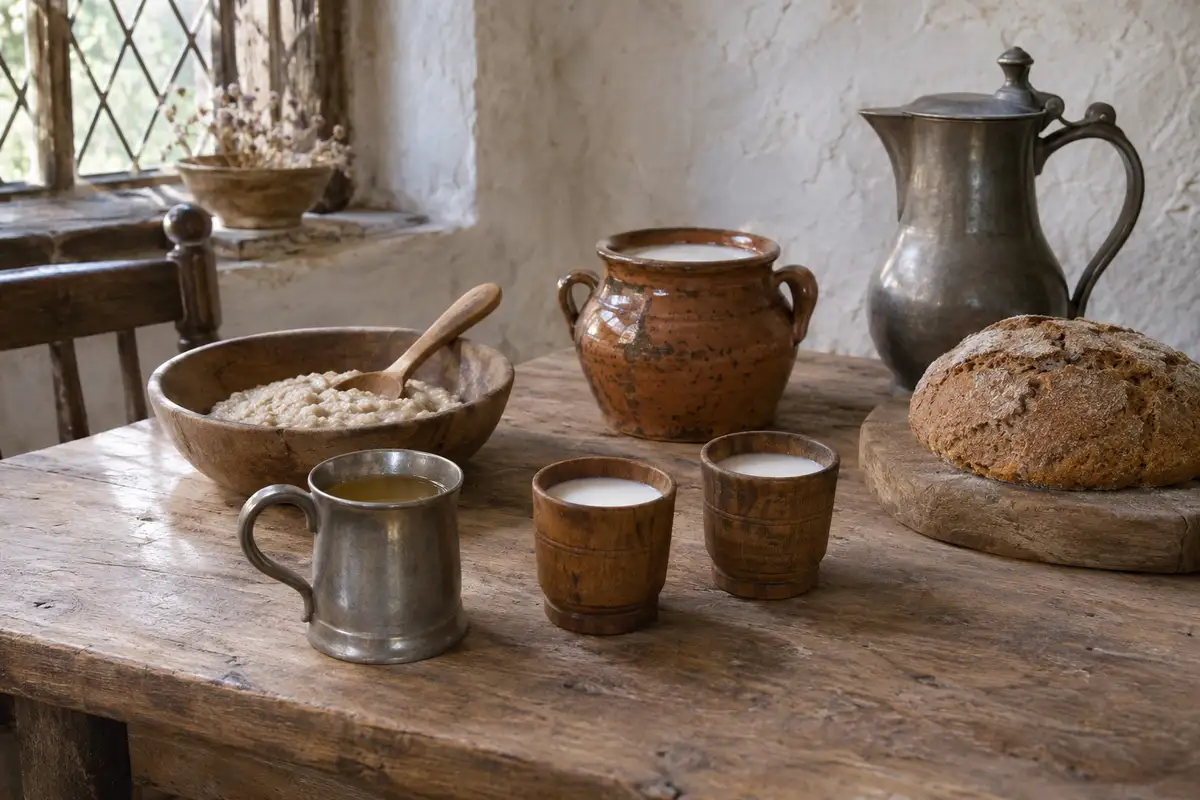
English children of the 1600s and 1700s drank small beer and milk, as far as the sources show, and the records give the amounts. In 1672 Hannah Wolley printed a cold afternoon dish for children made of small beer, a little sack, bread and currants. In 1782 a workhouse in Tiverton, Devon, gave its youngest children a quarter of a pint of beer on four days a week, and a pint of milk with their supper bread. Water was there too, but it never needed a recipe or a ration.
Children of earlier centuries had milk, ale, water and whey, which is the subject of What Did Medieval Children Drink? This story covers the two centuries after them, from a cookbook, three parish reports and one boy’s memory.
Misers for a summer afternoon
The most child-centered recipe we found from the 1600s is in Hannah Wolley’s The Queen-like Closet, printed in London in 1672, and its title says it all: “To make Misers for Children to eat in Afternoons in Summer.” The whole recipe is three lines long:
“Take half a Pint of good small Beer, two spoonfuls of Sack, the Crum of half a penny Manchet, two handfuls of Currans washed clean and dried, and a little of grated Nutmeg and a little Sugar, so give it to them cold.”
Small beer was the weak everyday beer of the household, and sack was a Spanish wine. Manchet was fine white bread. So the “Misers” were a cold bowl of weak beer, sharpened with wine and thickened with breadcrumbs and fruit, eaten with a spoon. Wolley wrote “eat,” not drink, and the beer and wine are part of the dish, not a side glass.
We don’t give children beer or wine. The small beer of the period, a household brew of malt, hops and water, is our ordinary beer of 1623.
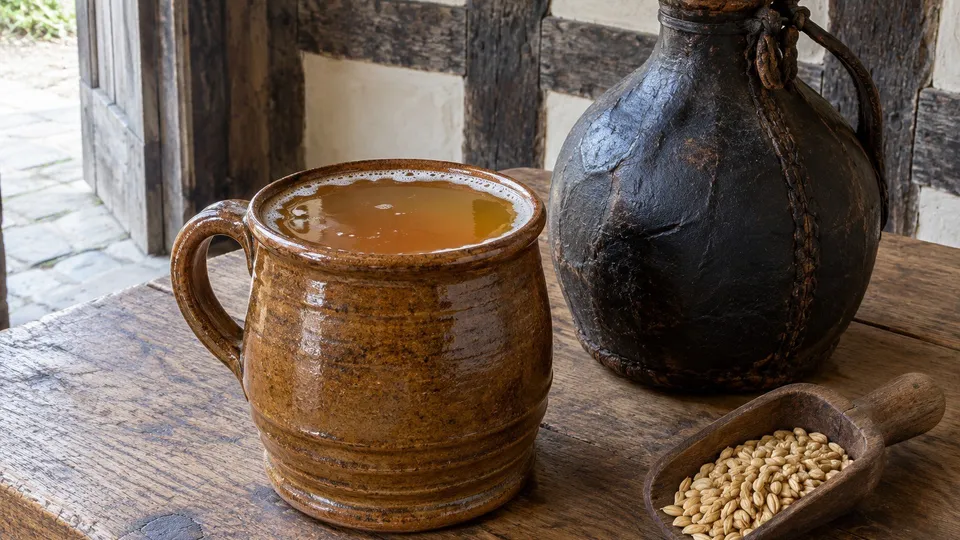 Make it todayOrdinary Beer, the Household Brew of 1623
A quarter pint at Tiverton
The clearest measure of what children were given comes from the poor. Frederic Morton Eden’s The State of the Poor (1797) collects reports on the parish workhouses of England, and its Tiverton report copies the “weekly rotation of diet appointed, 7th March 1782, for the Poor in the hospital,” Tiverton’s workhouse. Eden took the tables from a local history of 1790.
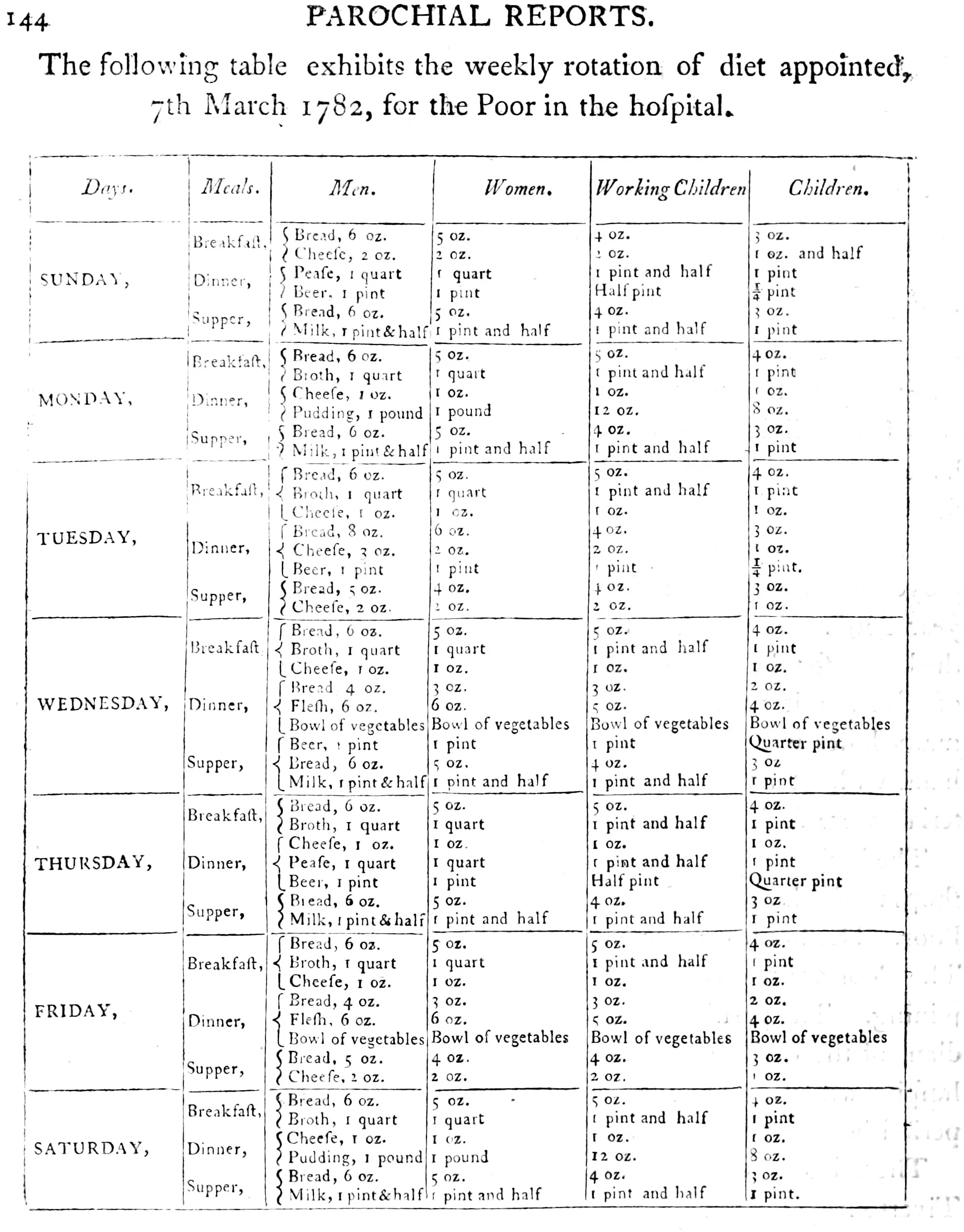
The weekly diet of the Tiverton hospital, appointed March 7, 1782, with separate columns for working children and children: F. M. Eden, The State of the Poor, vol. 2 (London, 1797), p. 144. Wellcome Collection copy, via the Internet Archive.
The table has four columns: men, women, “Working Children” and “Children.” Beer appears on four days. On Sunday and Thursday, with dinners of pease, a man got a pint, a working child half a pint and a young child “¼ pint.” On Tuesday, with bread and cheese at dinner, the young children’s share was again a quarter pint, and on Wednesday their quarter pint came at supper, beside the milk. Milk was the supper drink five evenings a week: a pint and a half for adults and working children, and a pint for the youngest, with three ounces of bread. Broth came at breakfast every morning but Sunday, a pint for each young child.
So beer was a measured part of a child’s dinner, and once a week of supper, given in a quarter of a man’s share, and milk was the larger drink by far. Nothing in the table says how strong the beer was.
A proportionable allowance
Other parishes counted less carefully. At Ashby de la Zouch in Leicestershire, Eden reported, the workhouse held 52 people, “chiefly old women and children.” Its supper had once been “about 1 lb. of bread, and 1 pint of small beer for each grown person; children had a proportionable allowance.” By the time of his visit the bread had grown dear, and potatoes and vegetables had taken its place. The new bill of fare gave milk-pottage, water-pottage or gruel at breakfast and mashed potatoes with milk at supper, and it no longer mentions beer.
A “proportionable allowance” is as close as the report comes to a number. Whether the children’s share was a quarter, as at Tiverton, or something else, Eden doesn’t say.
Tea, sugar and cups at Hampton
At Hampton in Middlesex the poor-house held “7 girls, 5 boys, 4 women, and 1 man” at the time of the report, and its diet table separates the children at two meals. Breakfast was “Broth, or water-gruel: and sometimes bread and milk for the children.” Sunday dinner was hot boiled beef and “1 pint of beer: the children are not limited to any certain quantity.” The table doesn’t say whether that freedom covered the beer, the beef or both. At supper, beer went to “each man and woman,” and the children had bread with a piece of cheese, or sometimes a little treacle in its place.
Tea was not on the table at all, which is what makes the rest of the Hampton report interesting. The women, it says, “would be riotous without tea every morning,” which the master did not allow, and yet the inmates “contrive means of obtaining tea and sugar, cups and tea-pots.” By the 1790s, tea had reached even the poor-house, through the back door.
Porridge and milk, in silence
One boy remembered these meals. Samuel Bamford, born in 1788, grew up near Manchester, and in Early Days (1849) he described breakfast at his uncle’s house. A dish of water porridge was poured out “hot from the pan,” and a mess-pot with milk and a spoon was set for each person, “each of the children of the family standing around.” They helped themselves “as quickly as we chose,” Bamford wrote, “not a word being spoken all the time,” and finished with oaten cake eaten “to the remainder of his milk.”
His father had been governor of the Manchester workhouse, and Bamford remembered its diet too: “water porridge and milk for breakfast,” and the same, or drink porridge, at supper, “except on Sunday evenings, when each adult had a pint of good ale.” The ale, in his memory, was for the adults.
What the records add up to
Read together, these sources make milk the children’s main drink, in a pint at supper or a mess-pot at breakfast, and small beer a smaller, measured one at dinner, served by the same household that brewed for everyone. The Misers sat somewhere between food and drink, a summer treat rather than a daily one. What changed after 1800 was the advice: by the 1870s American household books were steering children away from strong coffee and alcohol and toward milk and hot water, as What Did Children Drink in the 1800s? shows.
For a sober drink of the same century, Eliza Smith’s barley water with lemon and mace of 1739 needs only pearl barley, water and a lemon.
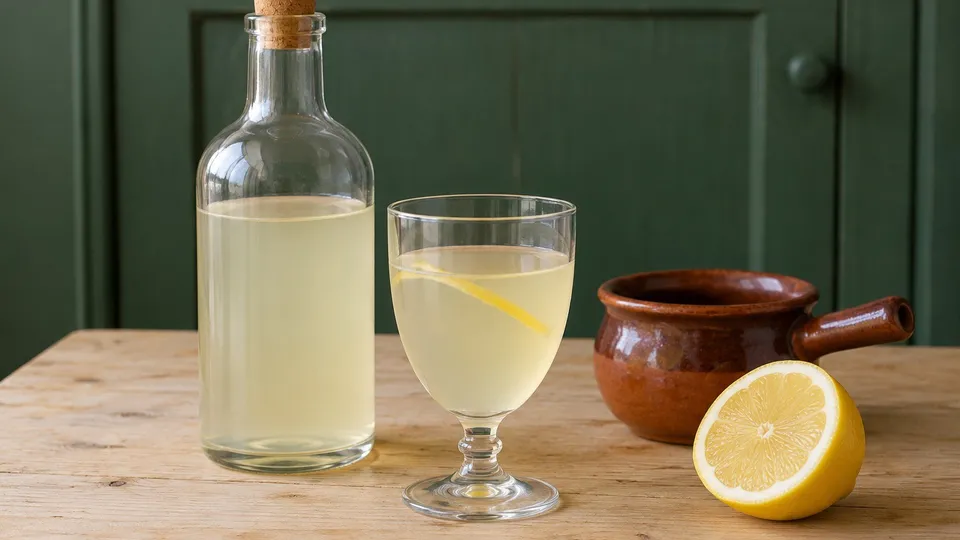 Always alcohol-freeBarley Water with Lemon and Mace
For what was on the plate, our sister site The Forgotten Menu has what children ate in the 1700s (opens in a new tab).
Sources
- Hannah Wolley, The Queen-like Closet; or, Rich Cabinet, 2nd ed. (London: Richard Lowndes, 1672), No. 94, p. 208.
- Sir Frederic Morton Eden, The State of the Poor, vol. 2 (London: J. Davis, 1797): Tiverton, p. 144; Ashby de la Zouch, p. 375; Hampton, pp. 435–436.
- Samuel Bamford, Early Days (1849), in Bamford’s Passages in the Life of a Radical, and Early Days, ed. Henry Dunckley, vol. 1 (London: T. Fisher Unwin, 1905), pp. 58–59, 76 and 98.