Hootch, 50-Cent Coffee and $40 Champagne: Drinking in the Klondike
Klondike gold rushers drank coffee, tea and cocoa at gold-rush prices, watered whiskey, and hootch from a still made of coal-oil cans.
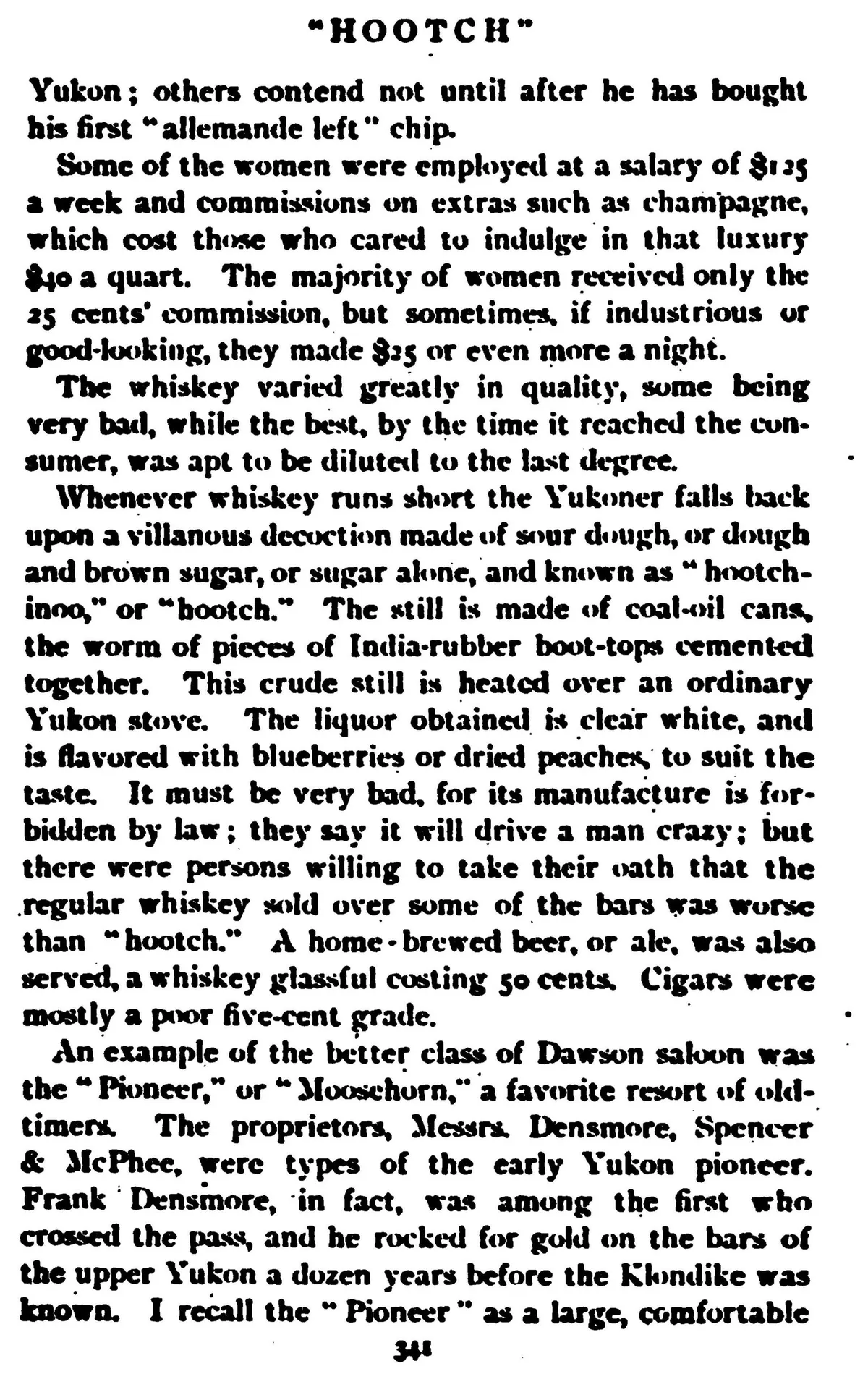
Klondike gold rushers drank coffee and tea on the trail, cocoa when they could pay for it, and whiskey that was weak, watered and dear. When the whiskey ran short in Dawson, they distilled their own from sourdough and sugar and called it “hootch.” The fullest account comes from Tappan Adney, whom Harper’s Weekly sent north in 1897 and who wintered in Dawson in 1897–98. His book, The Klondike Stampede, came out in 1900, and he wrote down the prices.
This story is part of our What Did People Drink in the 1800s? 19th-Century Drinks and Recipes guide.
A tent, a board and a bottle
Gold had reached Seattle and San Francisco by ship in July 1897, and the stampede followed. By the end of August, Adney was on the trail from Dyea toward the passes. At Finnegan’s Point he counted twenty tents, among them a blacksmith’s shop, a saloon and a restaurant, and gave the local definition of a bar: “A tent, a board counter a foot wide and six feet long, a tall man in a Mackinaw coat, and a bottle of whiskey is called a saloon here.”
The restaurant was better stocked. It was run by two young women from Seattle, and “a full meal of beans and bacon, bread and butter, dried peaches and coffee is served for 6 bits, or 75 cents.” That is about $29 in today’s money, by US consumer prices.
Dawson prices
In Dawson the prices climbed with the distance from anywhere. At an eating place called the Eldorado, a meal of moose meat or beef, beans, stewed apples or peaches, one “helping” of bread and butter “and one cup of tea or coffee” cost $3.50, about $135 today.
At Jake’s, Adney writes, there hung all winter a bill of fare “drawn in large black letters on a sheet of Bristol-board.” Its last two lines were the drinks.
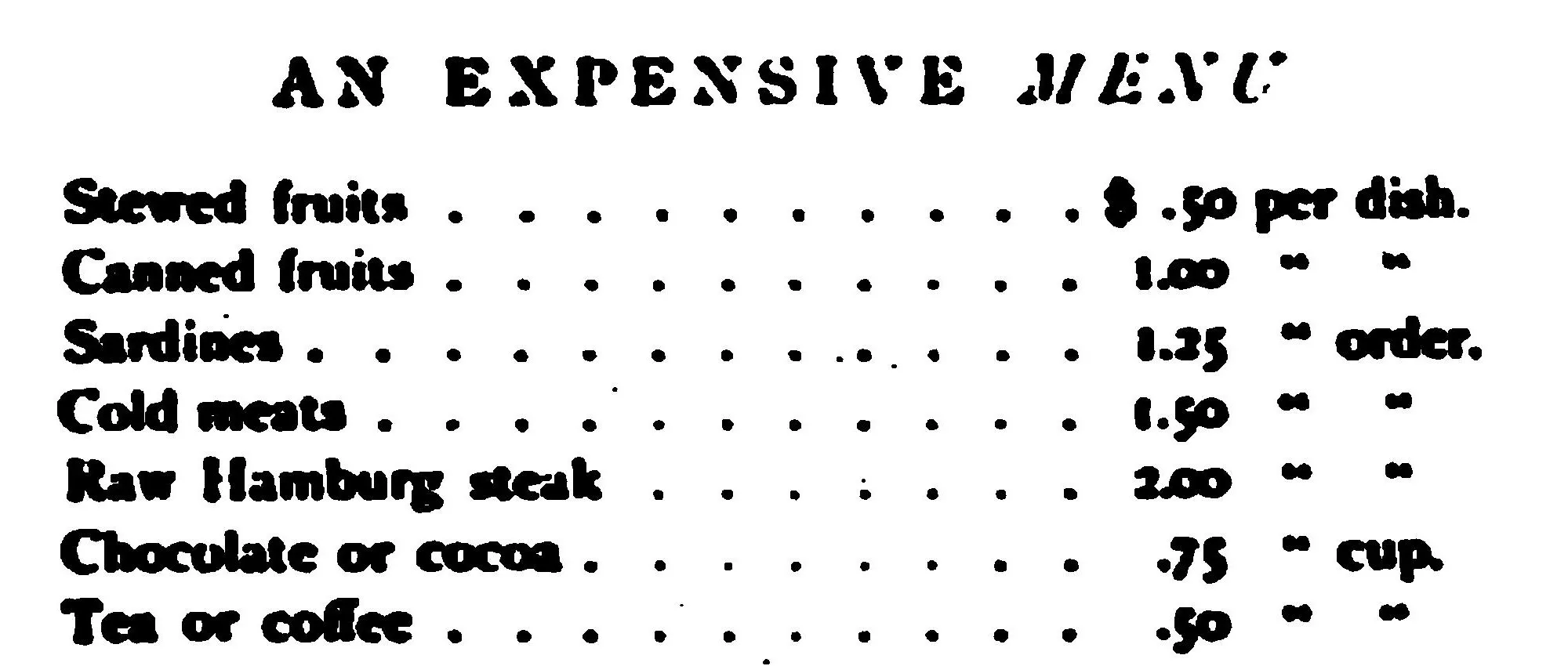 The end of Jake’s bill of fare in Dawson, winter 1897–98, from Tappan Adney, The Klondike Stampede (1900), p. 347.
Chocolate or cocoa was 75 cents a cup, about $29 today, and tea or coffee 50 cents, about $19. Adney adds that the card and its lettering together cost $15, “probably one of the most expensive menu cards in the world.” Jake’s own shelves rarely held more than a bottle of Worcestershire sauce, a pie, some sardines, some tins of milk, a pan of beans and a loaf.
The dance halls charged more. Some of the women there were paid commissions “on extras such as champagne, which cost those who cared to indulge in that luxury $40 a quart,” about $1,550 today. The whiskey “varied greatly in quality, some being very bad, while the best, by the time it reached the consumer, was apt to be diluted to the last degree.” There was beer too: “A home-brewed beer, or ale, was also served, a whiskey glassful costing 50 cents.” Customers paid in gold dust, weighed out at the counter, and Adney reckoned that small buyers lost $4 to $6 in every $50, to the weigher’s “turn” of the scale, to carelessness and to plain theft.
Hootch
When the whiskey ran out, the miners made their own. “Whenever whiskey runs short the Yukoner falls back upon a villanous decoction made of sour dough, or dough and brown sugar, or sugar alone, and known as ‘hootchinoo,’ or ‘hootch.’”
Adney describes the still. “The still is made of coal-oil cans, the worm of pieces of India-rubber boot-tops cemented together. This crude still is heated over an ordinary Yukon stove. The liquor obtained is clear white, and is flavored with blueberries or dried peaches, to suit the taste.” Making it was against the law, and people said it would drive a man crazy, but “there were persons willing to take their oath that the regular whiskey sold over some of the bars was worse than ‘hootch.’”
The English word “hooch” comes from this. “Hootchinoo” is usually traced to a Tlingit village in Alaska, where American soldiers met homemade stills in the 1870s. There is no recipe for it here. A still like Adney’s is illegal in most places without a license, and a homemade still can make poisonous spirit.
A cocktail for the ones who struck it rich
The miners who came home rich had a cocktail waiting for them, if a bar book is to be believed. In 1903 Tim Daly of Worcester, Massachusetts, printed a Klondike Cocktail in Daly’s Bartenders’ Encyclopedia: Tom gin stirred over fine ice with orange bitters, a dash of Bénédictine and a little brandy, finished with lemon. Daly calls it “a nugget” for “returned miners and prospectors from the gold fields of Alaska who have struck it rich,” which is his geography. The Klondike is in Canada’s Yukon, though most stampeders went in through Alaska. The drink is on our pages as the Klondike Cocktail.
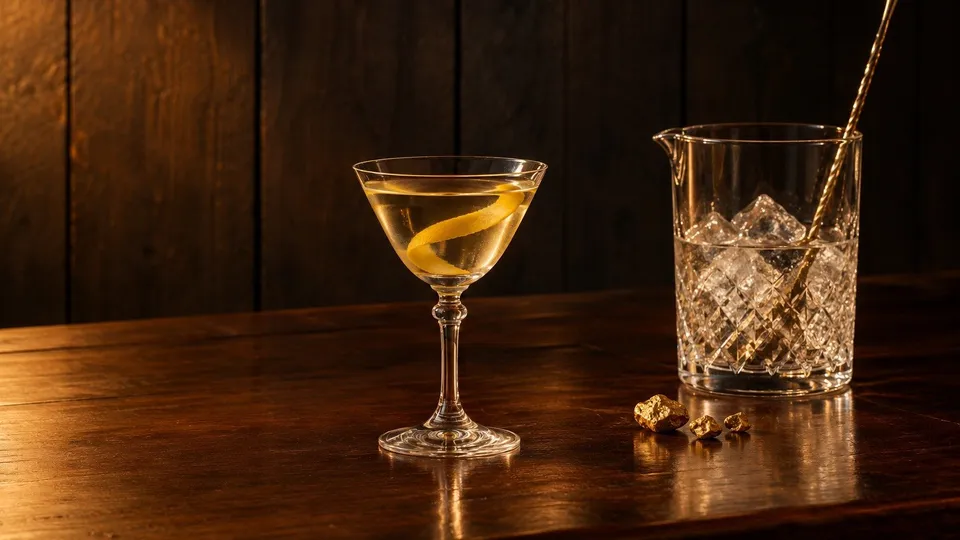 Make it todayKlondike Cocktail: Tom Gin and Bénédictine from 1903
The cup most stampeders could actually afford was coffee, tea or cocoa from a tin. Nobody in Dawson printed a recipe for their cocoa, but the breakfast cocoa of 1886, half milk and half water, is a plain cocoa of the period, and A Short History of Hot Chocolate follows the drink from its beginnings. For the saloons farther south, see What Did People Drink in a Wild West Saloon?
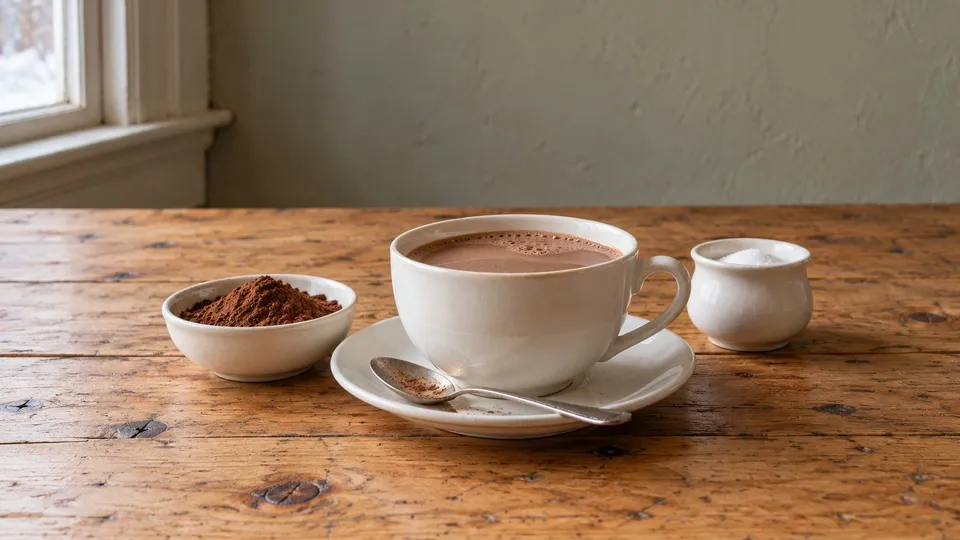 Always alcohol-freeBreakfast Cocoa the 1886 Way, Half Milk and Half Water
For what was on the plate, our sister site The Forgotten Menu has what the stampeders ate on the trail (opens in a new tab).
Sources
- Tappan Adney, The Klondike Stampede (New York and London: Harper & Brothers, 1900), pp. 99, 341 and 346–347. University Microfilms reprint, Internet Archive.
- Tim Daly, Daly’s Bartenders’ Encyclopedia (Worcester, Mass.: T. Daly, 1903), p. 90. Library of Congress copy, Internet Archive.
- Present-day equivalents are by US consumer prices (Minneapolis Fed / BLS CPI-U table).