What Did People Drink on the Titanic?
Tea and coffee in all three classes, wine in first, Munich lager at lunch and a half-frozen Punch Romaine at dinner: what the Titanic poured in April 1912.
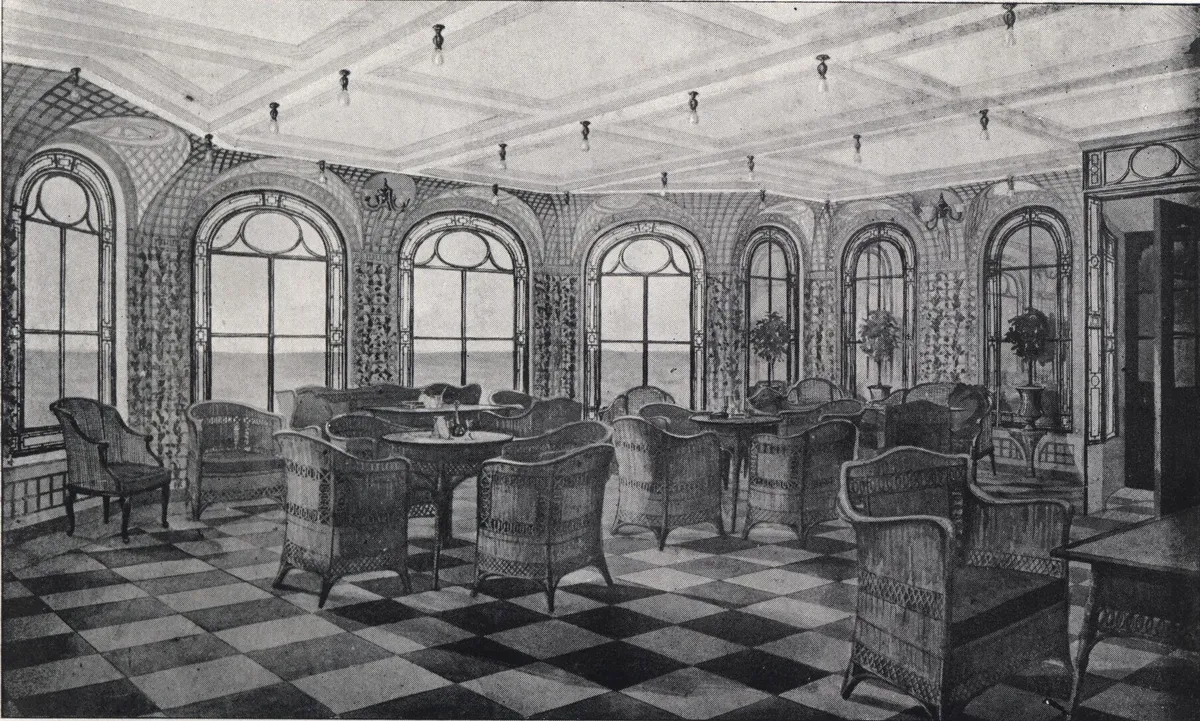
On the Titanic, tea and coffee reached every class. First-class passengers also drank wine with dinner in the restaurant and café, coffee and cordials after it, and at lunch on Sunday, April 14, 1912, they could order iced draught Munich lager at 3d. or 6d. a tankard, about £1.25 or £2.50 today by UK consumer prices (Bank of England).
Their last dinner menu, as usually transcribed, included Punch Romaine, in Escoffier’s recipe a half-frozen ice of wine, citrus and meringue with rum stirred in. Second class ended its dinner with coffee, and third class had tea and coffee with its meals. The crew could not get a drink at all. Cooled drinking water was supplied in all three classes and the cold rooms held mineral waters; beyond those, tea and coffee, no alcohol-free drink is documented aboard, and no wine list or cocktail list from the ship is known.
Punch Romaine is the drink most often tied to the ship, and it is usually called the Titanic’s last cocktail. It was a course of the dinner, served in a glass between the main dishes and the roast, and Escoffier’s cookery book filed it with the ices.
Coffee in the palm room
Archibald Gracie, a first-class passenger who survived, set down the evening routine in The Truth about the Titanic (1913). After dinner he and his table companions “adjourned to the palm room, with many others, for the usual coffee at individual tables where we listened to the always delightful music of the Titanic’s band.” Major Arthur Peuchen told the US Senate inquiry that the Sunday dinner “seemed to be a better bill of fare than usual, although they are all good,” and that afterward “my friends and I went to the sitting-out room and had some coffee.” Daisy Minahan, in a letter to the same committee, saw Captain Smith in the café that evening “having coffee with these people.”
Tea had its room too. The Shipbuilder, a trade journal, described Olympic and Titanic in a special number of 1911, before the second ship had sailed, and expected that in the first-class lounge “passengers will indulge in reading, conversation, cards, tea-drinking, and other social intercourse.” The deck plan on the same page marks a bar beside it. Pantries served the smoking rooms, lounges and suites, the service rooms had silver coffee apparatus, and the silver service included “a neat portable spirit lamp, with a quick-heating flame, for keeping warm special sauces and making Turkish coffee.”
Wine at dinner, lager at lunch
Mrs. Lucian P. Smith went to dinner in the café at 7:30 on the last night, “as usual,” and in her statement printed in the Senate record she described a party there for the captain: “while they had various wines to drink, I am positive none were intoxicated at a quarter of 9 o’clock, when we left the dining room.” Just outside, she said, was a coffee room “in which people sat and listened to the music and drank coffee and cordials after dinner.” She named Bruce Ismay as the host. Minahan, dining in the same café, wrote that “Capt. Smith was a guest, as also were Mr. and Mrs. Widener, Mr. and Mrs. Blair, and Maj. Butt,” and named no host.
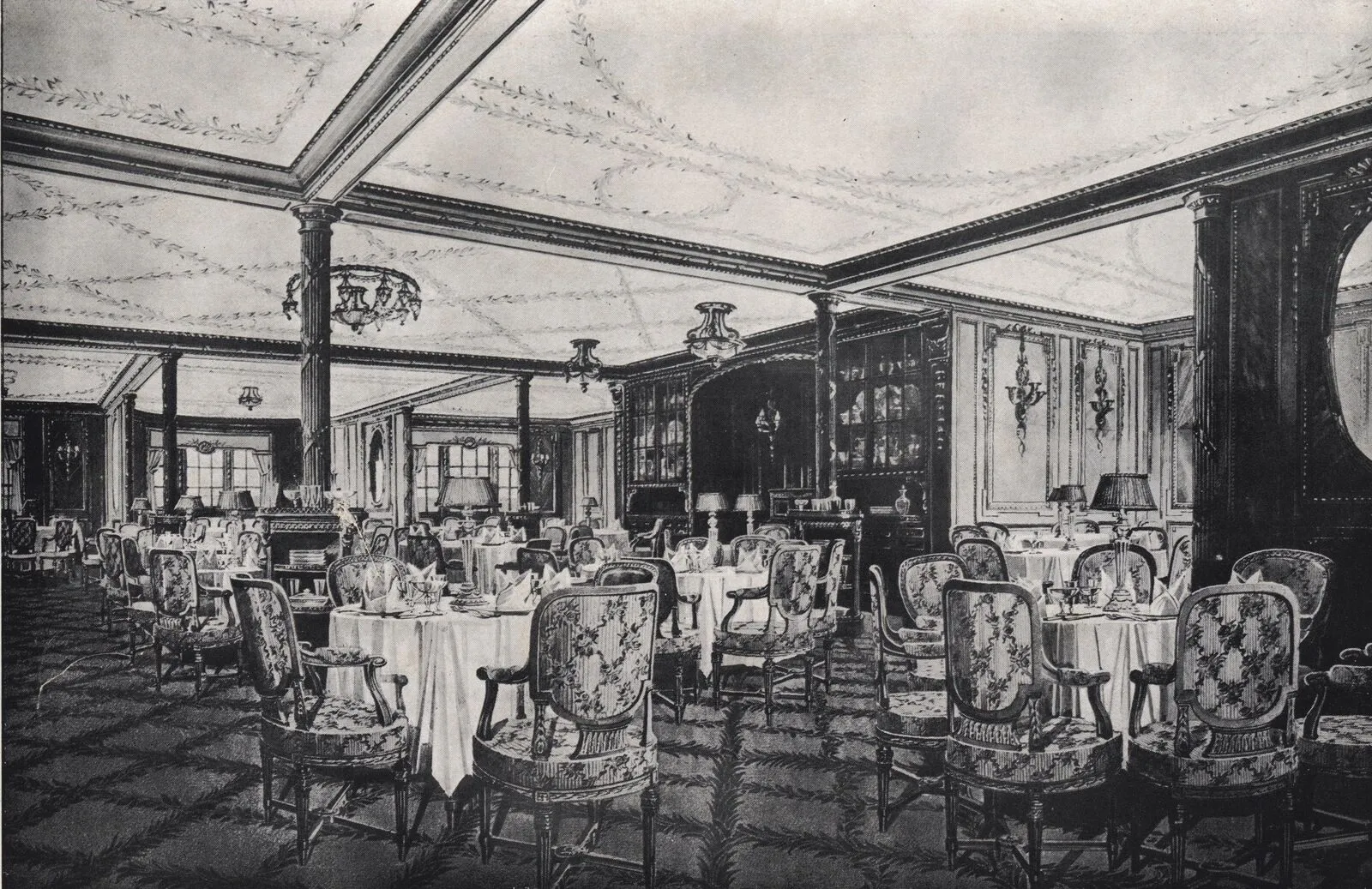 The first-class à la carte restaurant of Olympic and Titanic, probably photographed aboard Olympic. Fig. 78 in The Shipbuilder, special number, 1911.
That party grew a legend: that the captain had been drinking when the ship struck. It rests on hearsay. Catherine Crosby swore that a fellow passenger had told her, once they were on the Carpathia, that “a dinner was in progress at the time the boat struck; this banquet was given for the captain, and the wine flowed freely,” and she finished the sentence herself: “personally I know nothing about this.” C. E. Henry Stengel passed on what he remembered Mrs. Thorne, who said she was at the table, saying: “the captain did not drink a drop,” and added that the captain “smoked two cigars, that was all, and left the dining room about 10 o’clock.”
The glass cupboards of the sister ship give the scale of the wine service. R. A. Fletcher’s Travelling Palaces (1913) printed Olympic’s crockery and glass lists: “wine glasses, 2,000; champagne glasses, 2,500; cocktail glasses, 1,500; liqueur glasses, 1,200; claret jugs, 300.” The crockery list beside it has 3,000 teacups and 1,500 coffee cups. Olympic, at least, expected to mix cocktails, even if no list of them survives for either ship.
Lunch had its own drink. The first-class luncheon menu for the same Sunday is known from photographs and from Christie’s description of a copy offered in 2024, and its last line reads: “Iced draught Munich Lager Beer 3d. & 6d. a Tankard.” Even in first class, the beer had its price printed on the menu.
Punch Romaine, a course of dinner
The first-class dinner menu for April 14, one copy of which is held at Royal Museums Greenwich, is usually transcribed with Punch Romaine after the main courses and just before the roast squab and cress. That place on the menu is the clue. Auguste Escoffier’s A Guide to Modern Cookery, published in English in London in 1907, explains it: “Sherbets and their derivative preparations consist of very light and barely-congealed ices, served after the Entrées. They serve in freshening the stomach; preparing it to properly receive the roast.”
His Punch à la Romaine is one of those ices. Syrup is thinned with dry white wine or dry champagne, steeped for an hour with orange and lemon, frozen until it begins to stiffen and lightened with Italian meringue, and the rum goes in little by little just before it is served in glasses.
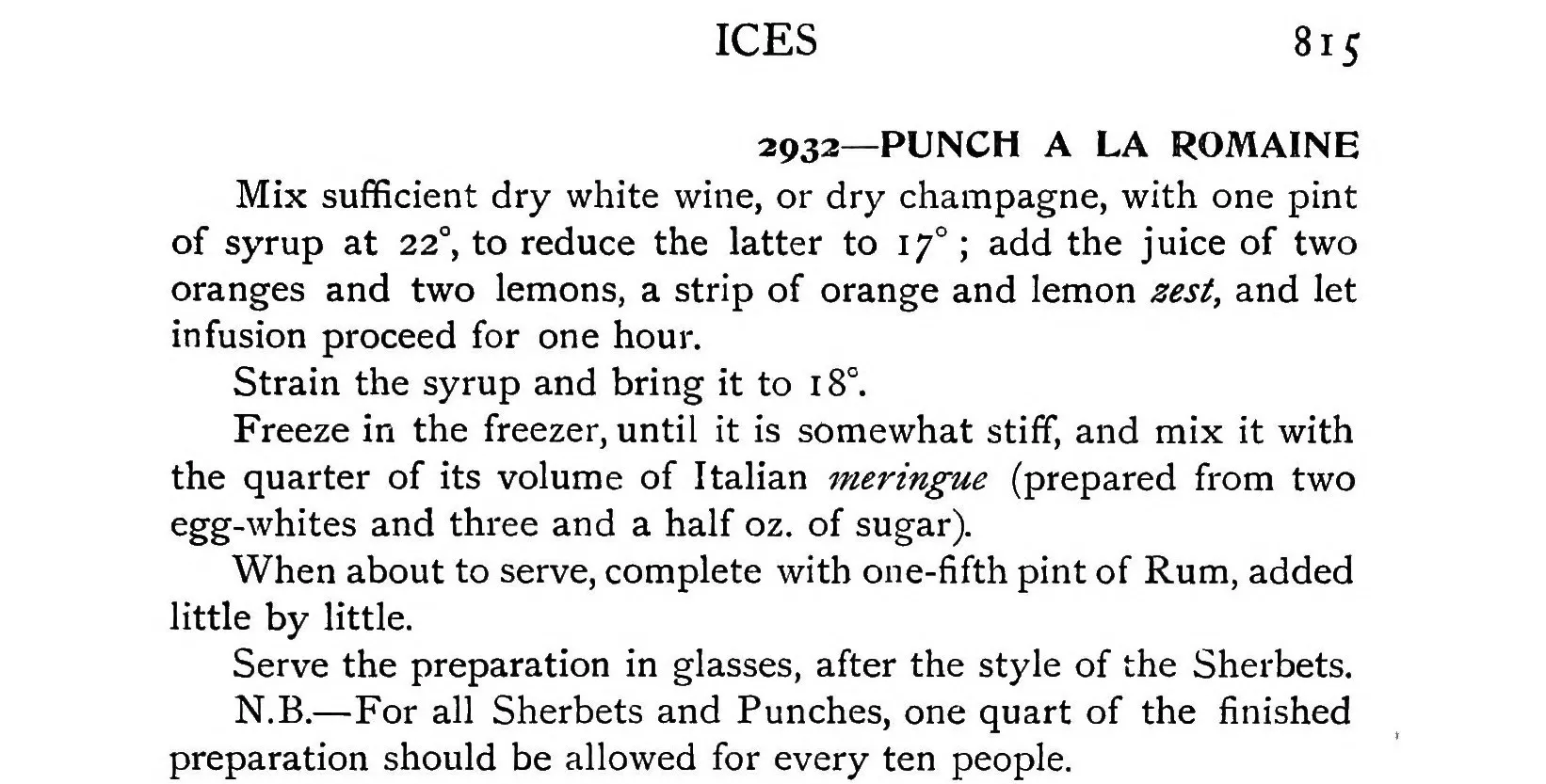 Punch à la Romaine as Escoffier printed it in A Guide to Modern Cookery (London: Heinemann, 1907), p. 815.
The name is older than the ice. Jerry Thomas’s How to Mix Drinks (New York, 1862) made Punch à la Romaine in a bowl for a party of fifteen: lemon and orange juice with two pounds of sugar and the whites of ten eggs beaten to a froth, frozen a little in an ice pail, and then “stir briskly into it a bottle of wine and a bottle of rum.” Harry Johnson’s bartenders’ manual of 1900 used sherry and Jamaica rum. By 1907 the kitchen had taken the drink over, and the menu’s course order matches Escoffier’s.
Made to his proportions, the ice comes out at about 5% alcohol, about as strong as a lager, and a small glass holds about half a UK unit. Our sister site The Forgotten Menu has the Punch à la Romaine of the 1912 menu (opens in a new tab) to make with wine and rum. Our alcohol-free Punch Romaine is a modern version, with white grape juice in place of the wine and no rum.
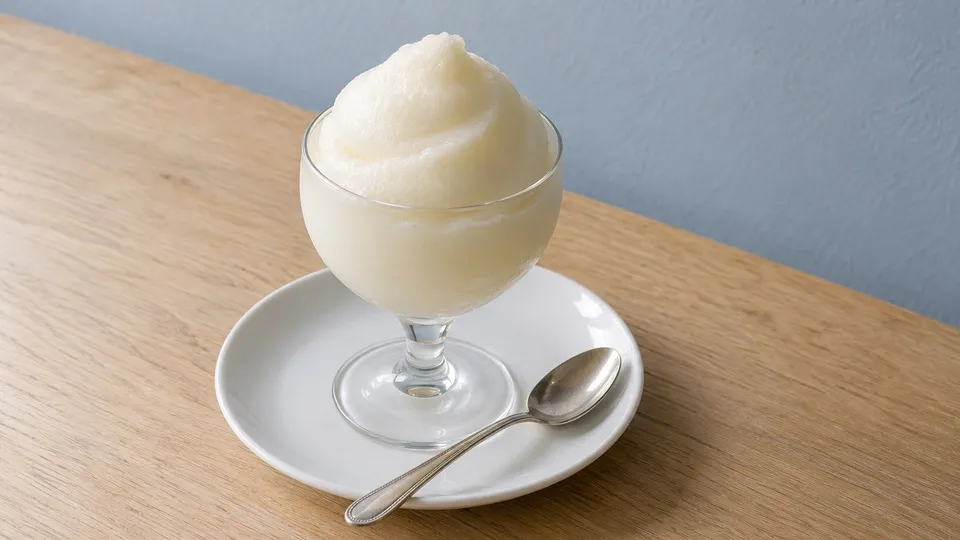 Alcohol-free versionAlcohol-Free Punch Romaine with White Grape Juice
Second and third class
In second class, the only drink on the dinner menu was coffee. Bertha Marshall’s copy of the second-class dinner menu for April 14, also at Royal Museums Greenwich, runs from consommé tapioca through curried chicken and rice, roast turkey and plum pudding to wine jelly (a dessert, not a drink), nuts, fruit, cheese and biscuits, and ends with one word: “Coffee.” Lawrence Beesley, a second-class passenger, wrote in his account of the voyage that after the Sunday evening hymn singing in the second-class saloon, which went on past ten, the stewards were waiting with biscuits and coffee before they went off duty.
The third-class menu for that day, as transcribed from a photograph of one copy, ends breakfast with “Tea, Coffee” and gives “Tea” with the cold meat, cheese and pickles of the evening tea meal; supper was gruel, cabin biscuits and cheese. TuneMyRecipe covers the food on all three menus in its guide to Titanic food by class (opens in a new tab). The water was the same for everyone: The Shipbuilder lists “arrangements for making ice and cooling the drinking water which is supplied at various points in the first, second, and third-class accommodation.”
What the cold rooms held
Below decks, the provision rooms had “separate cold chambers” for meat, fish, fruit, milk, flowers and “mineral waters, wine and spirits, and champagne.” No stores list for the Titanic is known, but Fletcher printed Olympic’s for one voyage, “a fair average of what the company has to provide every time that steamer leaves Liverpool”: 2,200 pounds of coffee, 800 pounds of tea, 50 boxes of lemons (16,000 lemons), 1,500 gallons of fresh milk and “beer and stout, 20,000 bottles; mineral waters, 15,000 bottles; wines, 1,500 bottles; spirits, 850 bottles; cigars, 8,000.”
Lists that circulate online as the Titanic’s drinks manifest, with lines such as “15,000 bottles of ale,” are garbled copies of those Olympic figures, where the 15,000 bottles were mineral water.
No source puts lemonade on the Titanic. Escoffier’s book, the one with the Punch à la Romaine, also has a lemonade of lemon zest and juice steeped cold for three hours, then lengthened with a siphon of seltzer water. Escoffier’s Lemonade with Seltzer Water is that recipe, a drink of the right years from the same book, though nothing records it aboard.
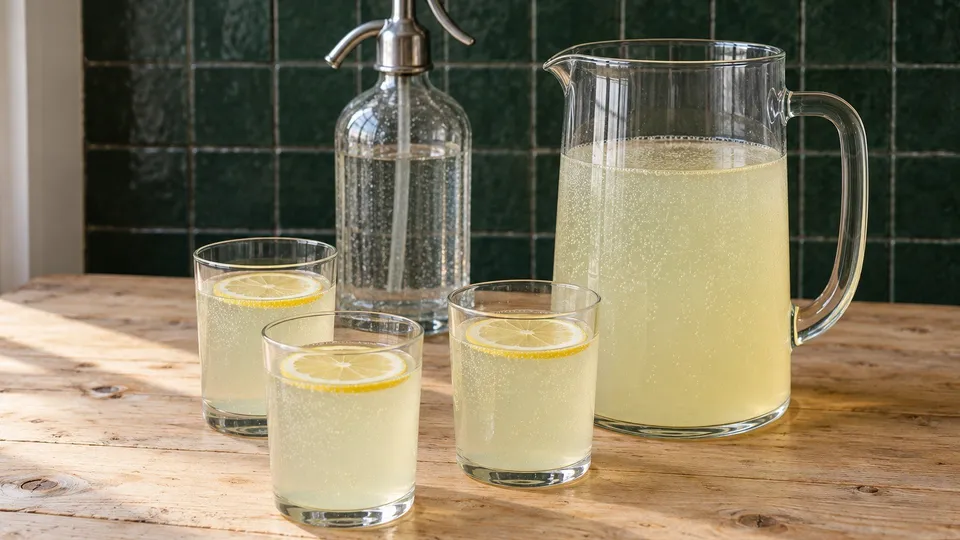 Always alcohol-freeEscoffier’s Lemonade with Seltzer Water
A dry ship for the crew
The Senate committee asked the crew about drink, and their answers agree. Asked whether any liquor was served to the crew, the lookout George Symons said no, and his fellow lookout George Hogg, asked whether he had seen a man under the influence on the voyage, answered, “No sir; I do not see where they could get it from.” John Hardy, the chief second-class steward, put it in terms of money: “In the first place, the crew could not afford to buy drinks. There is no other means of getting it but to buy it.” The able seaman Frederick Clench summed it up: “you can not get anything to drink there, so you are bound to be a teetotaler there.”
Fifth Officer Harold Lowe was one by choice. Asked whether he was a temperate man, he answered, “I am, sir. I never touched it in my life. I am an abstainer,” and then, indicating a glass of water, “this is the strongest drink I ever take.” Ashore, temperance reformers had been offering the same choice since the 1870s, in more than 3,000 coffee taverns by one promoter’s count, where coffee, tea and cocoa cost a penny or less a cup (a penny then is about 43p today).
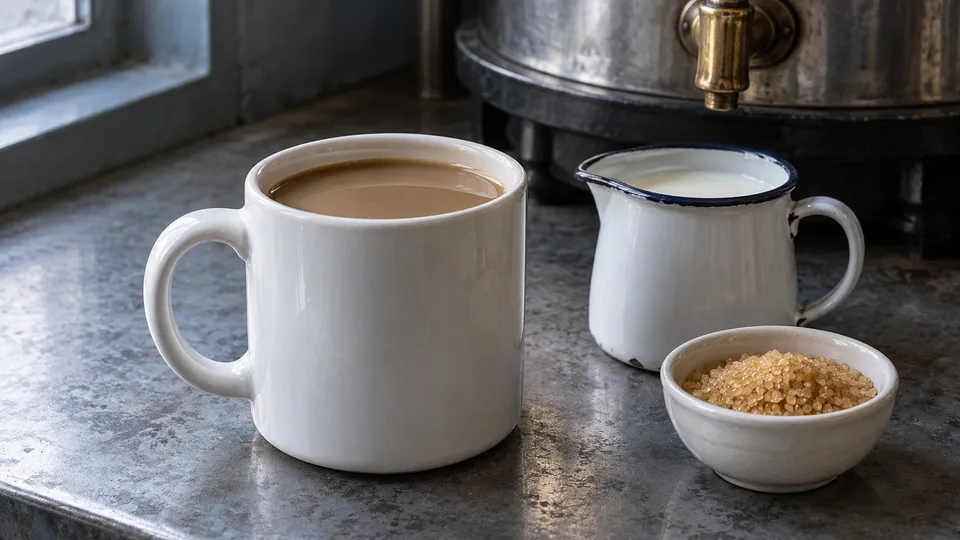 Always alcohol-freeCoffee-Tavern Coffee at a Penny a Cup
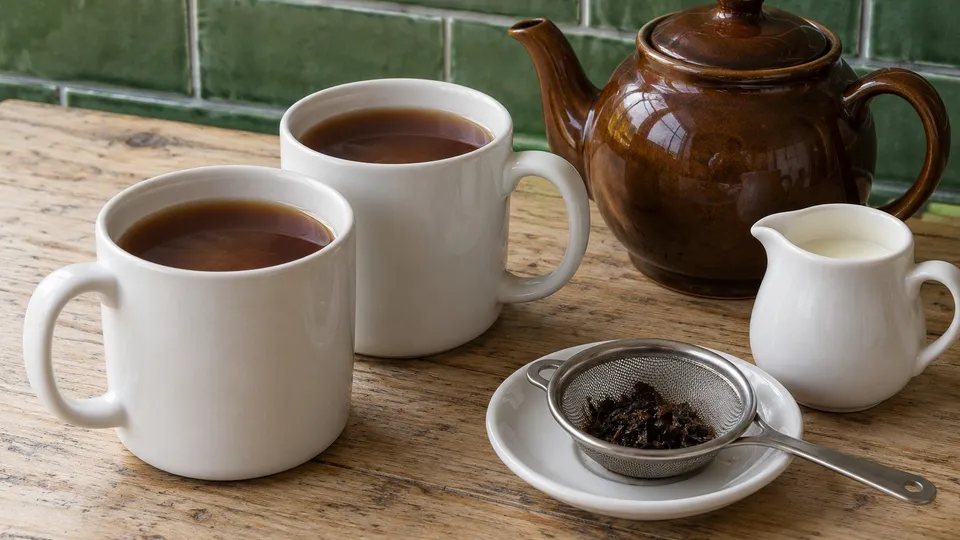 Always alcohol-freeCoffee-Tavern Tea, Steeped Ten Minutes
Flasks in the boats
Spirits appear in the testimony once the ship was gone. Quartermaster Robert Hichens, in charge of lifeboat 6, answered a newspaper story that he had drunk the boat’s whisky: “A lady had a flask of whisky or brandy, or something of that description, given her by some gentleman on the ship before she left, and she pulled it out and gave me about a tablespoonful and I drank it.” Evans, a crewman in another boat, told the committee that “one of the ladies there passed over a flash of whisky to the people who were all wet through” (the printed record reads “flash” for flask). Retellings say the chief baker, Charles Joughin, survived because he was full of whisky; his evidence to the British inquiry, as transcribed, mentions only that he went to his room “and had a drop of liqueur that I had down there.”
Captain Arthur Rostron of the Carpathia gave his orders as soon as the distress call reached him, and the Senate record prints them. The doctors were to have “restoratives, stimulants,” and the chief steward was to “have coffee, tea, soup, etc., in each saloon, blankets in saloons, at the gangways, and some for the boats.”
For a dinner of your own, the alcohol-free Punch Romaine takes about four hours from warm syrup to soft ice, so start it after lunch and serve it where the menu put it, just before the roast.
For what was on the plate, our sister site The Forgotten Menu has the last first-class dinner on the Titanic (opens in a new tab).
Sources
- United States Senate, Committee on Commerce, “Titanic” Disaster: Hearings before a Subcommittee, 62nd Congress (Washington: Government Printing Office, 1912), pp. 18, 332, 386, 462, 586, 592, 642, 682, 948, 1105–1106, 1139, 1143.
- The Shipbuilder, vol. VI, special number, “The White Star Liners ‘Olympic’ and ‘Titanic’” (London: The Shipbuilder, 1911), pp. 67, 77, 81, 104 and Fig. 78.
- Archibald Gracie, The Truth about the Titanic (New York: Mitchell Kennerley, 1913), p. 11.
- Lawrence Beesley, The Loss of the S.S. Titanic (Boston: Houghton Mifflin, 1912), p. 47.
- British Wreck Commissioner’s Inquiry, 1912, minutes of evidence, day 6, Charles Joughin, question 6020, as transcribed by the Titanic Inquiry Project, titanicinquiry.org.
- R. A. Fletcher, Travelling Palaces: Luxury in Passenger Steamships (London: Pitman, 1913), pp. 283, 291.
- A. Escoffier, A Guide to Modern Cookery (London: Heinemann, 1907), pp. 813, 815, 817.
- Jerry Thomas, How to Mix Drinks, or the Bon-Vivant’s Companion (New York: Dick & Fitzgerald, 1862), p. 36.
- Harry Johnson, New and Improved Illustrated Bartenders’ Manual (New York, 1900), p. 247.
- First-class luncheon menu, April 14, 1912: Christie’s, “Pushing Boundaries: Ten Masterpieces from the Collection of Paul G. Allen” (2024), lot 12.
- Second-class dinner menu, April 14, 1912, Royal Museums Greenwich, LMQ/1/12/2; first-class dinner menu, April 14, 1912, Royal Museums Greenwich, LMQ/1/14/5.