Alcohol-Free Punch Romaine with White Grape Juice
Reader ratingsEscoffier’s half-frozen Punch à la Romaine without the wine or rum: white grape juice, orange and lemon steeped in syrup, churned to a soft ice and lightened with Italian meringue.
- Recipe makes
- About 1.3 liters, 12 small glasses
- Prep
- Cook
- Total
Includes about 30 minutes for the syrup to cool, 1 hour steeping, about 1 hour chilling the base and 30 to 40 minutes in an ice-cream machine. Freezing in a tray instead takes 3 to 4 hours.
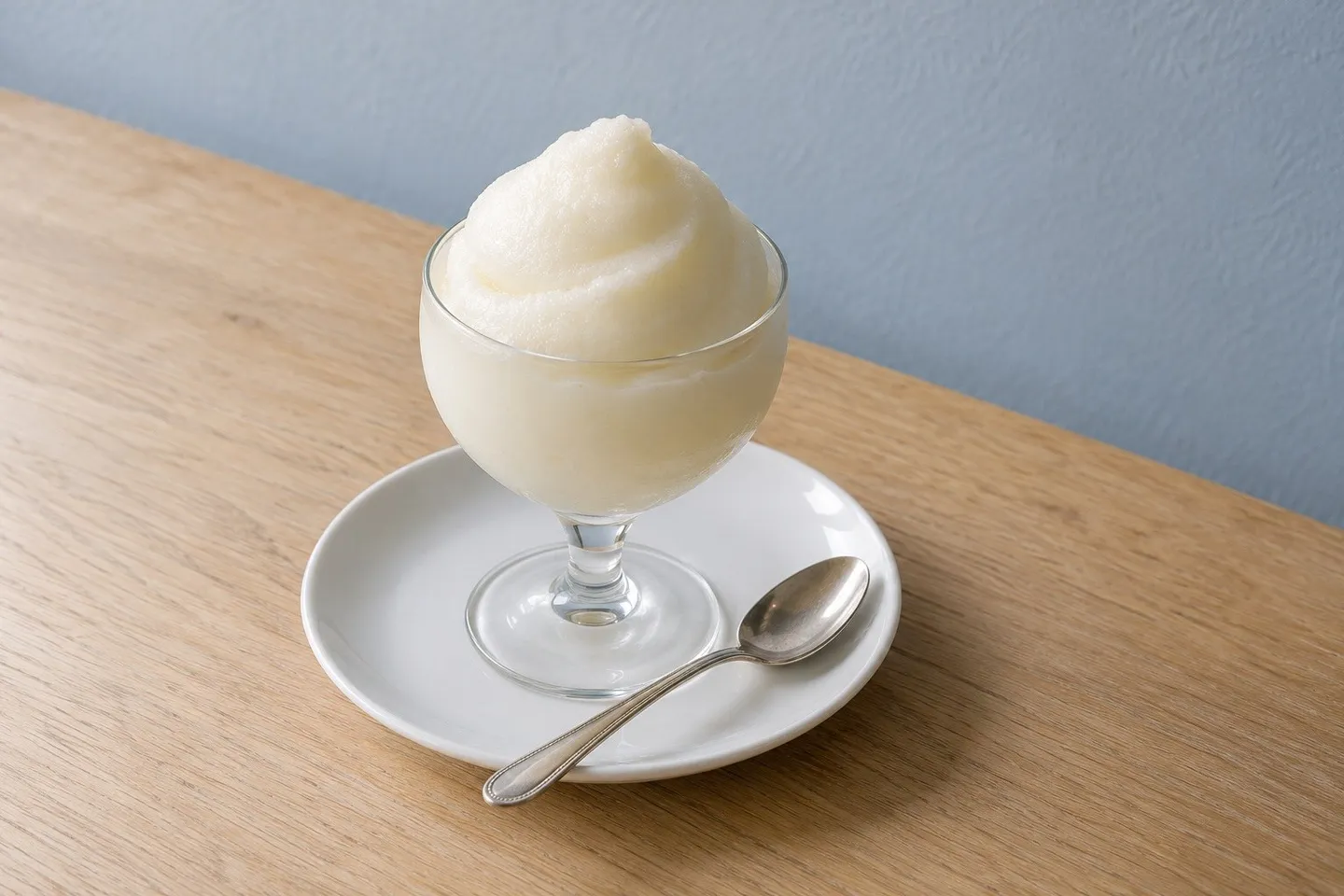
Alcohol-free Punch Romaine heaped in a short-stemmed glass on a white saucer, with a teaspoon.
The story behind the recipe
Alcohol-free Punch Romaine is a soft orange and lemon ice lightened with Italian meringue, made by Escoffier’s 1907 method with white grape juice where he used wine, and with no rum. His Punch à la Romaine is usually transcribed after the main courses on the Titanic’s last first-class dinner menu; this version keeps its citrus steeped in syrup, its half-frozen base and the meringue folded through it.
The ice before the roast
The first-class dinner menu for April 14, 1912, is usually transcribed with Punch Romaine just before the roast squab, which is exactly where Escoffier put such ices in A Guide to Modern Cookery. They were meant to freshen the diner before the roast, and the 1907 English edition says what they should feel like: “The consistence of a Sherbet ... should be such as to allow of its being drunk.” The result is a soft, sweet ice, close to a slush, taken from a small glass with a spoon. For portions he gave a rule of thumb: “one quart of the finished preparation should be allowed for every ten people.” This batch makes a little more, enough for a dozen small glasses. What Did People Drink on the Titanic? traces the ice back to Jerry Thomas’s punch bowl and sets it beside the coffee, lager and wine served aboard.
Read more about this recipe
Why grape juice
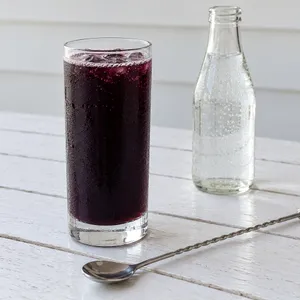
Escoffier diluted his syrup with dry white wine or champagne; unsweetened white grape juice is the closest alcohol-free match, but it carries its own sugar, so this version takes less of the second dose of sugar than the original with wine and rum, which our sister site The Forgotten Menu gives as the Titanic’s Punch à la Romaine of 1912 (opens in a new tab). Both are very sweet before freezing, and that is deliberate: the sugar is what keeps the ice soft enough to drink. A few years later grape juice was the dry hostess’s stand-in for wine: in 1920 Bertha Stockbridge noted that purple and white juice came in bottles at reasonable prices, and her grape juice highball is a cup of it under soda water.
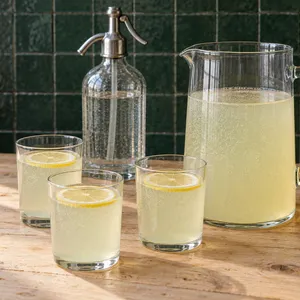
Escoffier finished his punch with rum, poured in little by little. A splash of chilled soda water stirred in at the table gives the same last-minute loosening without alcohol. For an alcohol-free drink from the same book that needs no freezer, Escoffier’s lemonade is a jug of lemon syrup lengthened with seltzer.
Recipe makes: About 1.3 liters, 12 small glasses
Ingredients
For About 1.3 liters, 12 small glasses. Quantities are shown as written.
Quantities as written here, for About 1.3 liters, 12 small glasses.
Base
- Sugar270 g
- Water400 ml
- Unsweetened white grape juice200 ml
- Orange juice (about 2 oranges)160 ml
- Lemon juice (about 2 lemons)90 ml
- Strip orange zest, no white pith1
- Strip lemon zest, no white pith1
- Sugar, to finish the base90 g
Italian meringue
- Sugar100 g
- Water30 ml
- Pasteurized egg whites2Author measures: about 60 g.
To serve (optional)
- Chilled soda water100 ml
Measurement notes
Ingredients as written here
- 270 g sugar
- 400 ml water
- 200 ml unsweetened white grape juice
- 160 ml orange juice (about 2 oranges)
- 90 ml lemon juice (about 2 lemons)
- 1 strip orange zest, no white pith
- 1 strip lemon zest, no white pith
- 90 g sugar, to finish the base
- 100 g sugar
- 30 ml water
- 2 pasteurized egg whites (about 60 g)
- 100 ml chilled soda water
Equipment
 Saucepan
- Small heavy saucepan
 Thermometer
 Fine strainer
 Ice-cream machine, or a shallow metal tray and a fork
 Whisk
 Small stemmed glasses
Instructions
Put the sugar for the base and the water in a saucepan and stir over low heat until the sugar has dissolved. Bring to a boil, take off the heat and leave to cool, about 30 minutes.
Stir the white grape juice, orange juice and lemon juice into the cool syrup, add the orange zest and lemon zest, and leave to steep for 1 hour.
Strain the base and stir in the sugar to finish the base until it has dissolved. Taste, adding a little more sugar if you like. Chill until very cold, about 1 hour.
Churn the base in an ice-cream machine until it is a stiff slush, 30 to 40 minutes. Without a machine, pour it into a shallow metal tray, freeze it and break it up with a fork every 30 minutes until it is a soft, even ice, 3 to 4 hours.
For the meringue, heat the meringue sugar with its water in a small heavy saucepan, stirring until it dissolves, then boil without stirring until it reaches 118 °C on a sugar thermometer.
Meanwhile, whisk the pasteurized egg whites until they hold soft peaks; an electric hand mixer makes this much easier. Still whisking, pour the hot syrup onto the whites in a thin stream, then keep whisking until the meringue is thick, glossy and cool, about 5 minutes.
Measure the frozen base and fold in a quarter of its volume of meringue; there will be meringue left over. Serve at once, or keep in the freezer for up to an hour.
Spoon into small stemmed glasses, heaping each to a point. Stir a little soda water into each glass at the table if you like, and serve with a spoon.
Nutrition
170calories per serving
- Recipe makes
- About 1.3 liters, 12 small glasses
- Servings
- 12
Roughly estimated from USDA FoodData Central values for granulated sugar, unsweetened white grape juice, orange and lemon juice and egg white; almost all of it is sugar.
Recipe notes
When adjusting quantities
Escoffier allowed one quart of finished ice for every ten people. Keep the meringue at about a quarter of the volume of the frozen base.
Notes
Quantities mentioned in these notes don’t change when you adjust the batch.
This version contains no alcohol: juice, sugar, water and egg white. An alcohol-free sparkling wine can stand in for the soda water, but such wines may contain up to 0.5% alcohol.
Use pasteurized egg whites. The FDA advises pasteurized eggs or egg products for any dish made with raw or lightly cooked eggs. In an Italian meringue the hot syrup warms the whites, but it cannot be relied on to make them safe.
Escoffier measured his syrups in degrees on a saccharometer, read here as degrees Baumé. His starting syrup at 22° is about 40 percent sugar by weight, which is what the 270 g of sugar in 400 ml of water gives; with a refractometer, aim for about 33 °Brix in the finished base before freezing. The amounts of orange and lemon juice assume about 80 ml from an orange and 45 ml from a lemon.
Storage
Best served the day it is made. It keeps covered in the freezer for a day or two but sets harder; let it soften in the fridge for 10 minutes and stir before serving.
Scaling changes the ingredients only; glassware, ice and timings need their own judgment. To adapt this recipe further, try the recipe tool at TuneMyRecipe (opens in a new tab), our sister site.
Sources and attribution
A modern alcohol-free adaptation of “Punch à la Romaine”, no. 2932, in A. Escoffier, A Guide to Modern Cookery (London: Heinemann, 1907), p. 815
Recipe details
- Drink
- Alcohol-freeMocktail
- Drink family
- Punches & Cups
- Region
- French
- Source decade
- 1900s
- Base
- Fruit & juice
- Difficulty
- Intermediate
- Occasion
- Dinner party
- Season
- Spring