What Did Babylonian Beer Taste Like?
Nobody knows how Babylonian beer tasted, or even how strong it was. A hymn, a brewery ledger, a cooking tablet and a test brew tell what we do know.
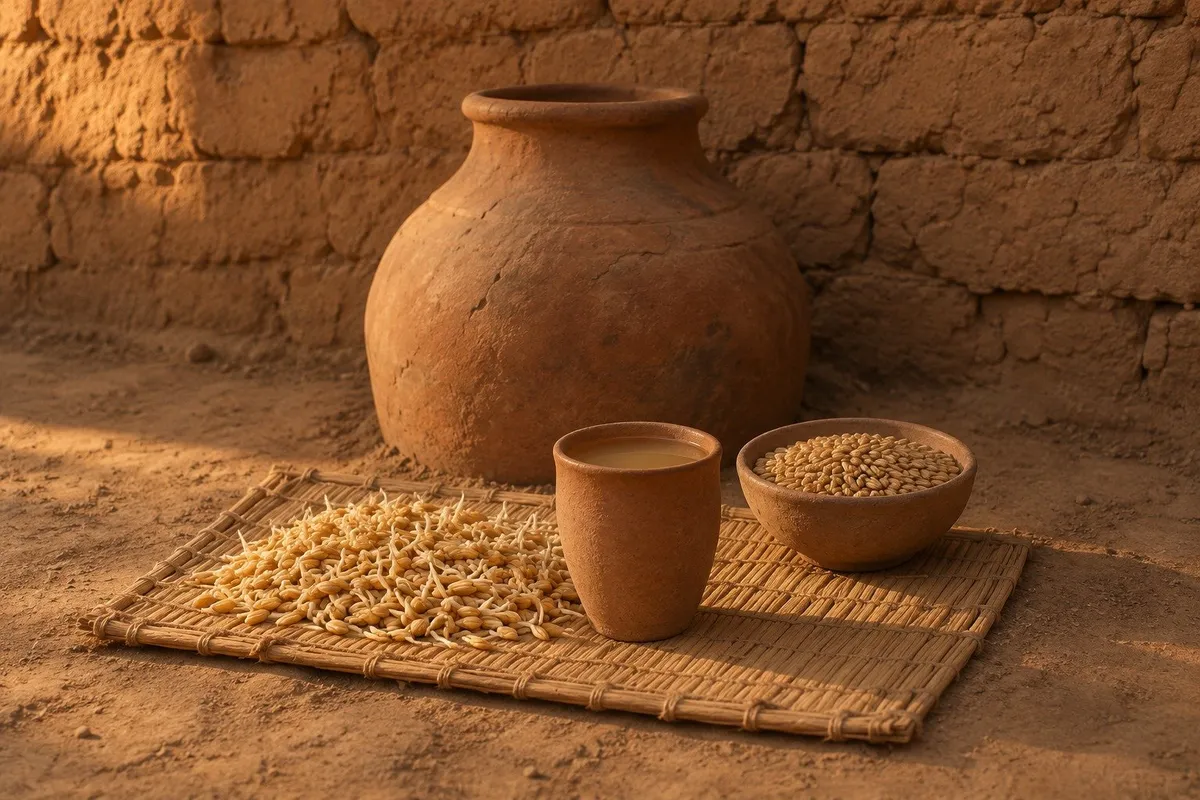
Nobody knows what Babylonian beer tasted like. People in ancient Mesopotamia brewed it in great quantities, sorted it into ordinary and good, poured it in taverns and cooked with it, but no source gives its recipe, its taste or its strength. Peter Damerow, a leading scholar of Sumerian brewing, put it plainly: “Given our limited knowledge of the Sumerian brewing process we do not even know for sure that the resulting product had any alcohol content at all.” What survives is three kinds of evidence, a hymn, the brewers’ accounts and a cookbook, and each answers a different question.
A praise song that names the steps
The best-known text is the Hymn to Ninkasi, a Sumerian song in praise of the goddess of beer. It is known from copies made in the Old Babylonian period, roughly 1900 to 1600 BC, and it is often called the world’s oldest beer recipe. It isn’t one, though it comes close to a list of jobs.
The hymn walks through the brewing in order. Ninkasi handles the dough and the bappir, a word usually translated as “beer-bread,” and bakes it in the oven. She soaks the malt, spreads the cooked mash on reed mats to cool, and works the sweet liquid, the “sweetwort” in the Oxford translation, with honey and wine. A fermenting vat stands on a collector vat, and at the end she pours out “the filtered beer of the collector vat.” The Oxford translation compares the flow to the rivers: “it is like the onrush of the Tigris and the Euphrates.”
What the hymn leaves out is everything a brewer would need. There are no amounts, no times and no temperatures, and two damaged lines fall exactly where the liquid is moved from one vessel to another. It praises a process its singers already knew.
Ordinary beer and good beer
The accounts are less poetic and more exact. A Sumerian brewery ledger now in the British Museum, which Damerow read for his 2012 study, reads like a business report. The brewer carried over a deficit of more than 700 gur of barley from the last period, about 210,000 liters by Damerow’s conversion of a gur at roughly 300 liters. He received about 1,400 gur of barley in two months, and was credited with nearly 1,000 gur of beer delivered.
The beer came in grades. In Damerow’s words, the accounts list “two types of beer designated as ‘ordinary beer’ (kaš du) and ‘good beer’ (kaš saga).” When the accounts turned good bappir into its value in barley, they added a tenth to its amount. None of these figures is a recipe. They are bookkeeping values, the way an administrator tracked what a brewery owed and delivered, and a debt carried over from last season is not grain in anyone’s mash. What they do show is the scale: beer brewed by the hundred thousand liters, in at least two qualities.
Damerow reads the hymn’s close as Ninkasi pouring for the drinkers “as if she represented” a female tavern keeper, and he points to the Code of Hammurabi, which shows taverns that were often run by women.
Beer in the stew
Beer also went into the cooking pot. A clay tablet at Yale, written about 1900 to 1600 BC, holds 25 short recipes for stews. As the Cuneiform Digital Library describes them, “The stews are based on water and fat, sometimes enriched with beer, milk, or blood for thickening and taste.” The cook didn’t explain the beer or measure it; it was simply something you reached for in a Babylonian kitchen. Of the 25 recipes, not one is for beer itself. The stews are food rather than drink, so we leave them there; the “cup of beer” in Yale’s modern reconstruction of one is a choice made today, not a measure on the tablet.
A brew at Tall Bazi
Experiment is the other way in. In 2004 and 2005 a team of brewing scientists from Weihenstephan and archaeologists working at Tall Bazi, a town of about 1200 BC in northern Syria, tried to brew in copies of the site’s big jars, without fire. They mashed ground malt at about 34°C for 15 minutes, with a little over eight parts water to one of grain, added yeasts and lactic bacteria, and left it for a day and a half. The beer kept for over two months, and a tasting panel on site found it pleasant and lively.
It came out at 1.6% alcohol, and that number is easy to misuse. The team made it weak on purpose, because they assumed the whole town drank it, children included. It shows that such jars could make a drinkable low-alcohol beer. It does not measure how strong Bronze Age beer was, and it says nothing direct about Sumer, a thousand years and hundreds of miles away.
Closer to kvass
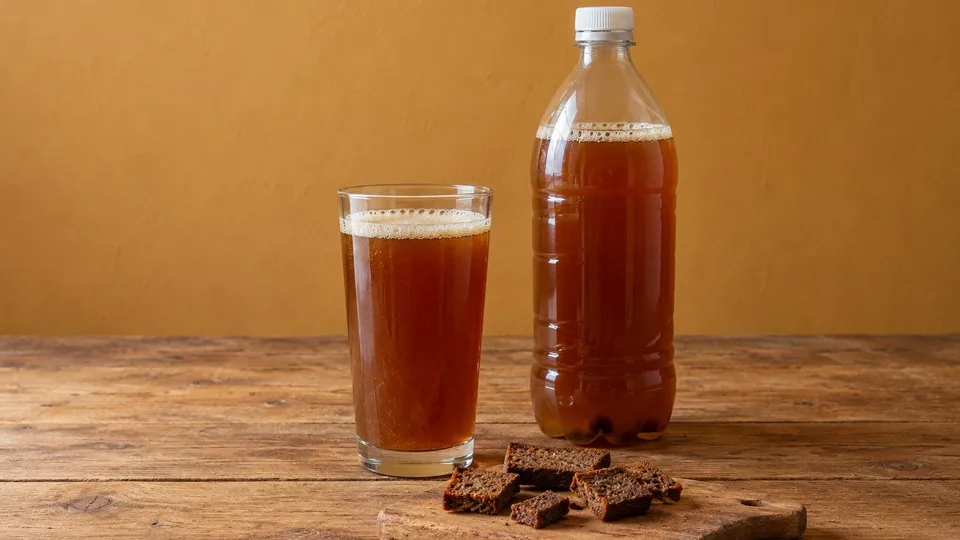
Damerow ended his study with a comparison rather than an answer: “We really cannot know whether Sumerian beer might after all have had a greater similarity with kvass than, say, with German beer.” Kvass is the Russian drink fermented from bread, and the hymn’s beer started with bappir, the “beer-bread.” The comparison is a guess, and he offers it as one, but it fits the little we know: a drink of grain and bread, perhaps low in alcohol, perhaps not.
Make the bread kvass of 1887 if you want to taste Damerow’s comparison: dried rye bread, treacle and a little yeast, fermented and bottled with two raisins, the nearest thing on our pages to beer made from bread. Its alcohol-free version leaves out the yeast and adds mint and lemon. For the hymn’s “sweetwort” step, Sweet Wort, the Malt Drink Before the Beer is the unfermented malt liquid that every beer begins as. How later writers imagined the ancients’ beer, from a Babylonian “drink” that was really a sauce to Cleopatra pulling a pint, is in Cleopatra’s Bitter and a Babylonian Sauce, and whether medieval Europe really drank beer instead of water is in Did Medieval People Really Drink Beer Instead of Water?
 Make it todayBread Kvass, the 24-Hour Rye Kvass from 1887
 Alcohol-free versionAlcohol-Free Bread Kvass with Lemon and Mint
 Alcohol-free versionSweet Wort, the Malt Drink Before the Beer
Sources
- “A hymn to Ninkasi,” ETCSL 4.23.1, English translation, The Electronic Text Corpus of Sumerian Literature (Oxford, 1998–2006).
- Peter Damerow, “Sumerian Beer: The Origins of Brewing Technology in Ancient Mesopotamia,” Cuneiform Digital Library Journal 2012:2, §§5.7–5.9, 5.25 and 7.2–7.3. Quotations under CC BY 4.0.
- Klaus Wagensonner, “A Babylonian Cookbook” (YBC 4644), Cuneiform Digital Library Initiative tablet highlight, 2024.
- Yale Babylonian Collection, “Babylonian Cooking” (modern recipe credited to Gojko Barjamovic and Nawal Nasrallah).
- Martin Zarnkow, Elmar Spieleder, Werner Back, Bertram Sacher, Adelheid Otto and Berthold Einwag, “Cold mashing process: a technology possibly used in ancient times in the Orient,” Brauwelt International 2006/V, pp. 306–310.