28,000 Gallons of Ale, 72,000 of Lemonade: The King’s Dinner of 1902
At the King’s Dinner of 1902, half a million Londoners drank ale or temperance cordials, and lemonade and soft drinks outpoured the ale over two to one.
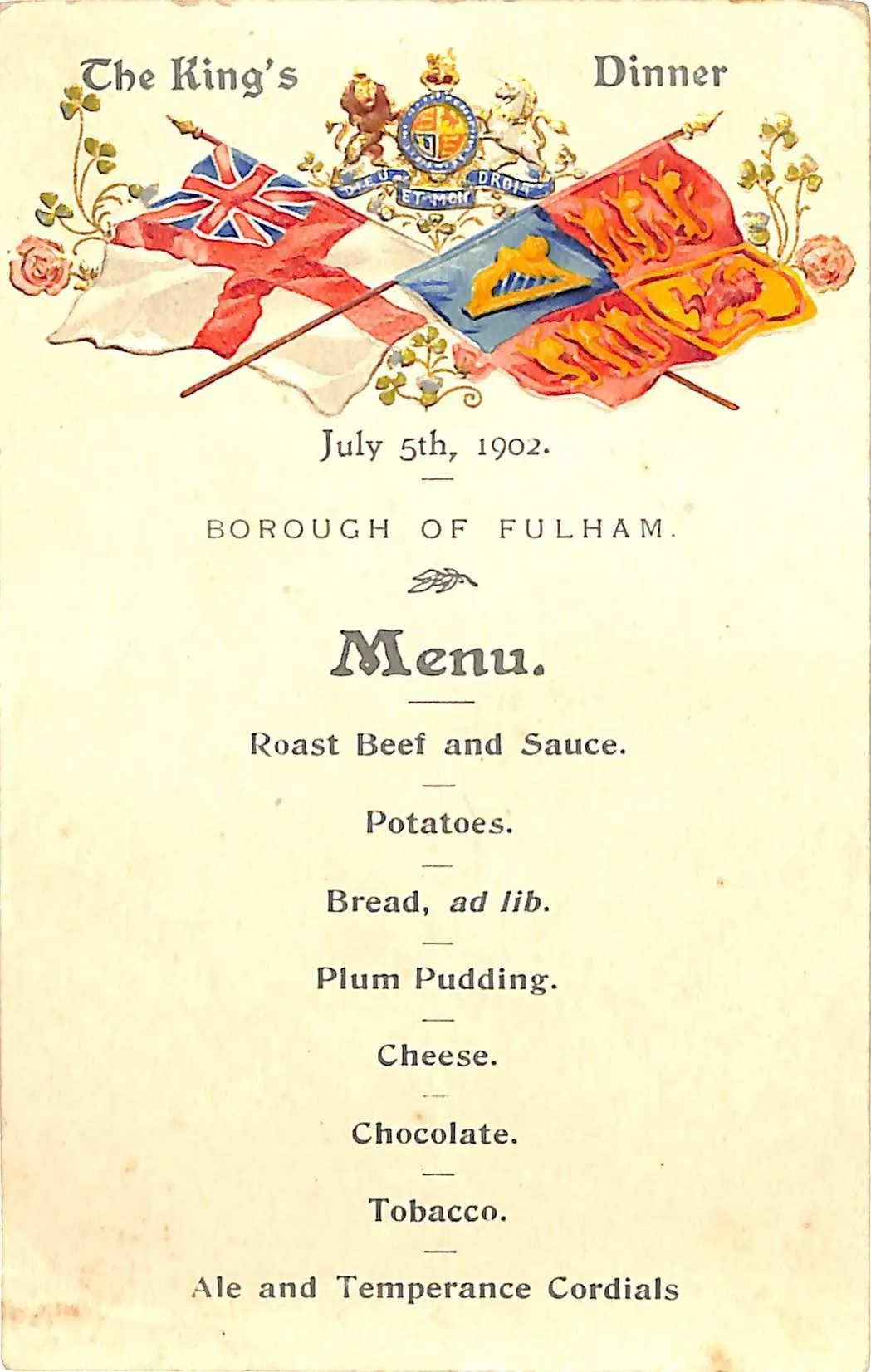
At the King’s Dinner of July 5, 1902, half a million of London’s poor drank ale or “temperance cordials,” and the soft drinks won by a wide margin. A 1910 history of the reign records nearly 28,000 gallons of ale given by Bass & Co. and 72,000 gallons of lemonade and other drinks given by R. White & Sons of Camberwell. Each guest also got a Doulton cup to drink the King’s health, and the King was not there to see it: he was lying ill, and his coronation had been put off.
A coronation dinner without a coronation
Edward VII was to be crowned on June 26, 1902. Two days before, the coronation was postponed and the King had an operation for appendicitis. The dinner he had promised the poor of London went ahead anyway, on July 5, while he recovered. He was crowned on August 9.
Edgar Sanderson and Lewis Melville’s King Edward VII, His Life & Reign, published in 1910, calls it “the great event, without precedent, on the same scale, in the annals of British royalty.” The Lord Mayor ran it with the mayors of the London boroughs, the chairman of the London County Council and Sir Thomas Lipton, the tea merchant, who had helped with a similar dinner at Queen Victoria’s Diamond Jubilee in 1897. “The royal purpose was to entertain at dinner, at the same hour, 500,000 of his poorer subjects in the capital, at a cost to the Sovereign of £30,000.” That is about £3.2 million today, by UK consumer prices (Bank of England), or by our arithmetic about £6.40 a guest.
No money was to be raised for it, but gifts in kind were welcome. The King asked that nobody be turned away “who was not of known bad character.” The size of a dinner ran from 1,000 guests in the City of London to 45,000 in Stepney, spread over 86 places there, from the Law Courts and Covent Garden Market to school rooms. The biggest single sitting was in Bishop’s Park, Fulham: “14,000 in Bishop’s Park, Fulham, where the Prince and Princess of Wales visited the guests, seated at 2½ miles’ length of tables, on 5 miles of seats.”
Ale and temperance cordials
Fulham printed a menu card for its guests, a gift of the publishers Raphael Tuck & Sons, with the royal arms and crossed flags at the top. It reads, one dish to a line: “Roast Beef and Sauce. / Potatoes. / Bread, ad lib. / Plum Pudding. / Cheese. / Chocolate. / Tobacco. / Ale and Temperance Cordials.”
The chocolate was not a drink. Sanderson explains it: “Messrs. Rowntree & Co., of York, presented each guest and helper with an ornamental box of chocolate, bearing portraits of the King and Queen.” The card does not say what the temperance cordials were, and the phrase covered any soft drink a temperance man could raise a glass of. Lemonade is what R. White & Sons sent.
Fulham’s card is only one card. The dinners were run by local committees, and a nursing paper’s report at the time, which we know only at second hand, said that some places served beer or cider and others only soft drinks. What the better-off drank in the same years, from claret cup at tennis to lemon squash in a tumbler, is in What Did People Drink in an Edwardian Country House?
The gallons
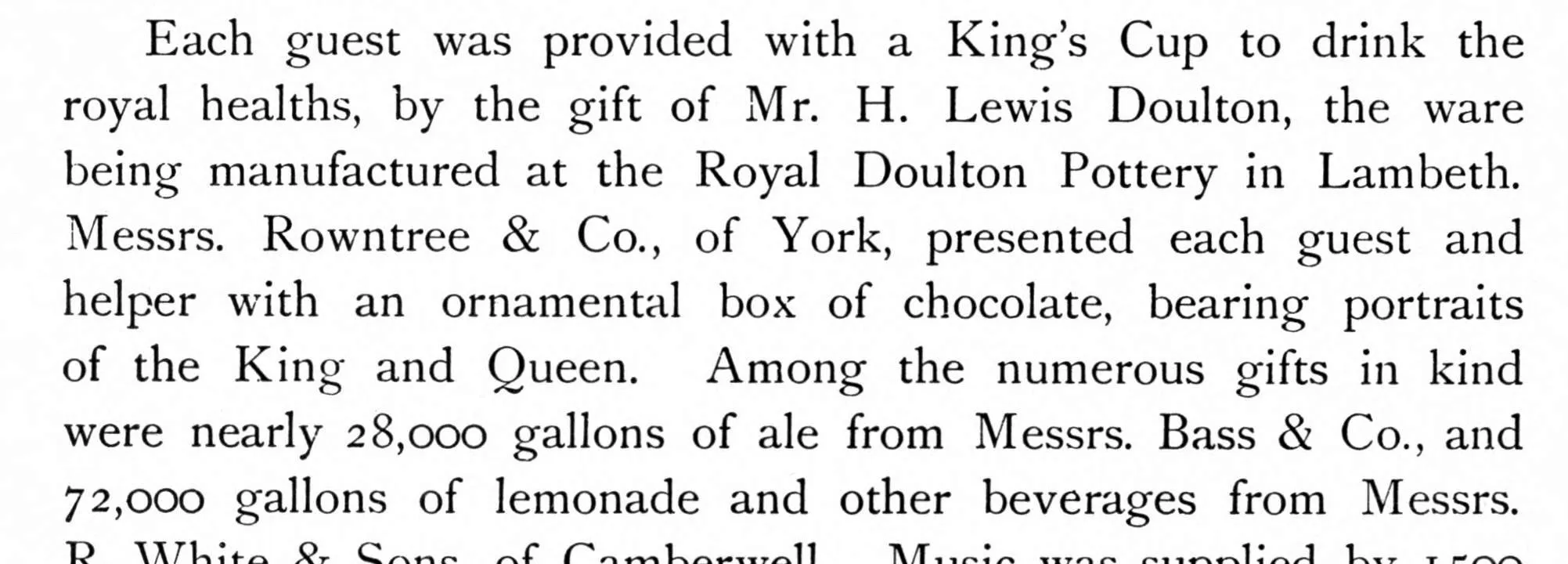 Sanderson and Melville, King Edward VII, His Life & Reign, vol. 5 (London: Gresham, 1910), p. 72.
“Each guest was provided with a King’s Cup to drink the royal healths, by the gift of Mr. H. Lewis Doulton, the ware being manufactured at the Royal Doulton Pottery in Lambeth.” Then come the two figures this story is about: “Among the numerous gifts in kind were nearly 28,000 gallons of ale from Messrs. Bass & Co., and 72,000 gallons of lemonade and other beverages from Messrs. R. White & Sons, of Camberwell.”
Shared out evenly, and it wasn’t, that comes to a little under half a pint of ale a guest and more than a pint of soft drinks. The sums are ours: 28,000 gallons is 224,000 imperial pints, or 0.45 of a pint for each of 500,000 guests, and 72,000 gallons is 1.15 pints each. By volume, the temperance side poured about two and a half glasses for every one of ale.
The toast had good news behind it. The King sent a message of regret through the Lord Mayor that he could not see his guests, and it “arrived very fitly along with the official news that the Sovereign was out of danger.”
The drink nobody had invented
A week later, The Lancet ran a leader on the King’s illness and the summer heat. It was not writing about the dinner, but it was writing about the same choice the Fulham tables faced. “Then more than ever is a really good temperance drink urgently needed,” it said. “It does not say much for the practical sense of the temperance party in this country that they have never yet been able to invent such a drink.”
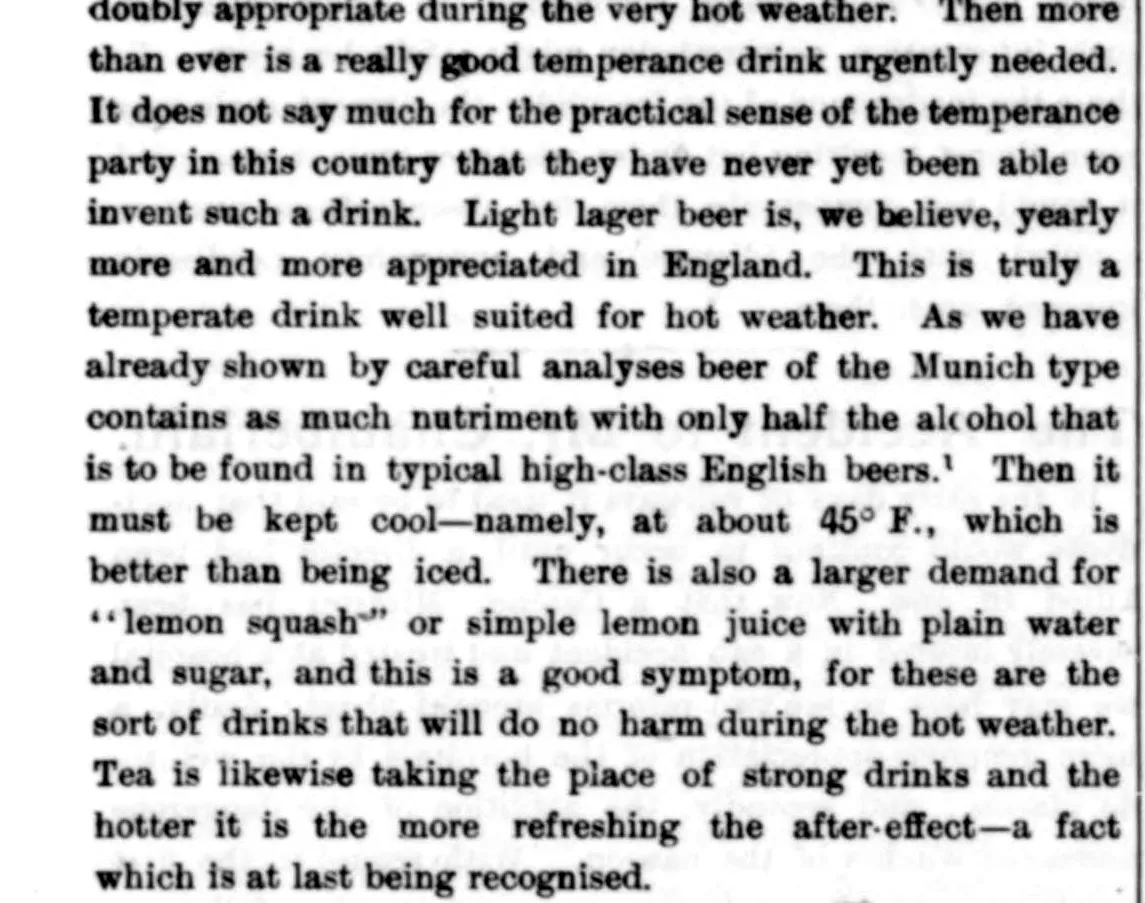 The Lancet, July 12, 1902, p. 85.
Its own first answer was light lager, “truly a temperate drink well suited for hot weather.” Its second needed no brewer: “There is also a larger demand for ‘lemon squash’ or simple lemon juice with plain water and sugar, and this is a good symptom.”
You can make the lemon cordial of that very moment, from a book of 1903, as Superior Lemon Squash, topped up with soda water. For plain lemonade, Mrs. Beeton’s lemonade made with boiling water is the older household version. And if you can’t choose between the two halves of Fulham’s last line, a Shandy Gaff puts ale and ginger beer in one glass, and the alcohol-free Shandy Gaff keeps it on the temperance side. Nobody served either one at the King’s Dinner; that pairing is our suggestion.
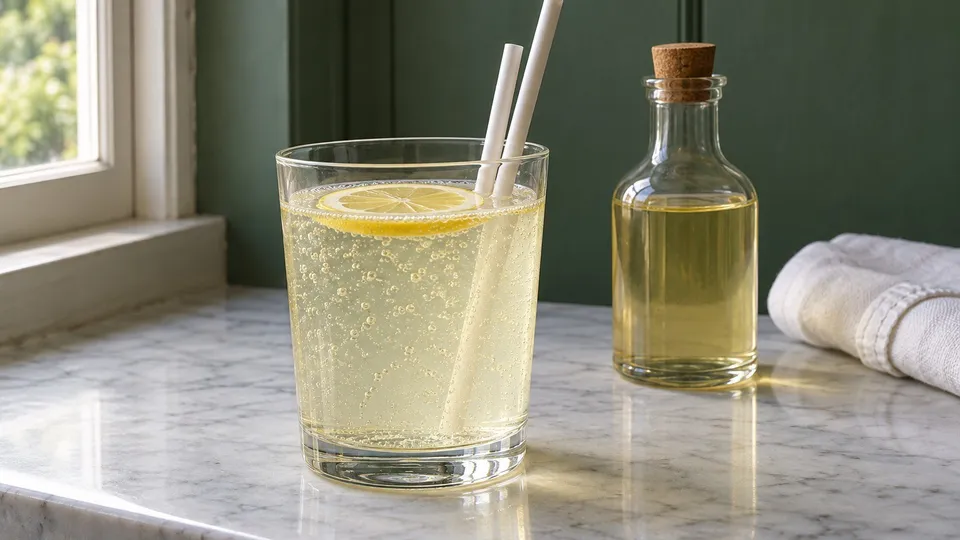 Always alcohol-freeSuperior Lemon Squash, a Lemon Cordial for Soda Water
 Always alcohol-freeMrs. Beeton’s Lemonade, Made with Boiling Water
 Make it todayShandy Gaff, the 1869 Ale and Ginger Beer
 Alcohol-free versionAlcohol-Free Shandy Gaff, Ginger Beer and Alcohol-Free Ale
For what was on the plate, our sister site The Forgotten Menu has the menu of the King’s Dinner (opens in a new tab).
Sources
- Fulham menu card, “The King’s Dinner, July 5th, 1902, Borough of Fulham,” presented by Raphael Tuck & Sons. TuckDB Ephemera, object 24101.
- Edgar Sanderson and Lewis Melville, King Edward VII, His Life & Reign, vol. 5 (London: Gresham, 1910), pp. 71–72. University of Toronto copy, Internet Archive.
- The Lancet, July 12, 1902, “The Illness of the King. The Summer Season,” pp. 84–85. Internet Archive.