Shandy Gaff, the 1869 Ale and Ginger Beer
Reader ratingsCold ale topped up with ginger beer, the shandy before lemonade: William Terrington’s one-line recipe of 1869, and Oxford students knew it by 1853.
- Recipe makes
- 1 tall glass, about 2 cups
- Prep
- Total
Chill the ale and the ginger beer for a few hours first. The drink takes a minute to pour.
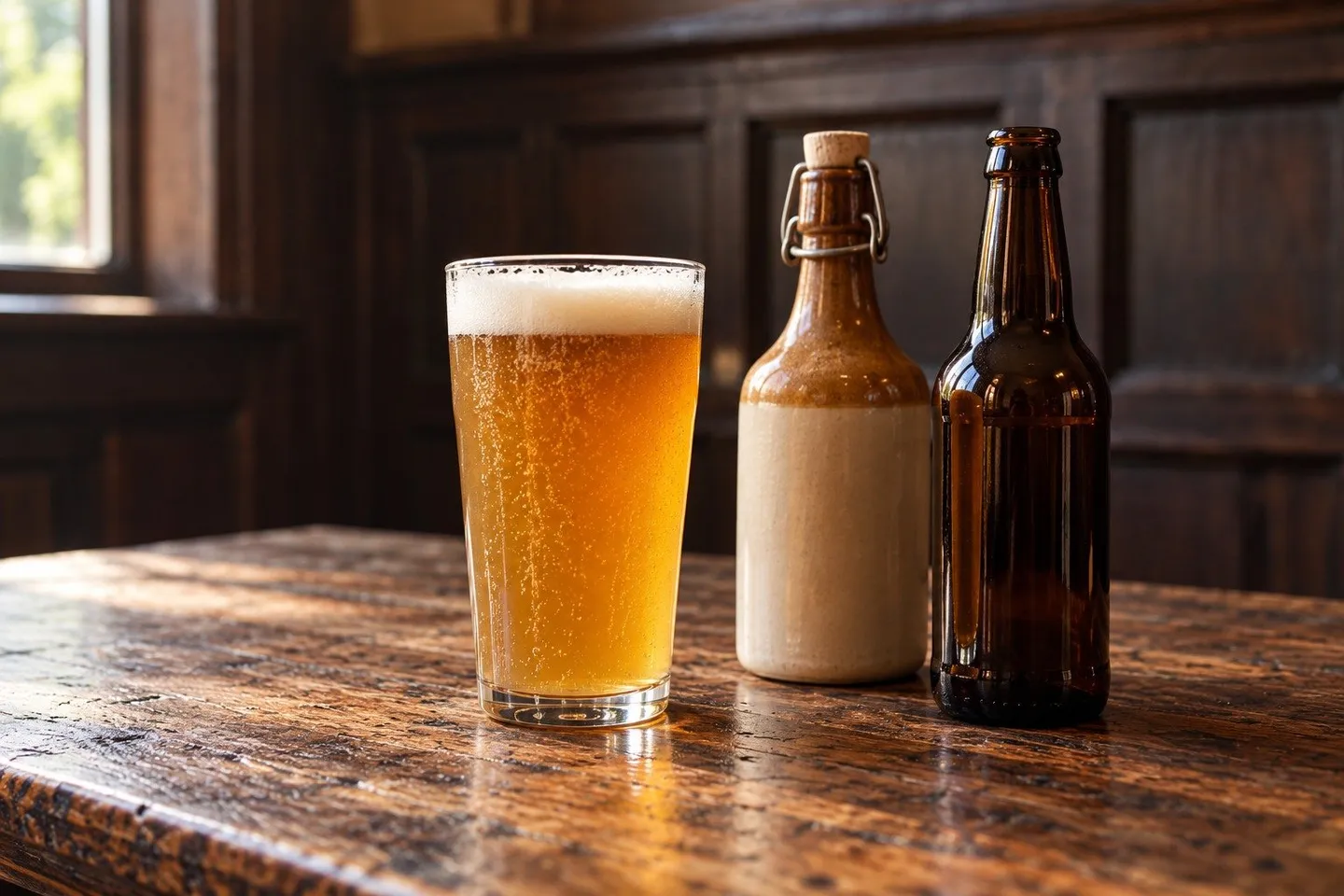
Shandy gaff in a pint glass on a pub table, with a stoneware ginger-beer bottle and a brown ale bottle.
The story behind the recipe
A Shandy Gaff is ale topped up with ginger beer. William Terrington’s Cooling Cups and Dainty Drinks of 1869 gives the whole recipe in a single line, a pint of good ale and a bottle of ginger beer, and it is the parent of today’s shandy.
Oxford slang first
The name was in print sixteen years before the recipe. In Cuthbert Bede’s comic novel The Adventures of Mr. Verdant Green (1853), the young hero comes home from his first year at Oxford and tells his family what a college friend has taught him: “to make shandy-gaff and sherry-cobbler, and brew bishop and egg-flip.” It is a novel, so it shows that students knew the drink by 1853, not who first mixed it. Where the name comes from, none of our sources says. Two of Verdant’s other lessons are on this site, the Sherry Cobbler and Bishop, hot spiced port with a roasted lemon.
Read more about this recipe
A page of ale cups
Terrington put the shandy gaff among his “Ale Cups and Purl,” between the “Mother-in-law,” half old and half bitter ale, and the “Cooper,” a pint of Dublin stout with a pint of London porter. Just above it, “Wait a Bit” mixes the best Scotch ale with a bottle of aerated lemonade and lumps of ice, a lemonade shandy before the word. Honest mixtures like these were a long way from the doctored porter of a generation earlier, told in How Was Beer Doctored?
Making it today
Terrington doesn’t say how big his ginger-beer bottle was, so equal parts is our choice. With a 5% ale the glass is about 2.5% alcohol (half of 5%); a 4% bitter brings it to about 2%, and two parts ale to one of ginger beer to about 3.3%. Use a non-alcoholic ginger beer, the soft drink. Terrington gives no ice and no garnish, so chill both bottles well instead. For a glass with no alcohol at all, there is the Alcohol-Free Shandy Gaff.
Shandy Gaff.—Pint of good ale, bottle of ginger beer.

Recipe makes: 1 tall glass, about 2 cups
Ingredients
For 1 tall glass, about 2 cups. Quantities are shown as written.
Quantities as written here, for 1 tall glass, about 2 cups.
- Ale, chilled8 fl oz
- Ginger beer, chilled8 fl oz
Measurement notes
Ingredients as written here
- 8 fl oz ale, chilled
- 8 fl oz ginger beer, chilled
Equipment
 Tall glass or tankard, about 20 fl oz
Instructions
Pour the cold ale into a tall glass or tankard.
Top it up slowly with the cold ginger beer, pouring down the side of the tilted glass so it keeps its fizz. Don’t stir. Serve at once, with no ice.
Nutrition
190calories per serving
- Recipe makes
- 1 tall glass, about 2 cups
Estimated from typical label values for 5% ale (about 43 kcal per 100 ml) and ginger beer (about 35 kcal per 100 ml), for one 480 ml glass.
Recipe notes
When adjusting quantities
Keep ale and ginger beer in equal parts, and pour each glass separately.
Notes
Quantities mentioned in these notes don’t change when you adjust the batch.
Terrington’s pint was an imperial pint, about 19 fl oz, and his bottle size isn’t given; the 8 fl oz of each here is our choice, for one glass. For his full quantity, use a whole pint of ale and a bottle of ginger beer of about the same size, and divide it between two glasses.
Any pale or amber ale works; Terrington asks only for “good ale.” Use ginger beer, as he does, not ginger ale. Our homemade alcohol-free ginger beer, the fountain way works too: mix its syrup with lemon juice and soda water first, then use that in place of the bottle.
Scaling changes the ingredients only; glassware, ice and timings need their own judgment. To adapt this recipe further, try the recipe tool at TuneMyRecipe (opens in a new tab), our sister site.
Sources and attribution
William Terrington, Cooling Cups and Dainty Drinks (London and New York: George Routledge and Sons, 1869), p. 187
See the original pages (scan at Internet Archive) (opens in a new tab)
Recipe details
- Drink
- DrinkLow-alcohol
- Drink family
- Wine, Beer & Mead
- Region
- British
- Era
- 19th century
- Source decade
- 1860s
- Base
- Beer & ale
- Difficulty
- Easy
- Season
- Summer