Superior Lemon Squash, a Lemon Cordial for Soda Water
Reader ratingsLemon juice boiled with sugar, cleared with egg white and sharpened with citric acid, then poured over soda water: Edward Spencer’s 1903 lemon squash. Alcohol-free.
- Recipe makes
- About 450 ml squash, enough for 6 glasses
- Prep
- Cook
- Total
Includes about 1 hour for the strained squash to cool before the citric acid goes in.
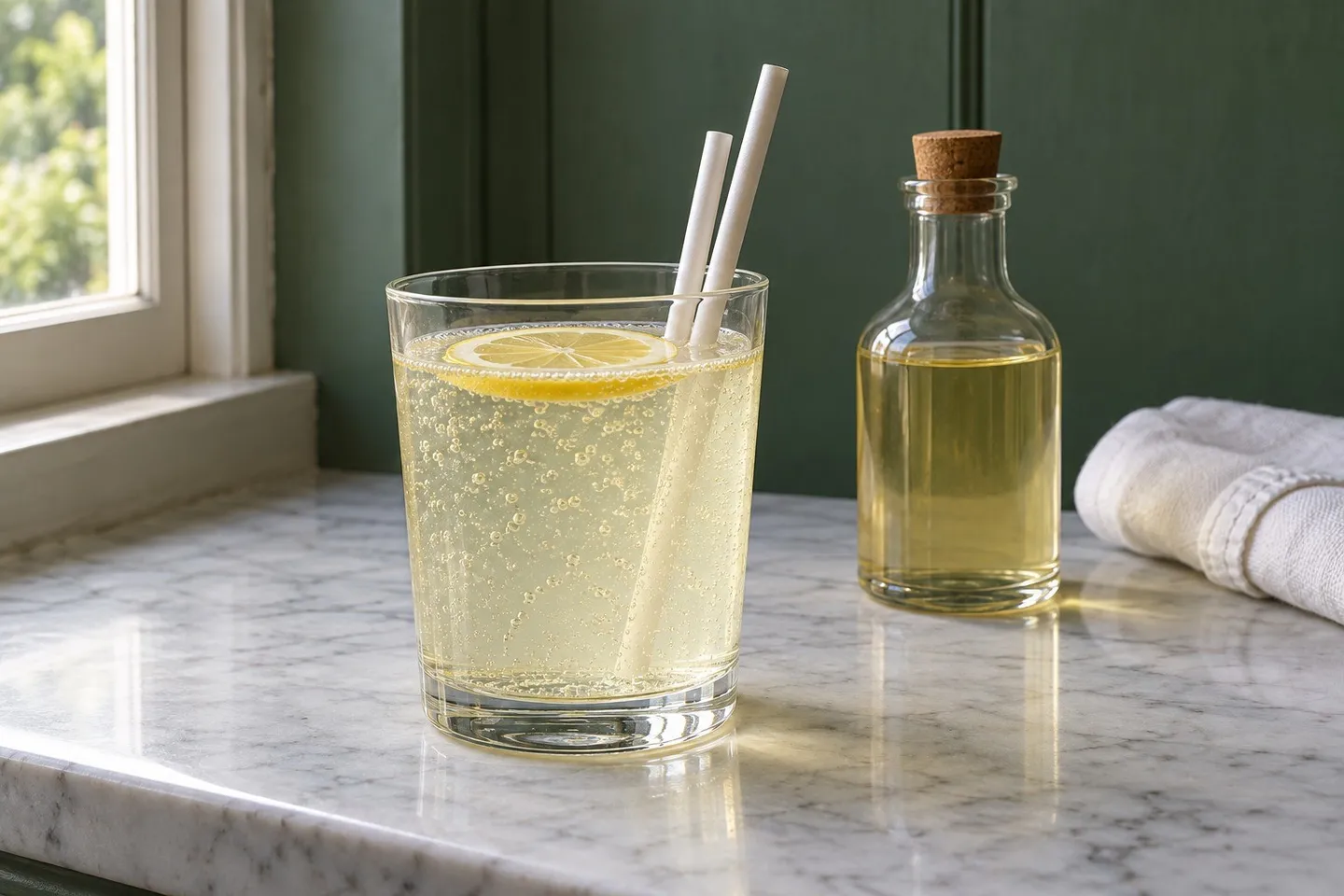
Lemon squash with soda water in a straight-sided tumbler with a lemon slice and two paper straws, beside a corked bottle of the cordial.
The story behind the recipe
A Superior Lemon Squash is a lemon cordial for the larder: the juice of eight lemons simmered with sugar, cleared with egg white, strained through a jelly bag, sharpened with citric acid and corked. Edward Spencer printed it in The Flowing Bowl (1903). To serve, a wine-glassful goes into a soda-water tumbler that has been swirled with six drops of Angostura bitters, and soda water fills it up.
A whisky man’s soft drink
Spencer gives long chapters to cups and to wine, but one, “Sworn Off!”, turns to “a few hints as to some non-alcoholic beverages.” The thirsty man, he writes, “can do much worse than turn to a teetotal beverage,” and “a follower of the sport of kings would rather go without whisky all the afternoon than miss his cup of tea, after business hours.” He had no good word for the fizzy bottles sold at country inns.
The squash was not his invention. Frederick and Seymour Davies had printed it almost word for word in Drinks of All Kinds (1896), with a skillet in place of the enamelled saucepan, a pint of water in with the juice, the egg’s shell beaten up with its white, and five drops of bitters, not six. One book copied the other, or both copied a third. The quick kind was made glass by glass: the 1906 Mrs. Beeton makes it from the juice of one lemon, sugar and a small bottle of soda water, at 3d. a glass, about £1.30 today by UK consumer prices (Bank of England). Lemon squash lasted. In 1921 a visiting American found that most English chemists got no closer to a soda fountain than lemon squash, a story told with American lemonade, as London made it. With lemonade and barley water, it was one of the soft drinks of the Edwardian country house.
Read more about this recipe
Your own batch
Spencer allows “one tablespoonful of sifted sugar to each lemon.” A level modern tablespoon of superfine sugar weighs about 13 grams and the heaped spoon in Mrs. Beeton’s table of weights an ounce, 28 grams, so 25 grams a lemon is our choice between them. Lemons vary: eight give roughly 360 ml, but measure yours.
The egg white sets as it boils and gathers the pulp into a scum that stays behind in the jelly bag, which is why the squash comes out clear. By the arithmetic each glass holds about 32 grams of sugar in some 280 ml, near the sweetness of cola, with about 4 grams of acid from the lemon and the citric acid, which makes it sharp. Add more soda water if it is too tart.
Take the juice of eight lemons, and sweeten it, allowing one tablespoonful of sifted sugar to each lemon. Put the juice into an enamelled saucepan and simmer gently over the fire until the sugar is quite dissolved. Beat up the white of one egg, add to the syrup, and stir well till the mixture boils; let it boil for a minute or two, and pour gently through a jelly-bag into a basin. When quite cold add a quarter of an ounce of citric acid, bottle, and cork tightly. When required for use, put six drops of Angostura bitters in a soda-water tumbler, turn it round and round, then add a wine-glassful of the squash, fill up with soda-water, place a thin slice of lemon atop, and serve with two straws.

Recipe makes: About 450 ml squash, enough for 6 glasses
Ingredients
For About 450 ml squash, enough for 6 glasses. Quantities are shown as written.
Quantities as written here, for About 450 ml squash, enough for 6 glasses.
Squash
- Strained lemon juice, from about 8 lemons360 ml
- Superfine sugar200 g
- Egg white1
- Food-grade citric acid7 g
For each glass
- Angostura bitters (optional)6 drops
- Lemon squash70 ml
- Soda water, chilled200 ml
- Thin slice lemon1
Measurement notes
Ingredients as written here
- 360 ml strained lemon juice, from about 8 lemons
- 200 g superfine sugar
- 1 egg white
- 7 g food-grade citric acid
- 6 drops Angostura bitters (optional)
- 70 ml lemon squash
- 200 ml soda water, chilled
- 1 thin slice lemon
Equipment
 Citrus juicer
 Wide stainless steel or enameled saucepan
 Whisk
 Jelly bag or sieve lined with muslin
 Bowl
 Clean glass bottle
 Half-pint tumbler, about 285 ml
Instructions
Put the strained lemon juice and the superfine sugar in a stainless steel or enamel saucepan. Heat gently, stirring, until the sugar has dissolved.
Whisk the egg white until frothy and stir it into the syrup. Bring to a boil, stirring, and boil for 2 minutes, until the white has set into a scum.
Pour gently through a jelly bag, or a sieve lined with wet muslin, into a bowl. Do not press it.
Leave until completely cold, about 1 hour. Stir in the citric acid until it has dissolved, pour into a clean bottle, cork or cap it tightly and refrigerate.
For each glass, shake the Angostura bitters, if using, into a half-pint tumbler and turn the glass so they coat the inside.
Add the lemon squash, fill up with the chilled soda water, float the slice of lemon on top and serve with two straws.
Nutrition
135calories per serving
- Recipe makes
- About 450 ml squash, enough for 6 glasses
- Servings
- 6
Estimated per glass from USDA FoodData Central values for lemon juice and sugar, for 70 ml of squash; the bitters and egg white add nothing measurable.
Recipe notes
When adjusting quantities
Scale the squash by the lemons: 25 g of sugar for each lemon’s juice. The glass ingredients are for one drink: 70 ml of squash to about 200 ml of soda water.
Notes
Quantities mentioned in these notes don’t change when you adjust the batch.
Angostura bitters are about 44.7% ABV. Six drops, at about 0.05 ml a drop, come to about 0.3 ml, or 0.13 ml of alcohol in a glass of about 280 ml: roughly 0.05% ABV. That is right at the 0.05% ceiling the UK government’s guidance on low-alcohol descriptors puts on “alcohol free” (the guidance was written for drinks with the alcohol taken out), and larger drops tip it over. So the alcohol-free label is for the glass made without them; leave the bitters out for a drink with no alcohol at all.
The egg white is boiled for 2 minutes and strained off with the scum, but traces of egg may stay in the squash. Use a stainless steel or enamel pan: this much acid can react with aluminum or unlined copper.
Spencer gives no keeping time. Kept corked in the fridge, use it within 2 weeks, our limit.
The wine-glassful is ⅛ of an Imperial pint, about 71 ml, by the table of equivalents in Mrs. Beeton’s 1906 book; this recipe rounds it to 70 ml. A quarter of an ounce of citric acid is 7 g, about 1½ teaspoons.
Scaling changes the ingredients only; glassware, ice and timings need their own judgment. To adapt this recipe further, try the recipe tool at TuneMyRecipe (opens in a new tab), our sister site.
Sources and attribution
Edward Spencer, The Flowing Bowl: A Treatise on Drinks of All Kinds and of All Periods (London: Grant Richards, 1903), “A Superior Lemon Squash”, pp. 233–234
Recipe details
- Drink
- Alcohol-free
- Drink family
- Shrubs, Syrups & Cordials
- Region
- British
- Era
- Edwardian
- Source decade
- 1900s
- Base
- Fruit & juice
- Difficulty
- Intermediate
- Season
- Summer