Nelson’s Body and the Brandy Cask
Yes, in brandy, then brandy and spirit of wine, by the surgeon’s own account of 1807. The sailors who drank the cask dry belong to a later tale.
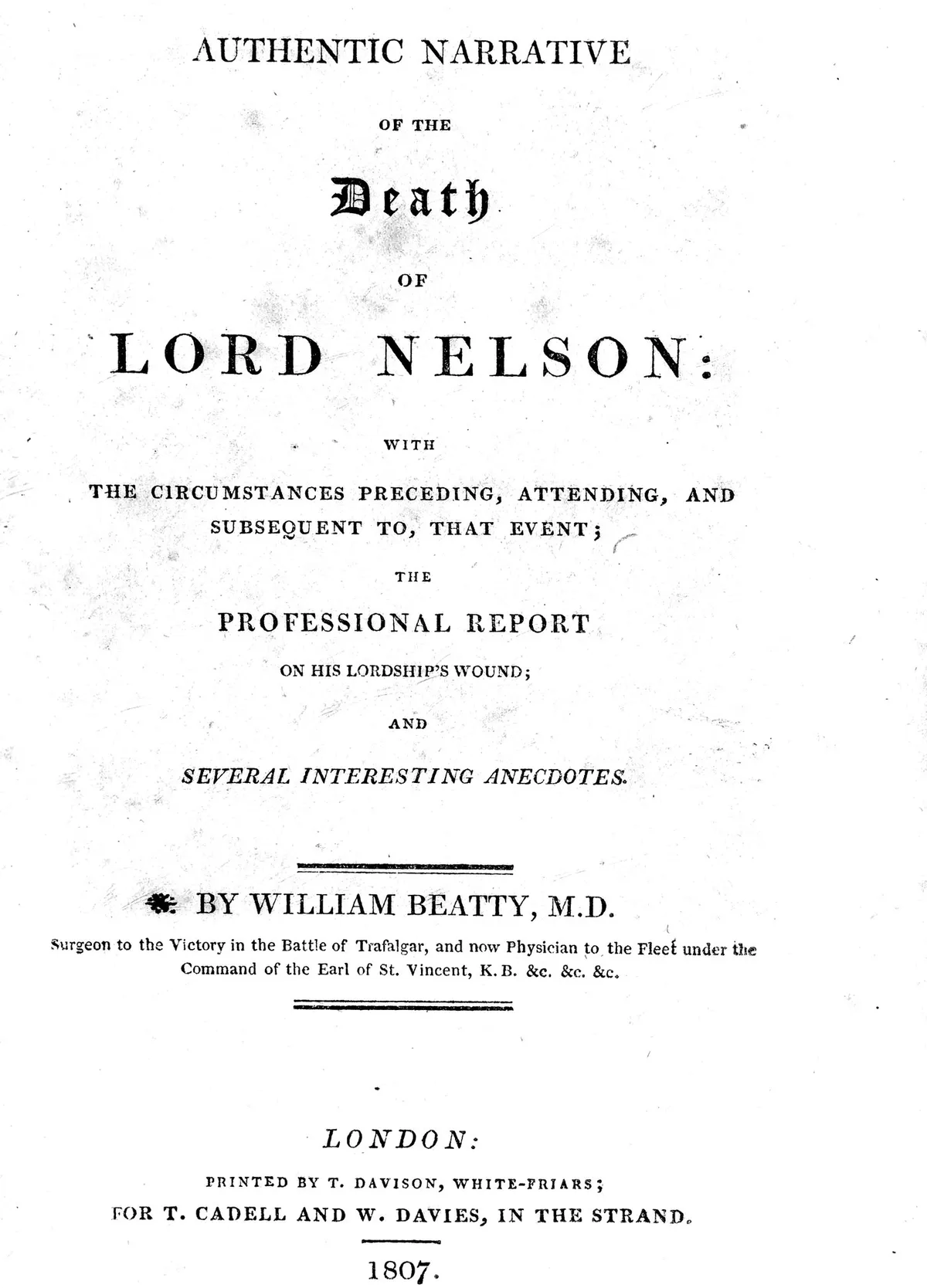
Yes. Nelson was killed at Trafalgar on October 21, 1805, and the next day the Victory’s surgeon, William Beatty, put his body into a cask and filled it with brandy. That was only the start. On the long voyage home the spirit was drawn off and renewed more than once, part of it with spirit of wine, and the body later went into a lead coffin with more brandy. The sailors who are supposed to have drunk the cask dry come from a tale printed decades later, and the surgeon who kept the cask never mentions them.
This story is part of our Soldiers’ and Sailors’ Drinks guide.
Beatty told it himself, in his Authentic Narrative of the Death of Lord Nelson, published in London in 1807. It is the surgeon’s own account of his own work, written in the third person, and it is the source for everything below that isn’t marked as legend.
A leaguer full of brandy
The ship had nothing to make a proper coffin with. Beatty explains the choice in one sentence:
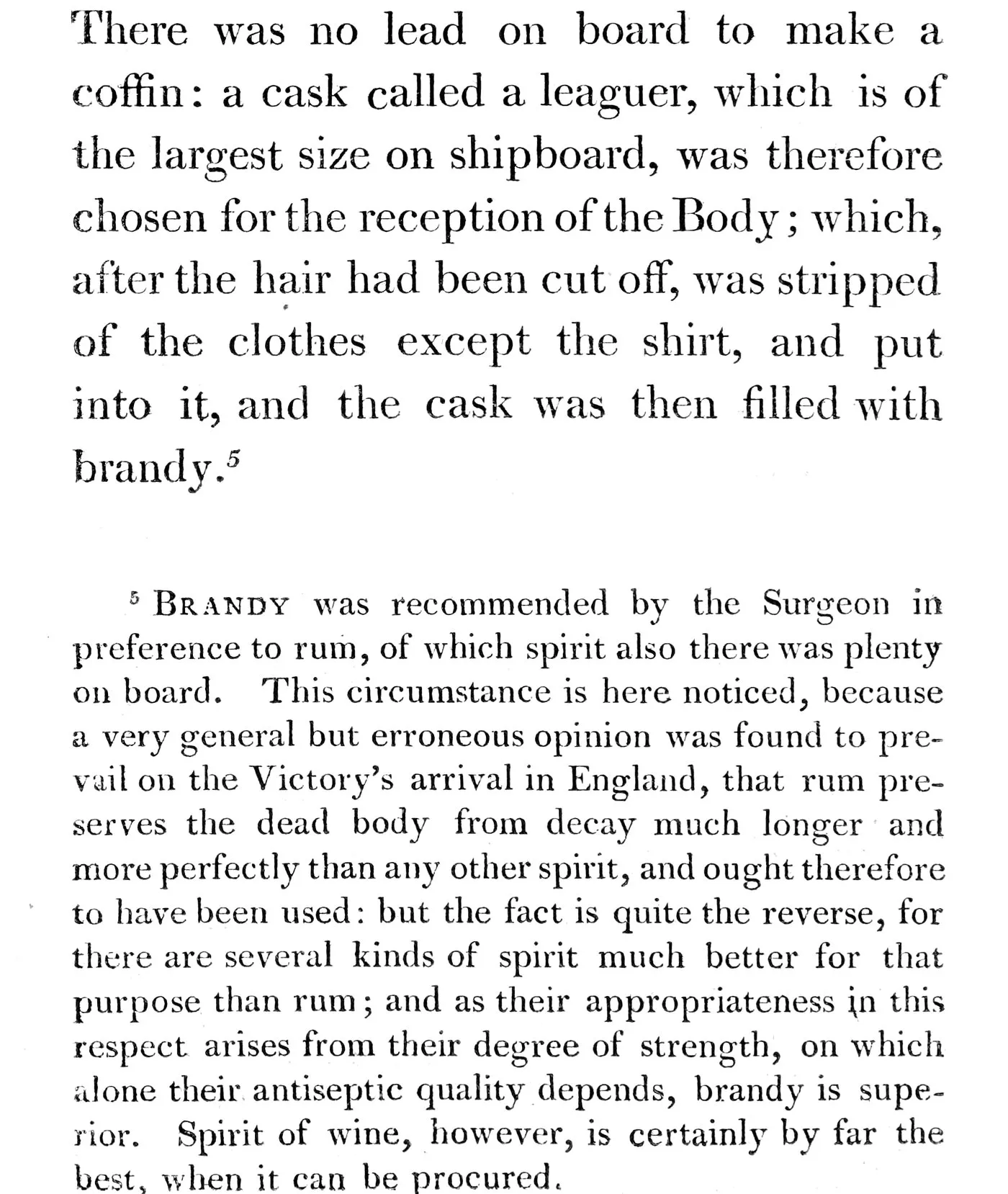 William Beatty, Authentic Narrative of the Death of Lord Nelson (London, 1807), p. 62. Wellcome Collection, public domain.
“There was no lead on board to make a coffin: a cask called a leaguer, which is of the largest size on shipboard, was therefore chosen for the reception of the Body; which, after the hair had been cut off, was stripped of the clothes except the shirt, and put into it, and the cask was then filled with brandy.”
The cask stood in plain sight. Beatty says it stood on end on the middle deck with a sentinel guarding it, and that it had two openings, one above and one below, so that spent spirit could be drawn off and fresh spirit poured in without moving the cask or disturbing the body. On October 24, in the gale after the battle, air escaping inside the cask lifted its head and gave the sentinel a fright; the cask was tapped to let the air out.
Why not rum?
The Victory had plenty of rum. Beatty’s footnote on the same page says so, and says why he chose brandy anyway. He was answering people at home. When the ship reached England, he wrote, “a very general but erroneous opinion” held that rum would have kept the body better. Beatty’s reply was that a spirit preserves according to its strength, that brandy was stronger, and that “Spirit of wine, however, is certainly by far the best, when it can be procured.”
That is Beatty defending his own decision, not a measured comparison: he gives no strength for the brandy he used. Nor does he say it was chosen because Nelson was an admiral, or that it was captured French cognac. Those touches turn up in modern retellings, not in his book.
Drawn off and renewed
Before the ship reached Gibraltar, the spirit was drawn off once and the cask refilled. At Gibraltar, on October 28, Beatty got spirit of wine and topped up the cask, which had lost some of its contents. He put the loss down to the body taking up the brandy. That is his explanation, and his book gives no measurement that would rule out leaks, evaporation or anything else.
The weather then made a slow passage slower:
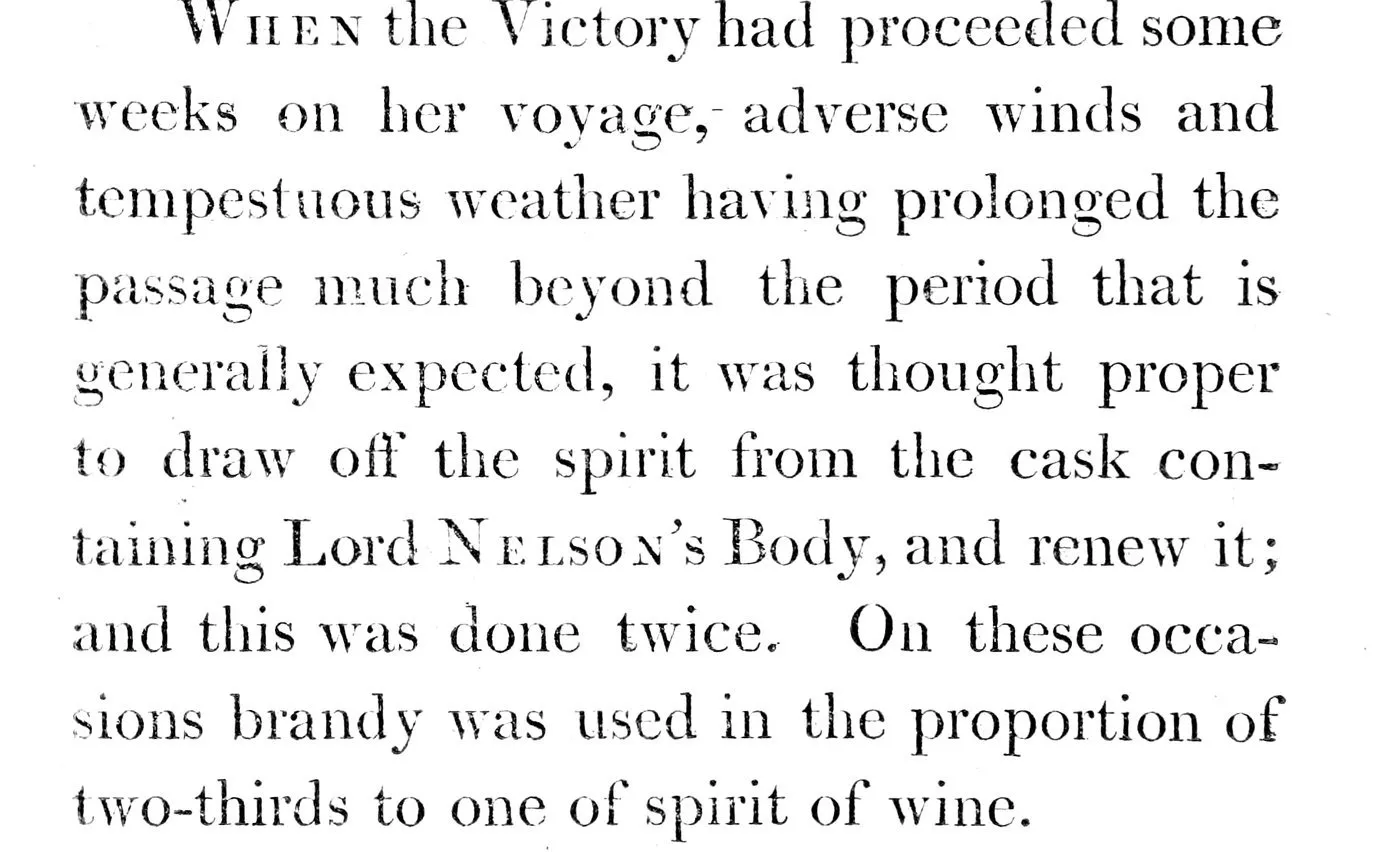 William Beatty, Authentic Narrative of the Death of Lord Nelson (London, 1807), p. 66. Wellcome Collection, public domain.
“It was thought proper to draw off the spirit from the cask containing Lord Nelson’s Body, and renew it; and this was done twice. On these occasions brandy was used in the proportion of two-thirds to one of spirit of wine.”
So the cask never held a single, untouched fill. It was topped up, drained and refilled under guard, with a mixture that changed as supplies did.
How well did it work?
Well on the outside, less well inside. On December 11, as the Victory left Spithead for the Nore, the body came out of the cask. Beatty found it externally in excellent condition, and in the same paragraph reports that the bowels were much decayed and that the affected parts were removed. Only at this examination was the ball found.
The body was wrapped in cotton and bandages and laid in a lead coffin filled with brandy, now with camphor and myrrh in it. The spirit of wine had run out. “The stock of spirit of wine on board was exhausted,” Beatty wrote, “and from the sound state of the Body, brandy was judged sufficient for its preservation.” On December 21 the body was moved once more, into the coffin made from the mast of L’Orient, and from there to Greenwich.
Tapping the admiral
The drinking story has a plausible look. There really was a cask of spirit, its level really did fall, and it really had a tap. But in Beatty’s account each of those things has its own job: the falling level is his absorption, the openings are for renewing the spirit, and the cask had a guard. He does not report anyone drinking from it. His silence can’t prove no sailor ever tried, but it leaves the tale without a witness.
The tale itself turns up in print later, in dictionaries of slang. John Camden Hotten’s Slang Dictionary of 1864 defines “tap the admiral” as “to suck liquor from a cask by means of a straw, said to have been first done with the rum-cask in which Lord Nelson’s body was brought to England, to such an extent as to leave the gallant Admiral high and dry.” Note the “said,” and the rum: Hotten’s cask holds the wrong spirit. Three years later W. H. Smyth’s Sailor’s Word-Book of 1867 told the story without Nelson’s name, as an insult for those who would “drink anything”; it came, he said, from “the tale of the drunkard who stole spirits from the cask in which a dead admiral was being conveyed to England.”
The phrase may be older than Trafalgar. The word historian Pascal Tréguer reports a newspaper item from 1790 and a Connecticut story from 1792; we have not seen those pages ourselves. And “Nelson’s blood” as a name for rum has no firm first date: the earliest use we have found a trace of is a transcription of an Australian dictionary from about 1924, which is a lead, not a dated page.
A drink from the same bottles
None of this is a recipe, and nothing here was ever served from the cask. But brandy and rum together were a familiar pairing in the punch bowl of the day. Maria Rundell’s New System of Domestic Cookery, in its edition of 1808, three years after Trafalgar, rubbed sugar on lemons, mixed in boiling water and then put in “brandy and rum in equal quantities.” The same idea, half a century on, is Mrs. Beeton’s Hot Punch, Rum and Brandy with Lemon, from her book of 1861.
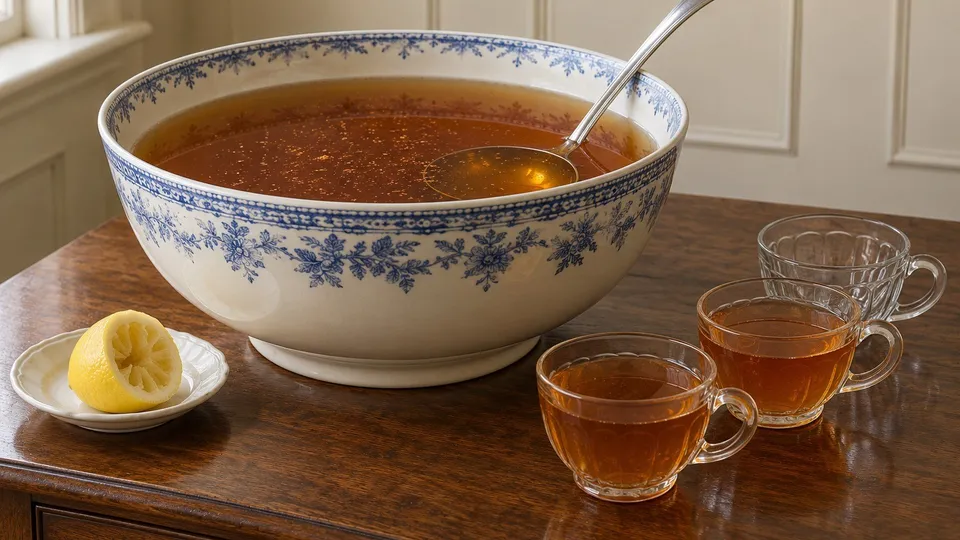 Make it todayMrs. Beeton’s Hot Punch, Rum and Brandy with Lemon
For the sailors’ own side of the ration, Half the Grog and a Pint of Tea tells how the navy cut the spirits in 1824 and handed out tea in their place, and The Navy’s Evening Pint of Tea from 1824 is the drink without alcohol that came of it.
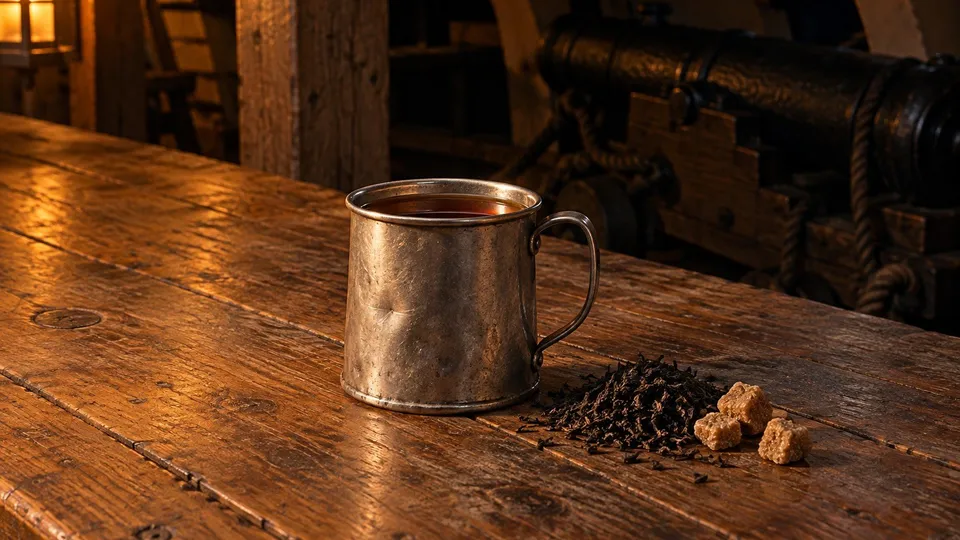 Always alcohol-freeThe Navy’s Evening Pint of Tea from 1824
Sources
- William Beatty, Authentic Narrative of the Death of Lord Nelson (London: T. Davison for T. Cadell and W. Davies, 1807), pp. 61–67, 72–74. Wellcome Collection b22036611, public domain.
- John Camden Hotten, The Slang Dictionary (London: John Camden Hotten, 1864), pp. 253–254.
- W. H. Smyth, The Sailor’s Word-Book, revised by Sir E. Belcher (London: Blackie and Son, 1867), p. 674.
- Maria Eliza Rundell, A New System of Domestic Cookery, new edition, corrected (London: John Murray, 1808), “An excellent Method of making Punch,” p. 257.
- Pascal Tréguer, “Tap the admiral,” Word Histories, June 1, 2020, https://wordhistories.net/2020/06/01/tap-the-admiral/ (opens in a new tab).