The Bloody Mary as First Described (1939)
Reader ratingsHalf tomato juice and half vodka, shaken cold: the Bloody Mary as New York’s columnists first described it in 1939, before salt, pepper and Worcestershire went in.
- Recipe makes
- 1 drink
- Prep
- Total
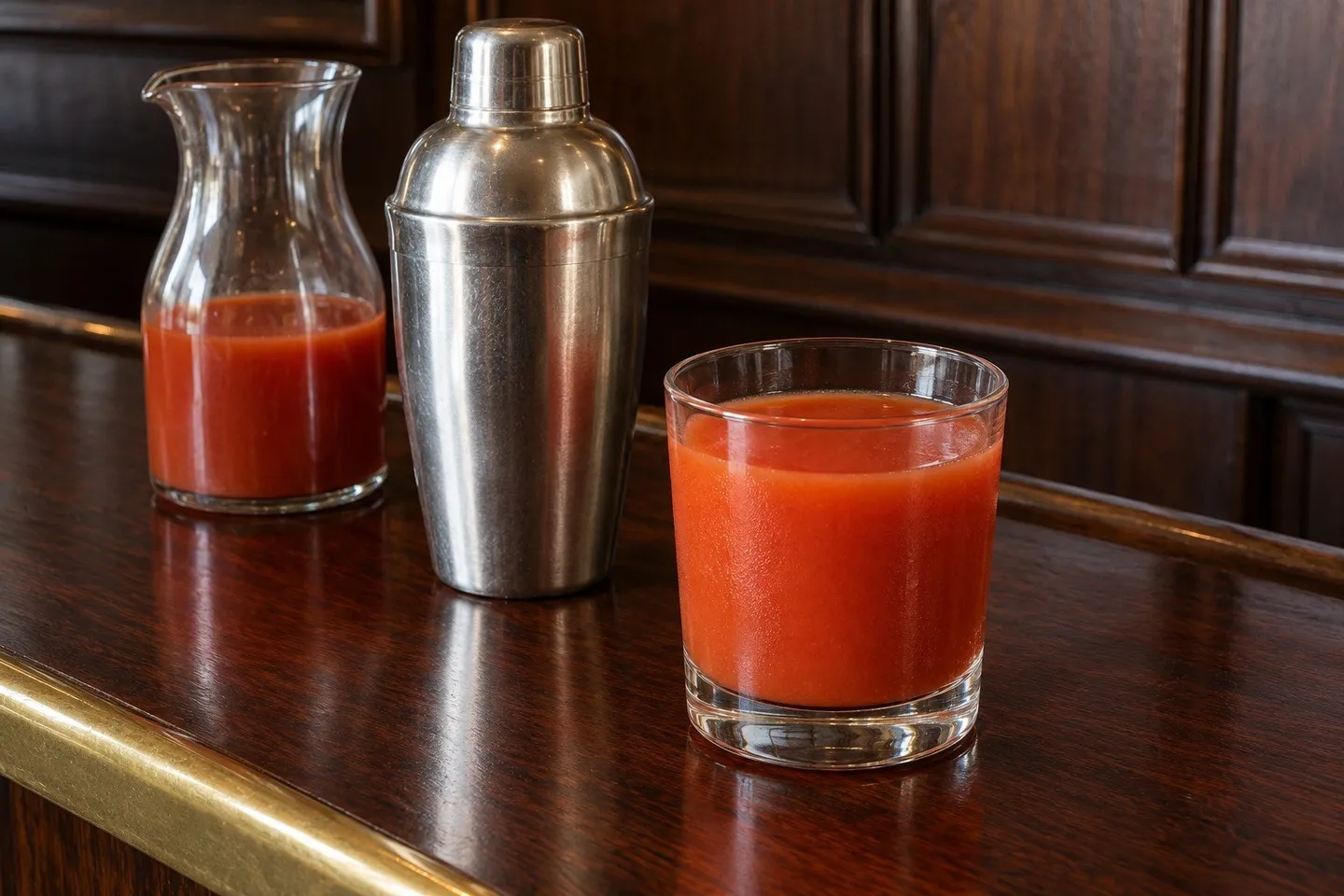
The 1939 Bloody Mary, half tomato juice and half vodka, in a small tumbler beside a shaker and a jug of tomato juice.
The story behind the recipe
When New York’s newspaper columnists first named the Bloody Mary, late in 1939, it had two ingredients: half tomato juice and half vodka, with no salt, pepper, lemon or Worcestershire sauce. The seasoned drink served today came after it, and who first made either one is still argued over.
A hangover cure at “21”
The mixture itself was older than the name, and gin came first: Broadway was drinking half gin and half tomato juice in January 1929, as The Bloody Mary Before It Had a Name tells. In June 1933 a London society paper, The Bystander, reported that an unnamed actress had taken to adding a tot of vodka to her tomato-juice cocktail. In America a tomato juice cocktail was then a seasoned first course with no spirit, and the vodka drinks that followed were written down by columnists, as The Bartenders Who Wrote Down the Classic Cocktails tells.
The name arrived in November 1939, in Dorothy Kilgallen’s syndicated column “The Voice of Broadway” (in the Trenton Evening Times on November 22): the newest hangover cure at the “21” club, she reported, was called a Bloody Mary. On December 2 Lucius Beebe gave it an owner and a formula in his New York Herald Tribune column “This New York,” describing it as George Jessel’s newest pick-me-up, half tomato juice and half vodka.
That much is documented. Who invented it is not. Jessel, a comedian, claimed it for decades, and in a 1956 vodka advertisement he said he thought he had invented it. Fernand Petiot, a bartender from Harry’s New York Bar in Paris and later the St. Regis in New York, told The New Yorker in 1964 that the drink was only vodka and tomato juice when he took it over, and that the seasoning was his. The oldest seasoned recipe we found, a Red Snapper of vodka and tomato juice with Worcestershire, salt, cayenne and lemon, is in Crosby Gaige’s Cocktail Guide and Ladies’ Companion of 1941.
Read more about this recipe
Two parts and no spice
This recipe is the 1939 version in Beebe’s equal measures. The columns name no glass, ice or method, so shaking it with ice and straining it into a small tumbler is our choice. At 2 fl oz each, the drink comes to about 17% ABV. Choose a thick, plain tomato juice, since nothing else in the glass seasons it.
To taste the kind of glass the vodka first went into, Aunt Sammy’s Tomato Cocktail of 1931 cooks tomatoes with celery and green pepper and holds no alcohol. Gaige’s seasoned Red Snapper and a Virgin Mary are in the Recipe notes; in Havana the same year, Bar La Florida printed a seasoned vodka and tomato drink as the Mary Rose.
Recipe makes: 1 drink
Ingredients
For 1 drink. Quantities are shown as written.
Quantities as written here, for 1 drink.
- Vodka2 fl oz
- Chilled tomato juice2 fl oz
- Ice cubes
Measurement notes
Ingredients as written here
- 2 fl oz vodka
- 2 fl oz chilled tomato juice
- ice cubes
Equipment
 Cocktail shaker
 Strainer
 Tumbler
Instructions
Chill a small tumbler in the freezer or with ice water.
Half fill a cocktail shaker with ice cubes and add the vodka and the chilled tomato juice.
Shake for about 10 seconds, until the shaker feels cold.
Strain into the chilled tumbler and serve at once, without garnish.
Nutrition
140calories per serving
- Recipe makes
- 1 drink
Estimated from USDA FoodData Central values for 80-proof vodka (64 calories per fl oz) and canned tomato juice.
Recipe notes
When adjusting quantities
Scale by whole drinks; shake no more than two at a time.
Notes
Quantities mentioned in these notes don’t change when you adjust the batch.
For the seasoned version, Gaige’s 1941 Red Snapper, shake the same 2 fl oz vodka and 2 fl oz tomato juice with 1/2 tsp Worcestershire sauce, a pinch each of salt and cayenne pepper and a dash of lemon juice, and strain into a small glass; Gaige serves it in a Delmonico glass. The Stork Club Bar Book of 1946 made its Bloody Mary longer, with twice as much tomato juice as vodka, two dashes of aromatic bitters and the juice of half a lemon, in a highball glass.
To make a Virgin Mary without alcohol, shake 4 fl oz tomato juice with the Red Snapper seasonings (1/2 tsp Worcestershire sauce, a pinch each of salt and cayenne and a dash of lemon juice) and strain over ice. These proportions are ours. Leave out the bitters, which are about 45% alcohol.
Scaling changes the ingredients only; glassware, ice and timings need their own judgment. To adapt this recipe further, try the recipe tool at TuneMyRecipe (opens in a new tab), our sister site.
Sources and attribution
Lucius Beebe, “This New York”, New York Herald Tribune, December 2, 1939, p. 9 (also syndicated in the Washington Post, December 3, 1939, Amusements p. 1); Dorothy Kilgallen, “The Voice of Broadway”, syndicated, Trenton Evening Times, November 22, 1939, p. 6
Recipe details
- Drink family
- Cocktails & Mixed Drinks
- Region
- American
- Source decade
- 1930s
- Difficulty
- Easy