Claret Cup, Iced Claret with Soda and Borage
Reader ratingsClaret chilled with lemon peel and sugar, then sherry, brandy, noyau, maraschino, borage and soda water: the claret cup of the Edwardian tennis tea, from 1906.
- Recipe makes
- About 1.4 liters, 10 small glasses
- Prep
- Total
Includes 1 hour for the claret to chill in a jug standing in ice.
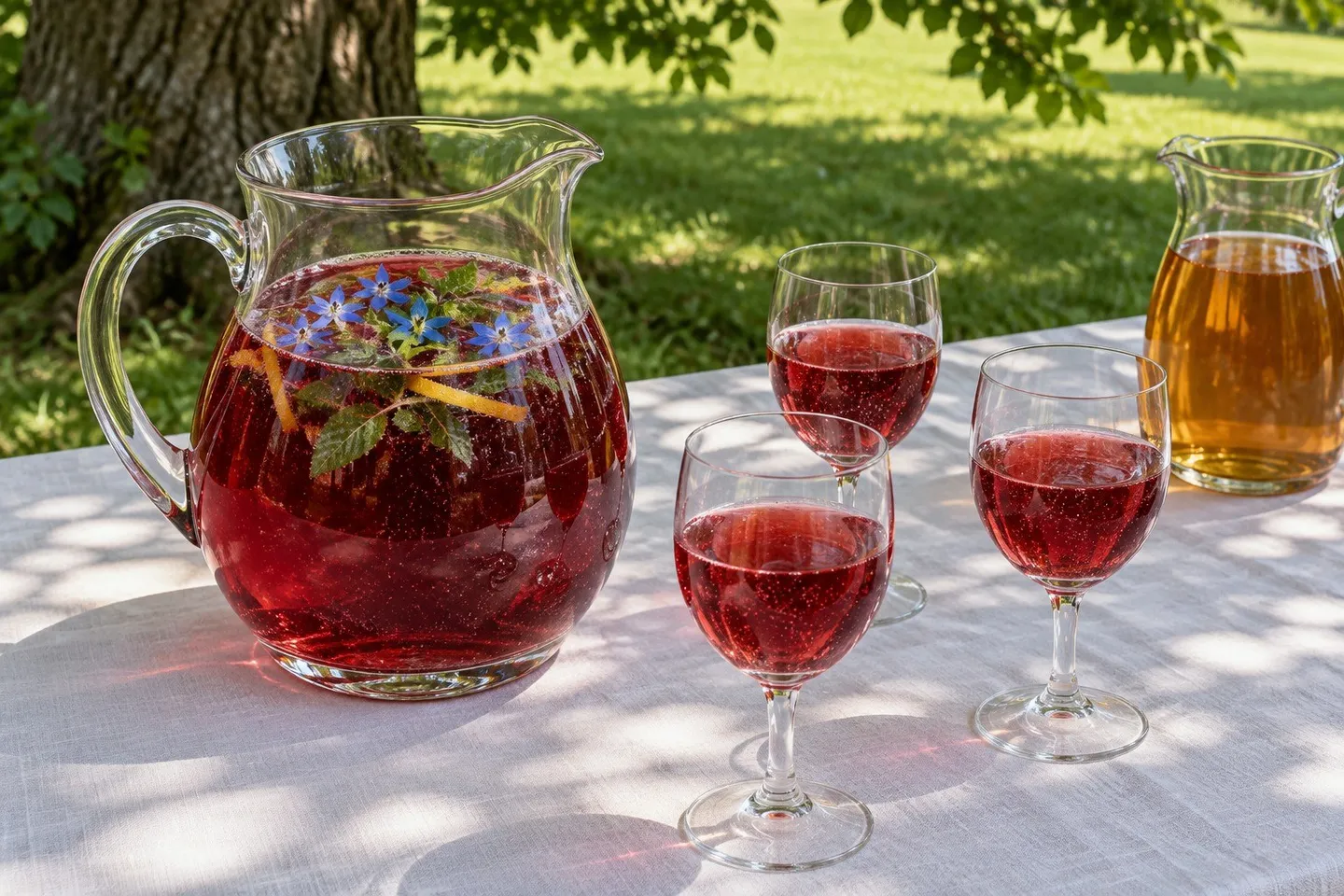
Claret cup in a glass jug with borage flowers and lemon peel, three stemmed glasses and a jug of iced tea, on a white cloth under a tree.
The story behind the recipe
Claret cup is a bottle of claret chilled for an hour with lemon peel and a little sugar, then lengthened with sherry, brandy, noyau, maraschino and a large bottle of soda water, with sprigs of borage on top. It is the one wine on the menu of the summer tennis or croquet tea in the 1906 revision of Mrs. Beeton’s Book of Household Management: “Iced tea, coffee, claret-cup, etc., are served.”
Ice around the jug
The book is firm about ice and wine: “Ice should never be put into wine, but this does not of course apply to claret cup and similar mixtures.” Even so, its claret cup is cooled from the outside. The claret, lemon rind and sugar stand covered in a jug “imbedded in ice for 1 hour,” and only then does the rest go in. The champagne cup on the same page gives the reason: it is “much better to ice the liquor which forms the basis of a ‘cooling cup’ than to reduce the temperature by adding crushed ice.”
Cups were for a crowd out of doors. Edward Spencer, in The Flowing Bowl (1903), recommends one claret cup as “a good cup for a garden-party, or a tent at Ascot; and remember always that the better the ingredients the better the cup.” He also warns about the noyau. That liqueur, made from fruit kernels, contains prussic acid, he writes, and should be used cautiously. Use a bought crème de noyaux; the recipe notes say why.
Read more about this recipe
In the glass
The book’s “ordinary” claret was the cheapest claret on its price list, at 12s. a dozen, about £5.30 a bottle today by UK consumer prices (Bank of England), so a light, inexpensive red Bordeaux is the right bottle. Beeton gives no size for a “liqueur glass” or a “large bottle” of soda water; we take them as 30 ml and 500 ml. On those figures the cup comes to about 9.5% ABV, a little weaker than most wine, and nearer 11% with a smaller bottle of soda. Serve it in small glasses.
At a table where some guests drink no wine, Ginger Ale Punch for a Dry Party is a 1920 bowl of tea, citrus and ginger ale, and TuneMyRecipe has a 1927 card-party fruit cup (opens in a new tab) with no alcohol. The claret cup’s place in the Edwardian summer is told in What Did People Drink in an Edwardian Country House?
3580.—CLARET CUP.
Ingredients.—1 bottle of claret, 1 wineglassful of sherry, 1 liqueur glass of brandy, 1 liqueur glass of noyeau, 1 liqueur glass of Maraschino, the thin rind of 1 lemon, 2 or 3 sprigs of balm, borage or verbena when procurable, castor sugar to taste, 1 large bottle of seltzer or soda water.
Method.—Put the claret, lemon rind, and 1 or 2 tablespoonfuls of castor sugar into a large jug, cover, and let it stand imbedded in ice for 1 hour. Add the rest of the ingredients, and serve. A few strips of cucumber peel may be used instead of balm, borage or verbena.

Recipe makes: About 1.4 liters, 10 small glasses
Ingredients
For About 1.4 liters, 10 small glasses. Quantities are shown as written.
Quantities as written here, for About 1.4 liters, 10 small glasses.
- Unwaxed lemon1
- Claret (red Bordeaux)750 ml
- Superfine sugar1 metric tbsp (15 ml per tbsp)
- Ice, to stand the jug in
- Dry sherry70 ml
- Brandy30 ml
- Crème de noyaux30 ml
- Maraschino liqueur30 ml
- Borage3 sprigs
- Soda water, chilled500 ml
Measurement notes
Ingredients as written here
- 1 unwaxed lemon
- 750 ml claret (red Bordeaux)
- 1 tbsp superfine sugar
- ice, to stand the jug in
- 70 ml dry sherry
- 30 ml brandy
- 30 ml crème de noyaux
- 30 ml maraschino liqueur
- 3 sprigs borage
- 500 ml soda water, chilled
Equipment
 Large jug
 Bowl
 Vegetable peeler
 Measuring jug
 Long spoon
Instructions
Pare the zest of the unwaxed lemon thinly with a vegetable peeler, leaving the white pith behind.
Put the zest in a large jug with the claret and the superfine sugar and stir until the sugar has dissolved.
Cover the jug and stand it in a bowl of ice, or in the fridge, for 1 hour.
Just before serving, add the dry sherry, brandy, crème de noyaux, maraschino liqueur and borage.
Pour in the chilled soda water and stir gently once. Taste, and if you want it sweeter, stir in a little more sugar gradually, so the cup doesn’t foam over.
Serve at once in small glasses.
Nutrition
105calories per serving
- Recipe makes
- About 1.4 liters, 10 small glasses
- Servings
- 10
Estimated from USDA FoodData Central values for red wine, dry sherry, brandy and sugar, with typical values for the two liqueurs, for ten small glasses.
Recipe notes
When adjusting quantities
The recipe is built on one bottle of claret. Scale by the bottle and keep the soda water at about two-thirds of the wine.
Notes
Quantities mentioned in these notes don’t change when you adjust the batch.
Never make noyau at home by steeping apricot kernels: they can release cyanide, and Food Standards Scotland and the UK Food Standards Agency warn against eating them. Bought crème de noyaux is made for drinking; amaretto is a modern stand-in if you can’t find it.
Beeton allows balm (lemon balm), borage or verbena, or a few strips of cucumber peel in their place. Any of them works in place of the borage here. Her sugar is “1 or 2 tablespoonfuls”; this starts with one.
Borage contains pyrrolizidine alkaloids, which can damage the liver. Germany’s Federal Institute for Risk Assessment (BfR) names borage among the plants that make them, and EU law caps their level in borage leaves sold as food. Use the sprigs to flavor the jug and as a garnish, and don’t eat them.
The ABV is our arithmetic, assuming claret at 12.5%, sherry at 17.5%, brandy at 40%, crème de noyaux at 25% and maraschino at 32%. Beeton’s own table of equivalents makes a wineglassful an eighth of an Imperial pint, so the sherry is 70 ml.
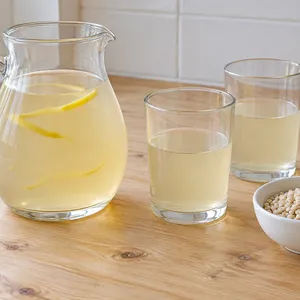
The same 1906 Beeton has a summer jug without wine, Beeton’s barley water with lemon peel, made with pearl barley, lemon peel and boiling water.
Scaling changes the ingredients only; glassware, ice and timings need their own judgment.
Sources and attribution
[Isabella Beeton, revised], Mrs. Beeton’s Book of Household Management, new edition (London: Ward, Lock & Co., 1906), “Claret Cup”, No. 3580, p. 1501
Recipe details
- Drink family
- Punches & Cups
- Region
- British
- Era
- Edwardian
- Source decade
- 1900s
- Base
- Wine
- Difficulty
- Easy
- Occasion
- Summer party
- Season
- Summer