Mrs. Beeton’s Ginger Beer, Brewed Overnight from 1861
Reader ratingsBruised ginger, lemon, cream of tartar and loaf sugar steeped in boiling water, started with yeast, left by the fire overnight and bottled: the brewed ginger beer of Mrs. Beeton’s 1861 Book of Household Management.
- Recipe makes
- About 1.1 liters, 4 of Beeton’s bottles
- Prep
- Total
About two days: 2 hours to cool, overnight in the bowl as Beeton directs, then 1 to 2 days in the bottle until firm, then the fridge. Hands-on time is about a quarter of an hour.
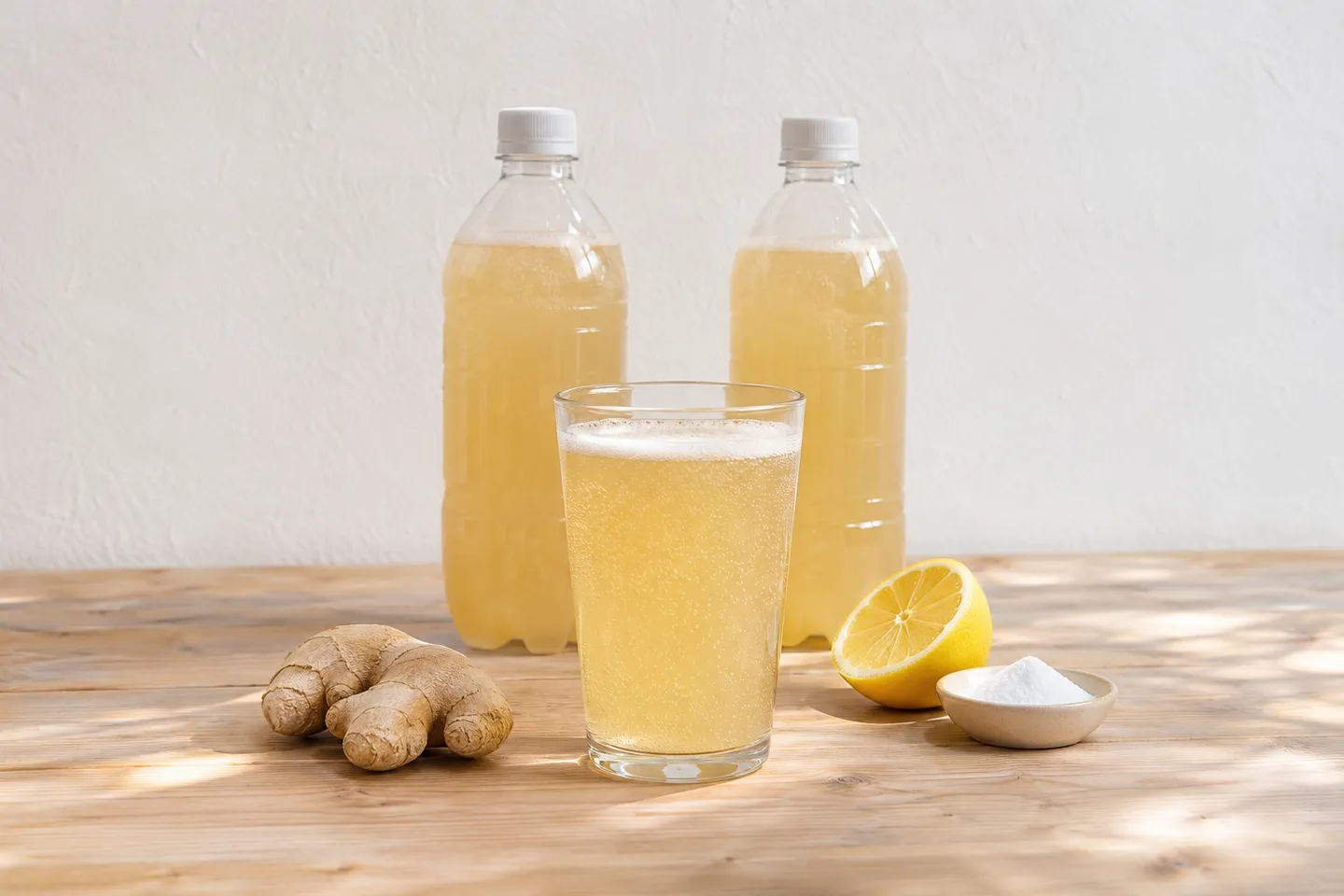
Cloudy home-brewed ginger beer in a glass and plastic bottles, with ginger root, a lemon and cream of tartar.
The story behind the recipe
Victorian ginger beer was brewed, not mixed. Isabella Beeton’s Book of Household Management (1861) pours three gallons of boiling water over bruised ginger, lemon, cream of tartar and two and a half pounds of loaf sugar, adds brewer’s yeast once it is “just warm,” and leaves the pan near the fire all night. Next day it is skimmed, bottled with the corks tied down, and “in 3 days the ginger beer will be fit for use.”
Four dozen bottles at a halfpenny
The recipe is costed, and cheap: “Average cost for this quantity, 2s.; or ½d. per bottle,” enough “to fill 4 dozen ginger-beer bottles.” By UK consumer prices (Bank of England), 2s is about £10 today and the halfpenny bottle about 20p. Her note on sweetness is practical, not about taste: less sugar is fine, “but the beer will not keep so long good.”
The method traveled well. Albert Hopkins’s Home Made Beverages, printed in New York in 1919, gives nearly the same drink in its “Non-Alcoholic Beers” chapter: brown sugar, cream of tartar and bruised ginger root in boiling water, yeast when lukewarm, then “Let it stand all night; then bottle.” Whether beers like these deserved that chapter heading is the question in What Were Victorian Non-Alcoholic Beers?
Read more about this recipe
Making it today
We make a twelfth of her batch, about 1.1 liters, which fills four of her bottles. Her bruised ginger is dried ginger root, crushed; at her rate this is a mild ginger beer, so use up to three times as much if you want more bite. A quarter teaspoon of dried yeast stands in for her spoonfuls of thick brewer’s yeast. The one rule we change is the bottle. Her tied-down corks held the gas in glass, and glass is exactly what modern brewing guidance warns against: this goes into plastic soda bottles, 1 to 2 days at room temperature, then the fridge.
It is a low-alcohol drink, not an alcohol-free one. For ginger beer that stays at zero, the alcohol-free ginger beer, the fountain way is mixed from a syrup and soda water.
GINGER BEER. 1833. INGREDIENTS.—2½ lbs. of loaf sugar, 1½ oz. of bruised ginger, 1 oz. of cream of tartar, the rind and juice of 2 lemons, 3 gallons of boiling water, 2 large tablespoonfuls of thick and fresh brewer’s yeast.
Mode.—Peel the lemons, squeeze the juice, strain it, and put the peel and juice into a large earthen pan, with the bruised ginger, cream of tartar, and loaf sugar. Pour over these ingredients 3 gallons of boiling water; let it stand until just warm, when add the yeast, which should be thick and perfectly fresh. Stir the contents of the pan well, and let them remain near the fire all night, covering the pan over with a cloth. The next day skim off the yeast, and pour the liquor carefully into another vessel, leaving the sediment; then bottle immediately, and tie the corks down, and in 3 days the ginger beer will be fit for use. For some tastes, the above proportion of sugar may be found rather too large, when it may be diminished; but the beer will not keep so long good.
Average cost for this quantity, 2s.; or ½d. per bottle.
Sufficient to fill 4 dozen ginger-beer bottles.
Seasonable.—This should be made during the summer months.

Recipe makes: About 1.1 liters, 4 of Beeton’s bottles
Ingredients
My drinksFor About 1.1 liters, 4 of Beeton’s bottles. Quantities are shown as written.
Quantities as written here, for About 1.1 liters, 4 of Beeton’s bottles.
- Strip lemon zest1
- Fresh lemon juice1/2 metric tbsp (15 ml per tbsp)
- Dried ginger root, bruised4 g
- Cream of tartar3/4 metric tsp (5 ml per tsp)
- Sugar95 g
- Boiling water1.1 l
- Dried yeast1/4 metric tsp (5 ml per tsp)
Measurement notes
Ingredients as written here
- 1 strip lemon zest
- 1/2 tbsp fresh lemon juice
- 4 g dried ginger root, bruised
- 3/4 tsp cream of tartar
- 95 g sugar
- 1.1 l boiling water
- 1/4 tsp dried yeast
Equipment
 Kettle
 Large heatproof bowl
 Clean cloth
 Fine sieve
 Funnel
 Plastic soda bottles, enough for 1.2 liters
Instructions
Put the lemon zest, the strained fresh lemon juice, the dried ginger root, the cream of tartar and the sugar in the bowl.
Pour on the boiling water and stir until the sugar has dissolved.
Leave it until it is just lukewarm, about 86 °F (30 °C). This takes about 2 hours.
Sprinkle on the dried yeast and stir it in well. Cover the bowl with a clean cloth and leave it overnight in a warm room, about 68 to 75 °F (20 to 24 °C), for about 12 hours.
Skim off any foam. Pour the liquid gently through the sieve and funnel into the plastic bottles, leaving the sediment behind in the bowl, and fill each bottle only to the shoulder. Screw the caps on tight.
Leave the bottles at room temperature for 1 to 2 days, no more than 2, until they are firm when squeezed. Then put them in the fridge.
Drink it cold within six days. Open the bottles slowly over the sink.
Nutrition
85calories per serving
- Recipe makes
- About 1.1 liters, 4 of Beeton’s bottles
- Servings
- 4
Roughly estimated from the sugar in the recipe, assuming about a tenth of it ferments, for one 280 ml bottle.
Recipe notes
When adjusting quantities
This is a twelfth of Beeton’s batch, which was 3 gallons of water for four dozen bottles. Keep plastic bottles at any size.
Notes
Quantities mentioned in these notes don’t change when you adjust the batch.
Changes from the source: a twelfth of Beeton’s quantities. Her 3 gallons are imperial, about 13.6 liters, so a twelfth is about 1.1 liters; her 2½ lb of sugar, about 1.13 kg, becomes 95 g, her 1½ oz of ginger about 4 g and her ounce of cream of tartar about 2.4 g, or 3/4 teaspoon. The lemon is scaled to a strip of zest and half a tablespoon of juice. Dried yeast in place of brewer’s yeast (an ale or champagne yeast from a home-brewing shop, or ordinary dried yeast), the temperatures, the time in the bottle, plastic bottles and the fridge are ours.
Never use glass bottles, swing-tops or corks for this, never fill the bottles to the top and never leave full bottles somewhere warm. A fermenting drink keeps making gas, and the National Centre for Biotechnology Education’s guide to brewing ginger beer warns that glass bottles can explode; it says to use plastic bottles, ferment for no more than 48 hours, then refrigerate and drink within six days.
Strength is an estimate; we have not measured it. The batch holds about 86 g of sugar a liter, so if all of it fermented the drink could pass 5 percent alcohol. A night in the bowl, a day or two in the bottle and a cold fridge ferment only a small part of it, and home-brewed root beer, made with yeast in the same way, measured between 0.25 and 1.77 percent in a pharmacist’s test of 1916, told in Did Root Beer Have Alcohol in It?, but it is not alcohol-free: it is no drink for children, for Dry January or for anyone avoiding alcohol.
Storage
Keep the bottles in the fridge once they are firm and drink the ginger beer within six days. It contains live yeast and goes on making gas; squeeze a bottle now and then and loosen the cap if it is rock-hard.
Scaling changes the ingredients only; glassware, ice and timings need their own judgment. To adapt this recipe further, try the recipe tool at TuneMyRecipe (opens in a new tab), our sister site.
Sources and attribution
Isabella Beeton, The Book of Household Management (London: S. O. Beeton, 1861), No. 1833, “Ginger Beer,” p. 889
See the original pages (scan at Internet Archive) (opens in a new tab)
Recipe details
- Drink
- DrinkLow-alcohol
- Drink family
- Wine, Beer & Mead
- Region
- British
- Era
- 19th century
- Source decade
- 1860s
- Base
- Spices
- Difficulty
- Intermediate
- Season
- Summer