Koumiss, the 1892 Fermented Milk Drink
Reader ratingsA quart bottle of milk, a little yeast and sugar, six warm hours and a week in the cold: Ella Kellogg’s 1892 koumiss, the fizzy cow’s-milk version of the steppe’s fermented mare’s milk.
- Recipe makes
- About 950 ml, 4 glasses
- Prep
- Total
About a week: 6 hours in a warm room, as Kellogg directs, then about a week cold. Hands-on time is about 10 minutes.
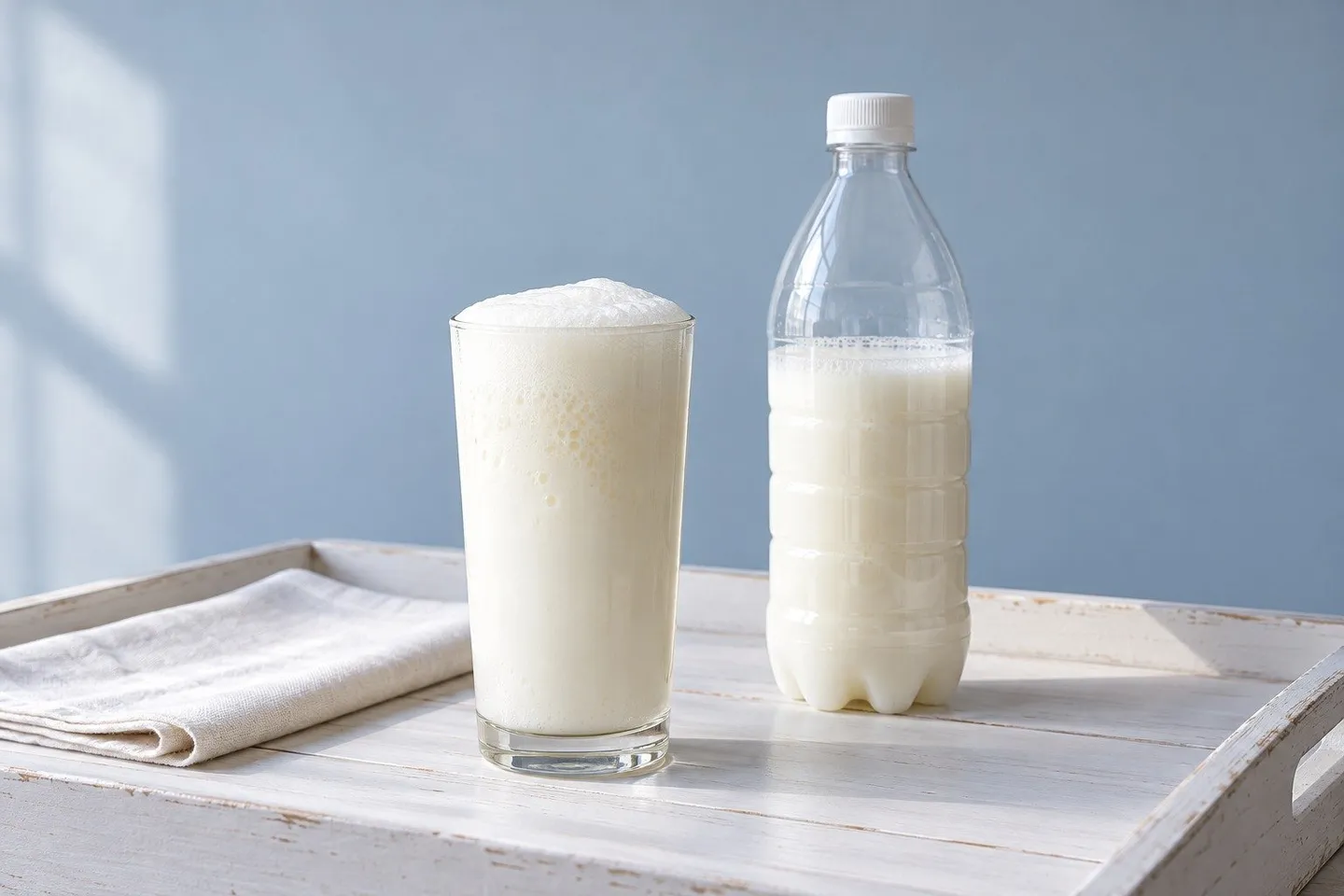
A glass of foaming white koumiss beside a capped bottle of it.
The story behind the recipe
Koumiss is fermented milk, sour and fizzy, and this is the cow’s-milk version Americans made at home for invalids. It comes from Ella Eaton Kellogg’s Science in the Kitchen, published at Battle Creek, Michigan, in 1892, where it sits among the “Preparations of Milk” in a chapter of food for the sick. Her method is short: yeast and sugar in a quart bottle of milk, six hours in a warm room, then a week corked in a cool place.
From mare’s milk to a quart bottle
The real thing was the fermented mare’s milk of the Central Asian steppe. Victorian doctors prescribed it for consumption, and since mare’s milk was hard to find in Battle Creek or London, cow’s milk took its place, bottled like champagne and opened with a champagne tap. How it arrived in British and American sickrooms, and what one doctor’s patient paid for it, is in What Was Koumiss?
Kellogg’s recipe is the plain household version, and it has a test most old recipes lack. A good koumiss is foamy and smooth; if there is “any curd or thickening resembling cheese,” she says, it has gone too far “and the koumiss should not be used.”
Read more about this recipe
Making it today
We use a plastic soda bottle instead of a corked quart, and the fridge instead of her cool place “not above 60°.” The fridge is colder than her cupboard, so the week works more slowly and the koumiss stays milder. Her quarter of a two-cent cake of compressed yeast is a small piece of fresh yeast; a quarter teaspoon of dried yeast does the same job.
Expect a white, foaming drink; a San Francisco label of 1879 promised that the glass “will be filled with a beautiful snow white foam.” Pour it slowly: shaken, it foams up the glass much as the champagne-tap bottles did. Another quick bottled ferment, from a Russian kitchen of the same years, is Bread Kvass, the 24-Hour Rye Kvass from 1887.
Koumiss.—Dissolve one fourth of a two-cent cake of compressed yeast, and two teaspoonfuls of white sugar, in three tablespoonfuls of lukewarm water. Pour this into a quart bottle and add sufficient fresh, sweet milk to nearly fill. Shake well, and place in a room of the temperature of 70° to 80° F., and allow it to ferment about six hours. Cork tightly and tie the cork in. Put in a cool place, not above 60°, and let it remain a week, when it will be ready for use. In making koumiss be sure that the milk is pure, the bottle sound, and the yeast fresh. Open the bottle with a champagne tap. If there is any curd or thickening resembling cheese, the fermentation has been prolonged beyond the proper point, and the koumiss should not be used.

Recipe makes: About 950 ml, 4 glasses
Ingredients
For About 950 ml, 4 glasses. Quantities are shown as written.
Quantities as written here, for About 950 ml, 4 glasses.
- Dried yeast1/4 metric tsp (5 ml per tsp)
- Sugar2 metric tsp (5 ml per tsp)
- Lukewarm water3 metric tbsp (15 ml per tbsp)
- Pasteurized whole milk850 ml
Measurement notes
Ingredients as written here
- 1/4 tsp dried yeast
- 2 tsp sugar
- 3 tbsp lukewarm water
- 850 ml pasteurized whole milk
Equipment
 Small bowl
 Funnel
 Plastic soda bottle, 1 liter
Instructions
Stir the dried yeast and sugar into the lukewarm water in the small bowl until dissolved.
Pour it through the funnel into the clean plastic bottle.
Add the pasteurized whole milk until the bottle is full to the shoulder, leaving a gap at the top. Cap it and shake well.
Loosen the cap a quarter turn and leave the bottle in a room at 21 to 27 °C for about 6 hours.
Screw the cap on tight and put the bottle in the fridge for about a week. Squeeze it once a day; it should grow firm.
Open it slowly over the sink, a little at a time, and pour gently. If it has curds or a thick, cheesy texture, throw it away.
Nutrition
150calories per serving
- Recipe makes
- About 950 ml, 4 glasses
- Servings
- 4
Estimated from USDA FoodData Central values for whole milk and sugar, for one 240 ml glass.
Recipe notes
When adjusting quantities
Kellogg’s batch is one quart bottle. Make more in separate bottles rather than one large one.
Notes
Quantities mentioned in these notes don’t change when you adjust the batch.
Changes from the source: a plastic soda bottle with a screw cap in place of a corked and tied quart bottle; the fridge in place of a cool place “not above 60°”; a quarter teaspoon of dried yeast in place of a quarter of a two-cent cake of compressed yeast, whose weight Kellogg does not give; pasteurized milk in place of “fresh, sweet milk”; a loosened cap during the warm hours and opening over the sink are ours. Her quart is about 950 ml; 850 ml of milk fills a 1-liter bottle to the shoulder.
Strength is an estimate; we have not measured it. Ordinary baking yeast ferments the added sugar but very little of the milk sugar, and two teaspoons of sugar in a quart could make well under 1 percent alcohol even if all of it fermented. It is low in alcohol, not free of it.
Use pasteurized milk only, never raw. Never use a glass bottle with a tight cap, never fill the bottle to the top, and never leave it somewhere warm once the cap is tight. If the bottle is rock-hard, chill it well and open it slowly.
Kellogg’s book also has drinks with no alcohol in them at all, among them Pink Lemonade, colored with berry juice.
Storage
Keep the bottle in the fridge and drink the koumiss within a day or two of opening. It contains live yeast and goes on making gas; squeeze the bottle each day and loosen the cap for a moment if it is rock-hard.
Scaling changes the ingredients only; glassware, ice and timings need their own judgment. To adapt this recipe further, try the recipe tool at TuneMyRecipe (opens in a new tab), our sister site.
Sources and attribution
E. E. Kellogg, Science in the Kitchen (Battle Creek: Health Publishing Company, 1892), “Koumiss,” p. 425
Recipe details
- Drink
- DrinkLow-alcohol
- Region
- American
- Source decade
- 1890s
- Base
- Milk & whey
- Difficulty
- Easy