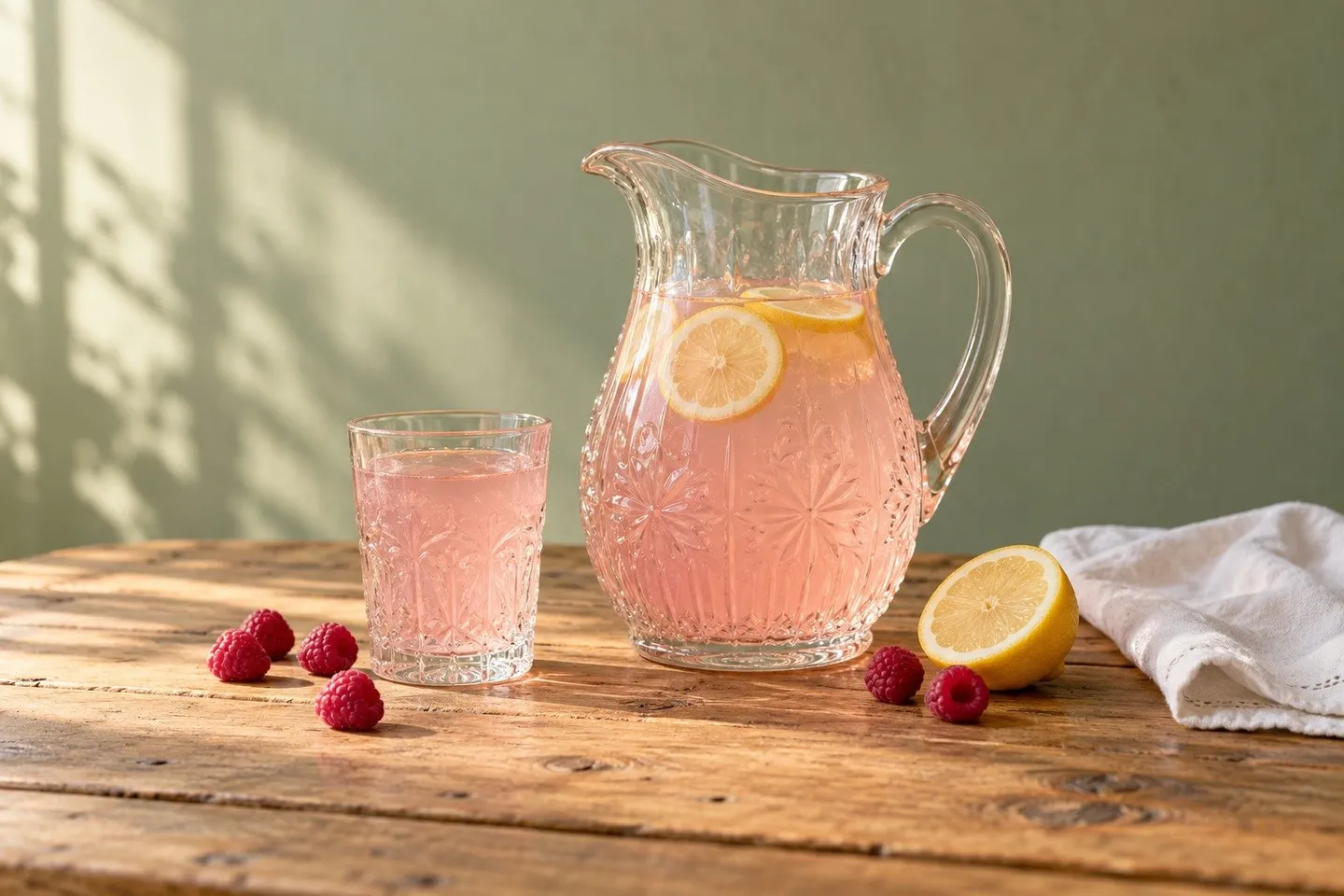
Kellogg’s Pink Lemonade, Colored with Berry Juice
Reader ratingsPlain lemonade made the 1892 way, three lemons to a quart, then half a cup of strawberry, raspberry, currant or cranberry juice to every pint: pink lemonade with nothing in it but fruit.
- Recipe makes
- About 5 cups, 5 glasses
- Prep
- Total
Kellogg lets the sugar, juice and lemon slices stand 10 to 15 minutes in a little boiling water before the cold water goes in.
A glass pitcher of pink lemonade with lemon slices, beside a tumbler and a few raspberries.
The story behind the recipe
Pink lemonade, as an American cookbook made it in 1892, is ordinary lemonade with fruit juice in it. Ella Eaton Kellogg’s Science in the Kitchen, published at Battle Creek, Michigan, gives it in two lines: “Add to a pint of lemonade prepared in the usual manner half a cup of fresh or canned strawberry, red raspberry, currant, or cranberry juice. It gives a pretty color besides adding a pleasing flavor.”
The usual manner
Her “usual manner” is the plain lemonade earlier on the same page: three large lemons to a quart of water and six to eight tablespoons of sugar. The juice goes over the sugar with a slice or two cut from each lemon, a little boiling water dissolves it all, and the cold water goes in after ten or fifteen minutes. The slices stay in the pitcher, and the hot water draws a little oil from their peel.
Kellogg’s book was written for a health-minded kitchen, and her pink comes from the fruit and nothing else. That was a point worth making: pink lemonade had been sold at fairs since at least the 1860s, and a circus memoir of 1921 admitted that the circus kind was colored with aniline dye. That story, and the much-repeated tale of the pink tights, are in A Short History of Lemonade.
Read more about this recipe
Making it today
Use unsweetened juice so the sugar stays as Kellogg set it: pure cranberry juice gives the deepest color and the sharpest taste, and raspberry or strawberry juice is softer. To make your own, crush 2 cups of raspberries or hulled strawberries and press them through a fine strainer; that gives about a cup. Seven tablespoons of sugar sits in the middle of her six to eight. Expect a clear, pale rose-pink drink.
For a fizzy pink version built in the glass over shaved ice, try American Lemonade, as London Made It, colored with strawberry syrup.
Lemonade.—Use three large or four medium-sized lemons for each quart of water, and from six to eight tablespoonfuls of sugar. Rub or squeeze the lemons till soft. Cut a slice or two from each, and extract the juice with a lemon drill; strain the juice through a fine wire strainer to remove the seeds and bits of pulp, and pour it over the sugar. Add the slices of lemon, and pour over all a very little boiling water to thoroughly dissolve the sugar; let it stand ten or fifteen minutes, then add the necessary quantity of cold water, and serve. Or rub the sugar over the outside of the lemons to flavor it, and make it into a syrup by adding sufficient boiling water to dissolve it. Extract and strain the lemon juice, add the prepared syrup and the requisite quantity of cold water, and serve.
Pink Lemonade.—Add to a pint of lemonade prepared in the usual manner half a cup of fresh or canned strawberry, red raspberry, currant, or cranberry juice. It gives a pretty color besides adding a pleasing flavor.

Recipe makes: About 5 cups, 5 glasses
Ingredients
For About 5 cups, 5 glasses. Quantities are shown as written.
Quantities as written here, for About 5 cups, 5 glasses.
- Large lemons3
- Sugar7 tbsp
- Boiling water1/4 cup
- Cold water3 3/4 cups
- Unsweetened cranberry, raspberry, strawberry or red currant juice1 cup
Measurement notes
Ingredients as written here
- 3 large lemons
- 7 tbsp sugar
- 1/4 cup boiling water
- 3 3/4 cups cold water
- 1 cup unsweetened cranberry, raspberry, strawberry or red currant juice
Equipment
 Citrus juicer
 Fine strainer
 Heatproof pitcher
Instructions
Roll the lemons firmly on the table to soften them. Cut one thin slice from the middle of each and set the slices aside.
Squeeze the lemons and strain the juice over the sugar in a heatproof pitcher, catching the seeds and pulp.
Add the lemon slices and pour in the boiling water. Stir until the sugar has dissolved, then leave it to stand for 10 to 15 minutes.
Add the cold water and stir.
Stir in the berry juice until the lemonade is evenly pink. Taste and add a little more sugar if you like. Serve cold.
Nutrition
95calories per serving
- Recipe makes
- About 5 cups, 5 glasses
- Servings
- 5
Roughly estimated from USDA FoodData Central values for lemon juice, granulated sugar and unsweetened cranberry juice, for one 1-cup glass.
Recipe notes
When adjusting quantities
Kellogg’s lemonade is a quart of water with three large lemons, and the berry juice goes in at half a cup to every pint.
Notes
Quantities mentioned in these notes don’t change when you adjust the batch.
Changes from the source: we cut one slice from each lemon where Kellogg allows “a slice or two,” use a citrus juicer for her lemon drill, and take seven tablespoons of sugar from her six to eight. A quarter cup of boiling water is our reading of “a very little.” The berry juice is scaled to her rate of half a cup to the pint of lemonade; her quart makes two pints, so it takes a full cup.
Kellogg’s second method, sugar rubbed over the lemon peel and made into a syrup, works here too, and gives a stronger lemon scent.
Scaling changes the ingredients only; glassware, ice and timings need their own judgment. To adapt this recipe further, try the recipe tool at TuneMyRecipe (opens in a new tab), our sister site.
Sources and attribution
E. E. Kellogg, Science in the Kitchen (Battle Creek: Health Publishing Company, 1892), “Lemonade” and “Pink Lemonade,” p. 362
Recipe details
- Drink
- Alcohol-free
- Drink family
- Sodas & Soft Drinks
- Region
- American
- Era
- 19th century
- Source decade
- 1890s
- Base
- Fruit & juice
- Difficulty
- Easy
- Season
- Summer