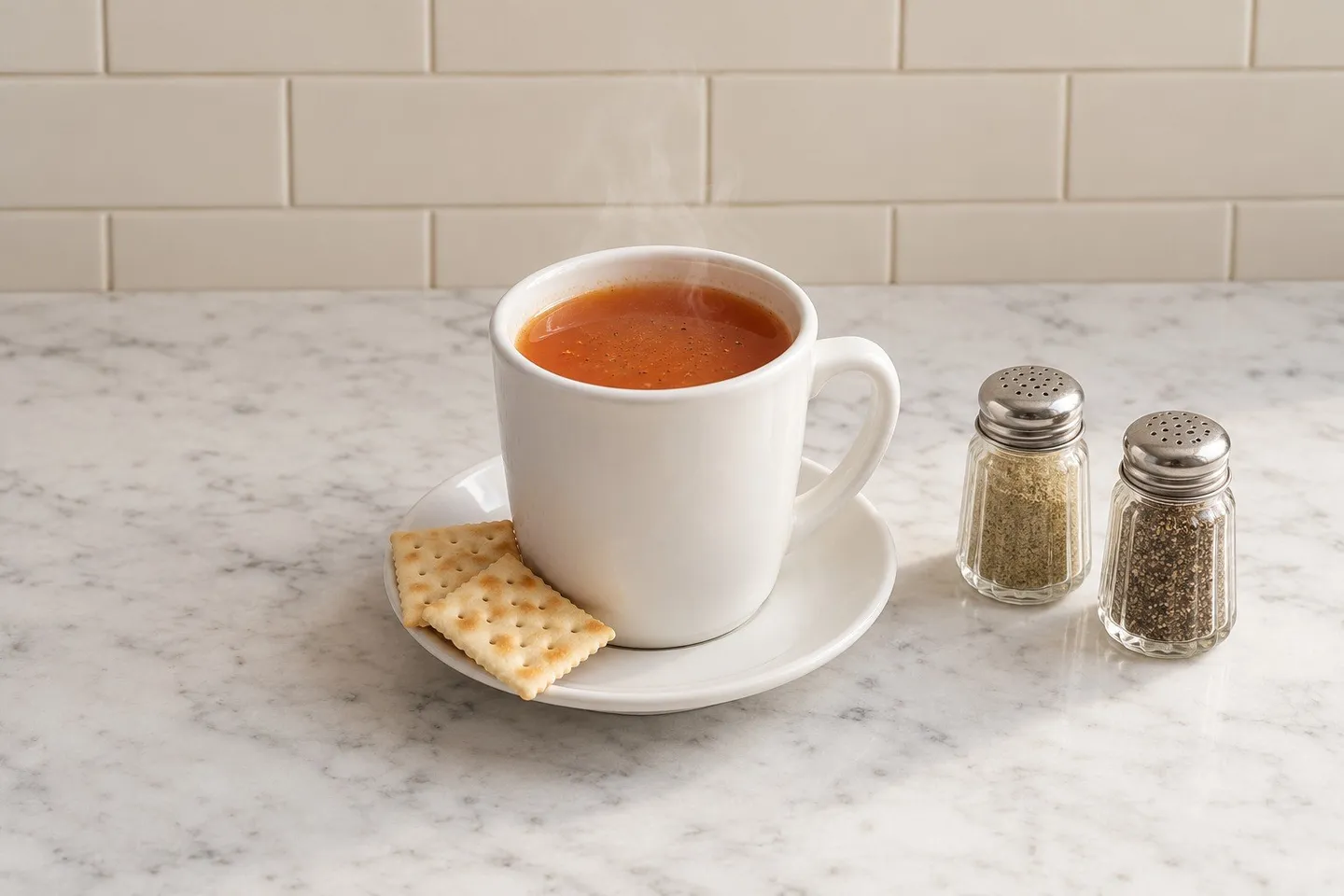
Hot Clam and Tomato Broth from 1919
Reader ratingsClam juice and tomato catsup stirred into a mug of boiling water and seasoned with salt, pepper and celery salt: the 1919 clam and tomato blend, a hot savory drink with no alcohol.
- Recipe makes
- 1 mug
- Prep
- Total
Hot clam and tomato broth in a white china mug, with soda crackers and salt and pepper shakers.
The story behind the recipe
This is a hot clam and tomato broth from Albert Hopkins’s Home Made Beverages of 1919: clam bouillon and tomato catsup in a mug of boiling water, seasoned “with salt, pepper and celery salt.” Hopkins calls it a “Blend,” and as he prints it there is no alcohol in it.
A lunch-counter mug
Fountains sold hot drinks all winter, drawing boiling water from an urn and flavoring it at the counter, and clam was one of the savory ones. Hopkins prints at least ten clam mixtures on one page, some made with milk, cream, butter, beef extract or ginger. This one is the plainest, close to a thin tomato soup with the sea in it. What Did Soda Fountains Sell in Winter? follows those mugs through the 1880s and 1890s.
Hopkins adds a dash of sherry to the same blend to make a clam punch, which is Clam Punch, Hot Clam and Tomato with Sherry from 1919. For another savory fountain mug, there is Hot Malted Milk with Salt and Pepper.
Read more about this recipe
Making it today
Bottled clam juice is weaker than the concentrated “extract clam bouillon” his other recipes name, which is why our mug takes two ounces of it. Salt it last and lightly: most bottled clam juice is salted already. Crackers on the side are the fountain way. Hopkins prints this mug first and the sherry only after it: “a dash of sherry wine in clam bouillon makes a very fine clam punch,” the Clam Punch beside this one. How a hot mug of clam and tomato fits the road to the Bloody Mary is in The Bloody Mary Before It Had a Name.
2.—Blend. Use 1 oz. clam bouillon, ½ oz. tomato catsup or bouillon; fill cup with boiling water; season with salt, pepper and celery salt.

Recipe makes: 1 mug
Ingredients
For 1 mug. Quantities are shown as written.
Quantities as written here, for 1 mug.
- Bottled clam juice2 fl oz
- Tomato ketchup1 tbsp
- Boiling water5 fl oz
- Salt1 pinch
- Black pepper1 pinch
- Celery salt1 pinch
- Soda crackers, to serve (optional)
Measurement notes
Ingredients as written here
- 2 fl oz bottled clam juice
- 1 tbsp tomato ketchup
- 5 fl oz boiling water
- 1 pinch salt
- 1 pinch black pepper
- 1 pinch celery salt
- Soda crackers, to serve (optional)
Equipment
 Kettle
 Mug, about 8 fl oz
Instructions
Put the bottled clam juice and tomato ketchup in the mug.
Fill it with the boiling water and stir until the ketchup dissolves.
Season with the salt, black pepper and celery salt and serve at once, with soda crackers on the side if you like.
Nutrition
25calories per serving
- Recipe makes
- 1 mug
Roughly estimated from USDA FoodData Central values for bottled clam juice and tomato ketchup.
Recipe notes
When adjusting quantities
One mug. Scale by whole mugs.
Notes
Quantities mentioned in these notes don’t change when you adjust the batch.
What we changed: bottled clam juice in place of clam bouillon, at double his one ounce, following his own No. 5 on the same page (2 oz of juice to 6 oz of water). Five fluid ounces of water stands in for “fill cup,” his half ounce of catsup becomes a tablespoon, and each seasoning is a pinch.
Hopkins warns that clam juice “spoils very readily and must be kept on ice”; keep an opened bottle in the fridge and use it within a few days, or as its label says.
Scaling changes the ingredients only; glassware, ice and timings need their own judgment. To adapt this recipe further, try the recipe tool at TuneMyRecipe (opens in a new tab), our sister site.
Sources and attribution
Albert A. Hopkins, Home Made Beverages (New York: Scientific American Publishing, 1919), “Hot Beverages: Clams”, No. 2, p. 119
Recipe details
- Drink
- Alcohol-free
- Drink family
- Hot Drinks
- Region
- American
- Source decade
- 1910s
- Base
- Spices
- Difficulty
- Easy
- Occasion
- Dry January
- Season
- Winter