Beef Tea with Sherry or Brandy from a 1900 Bar
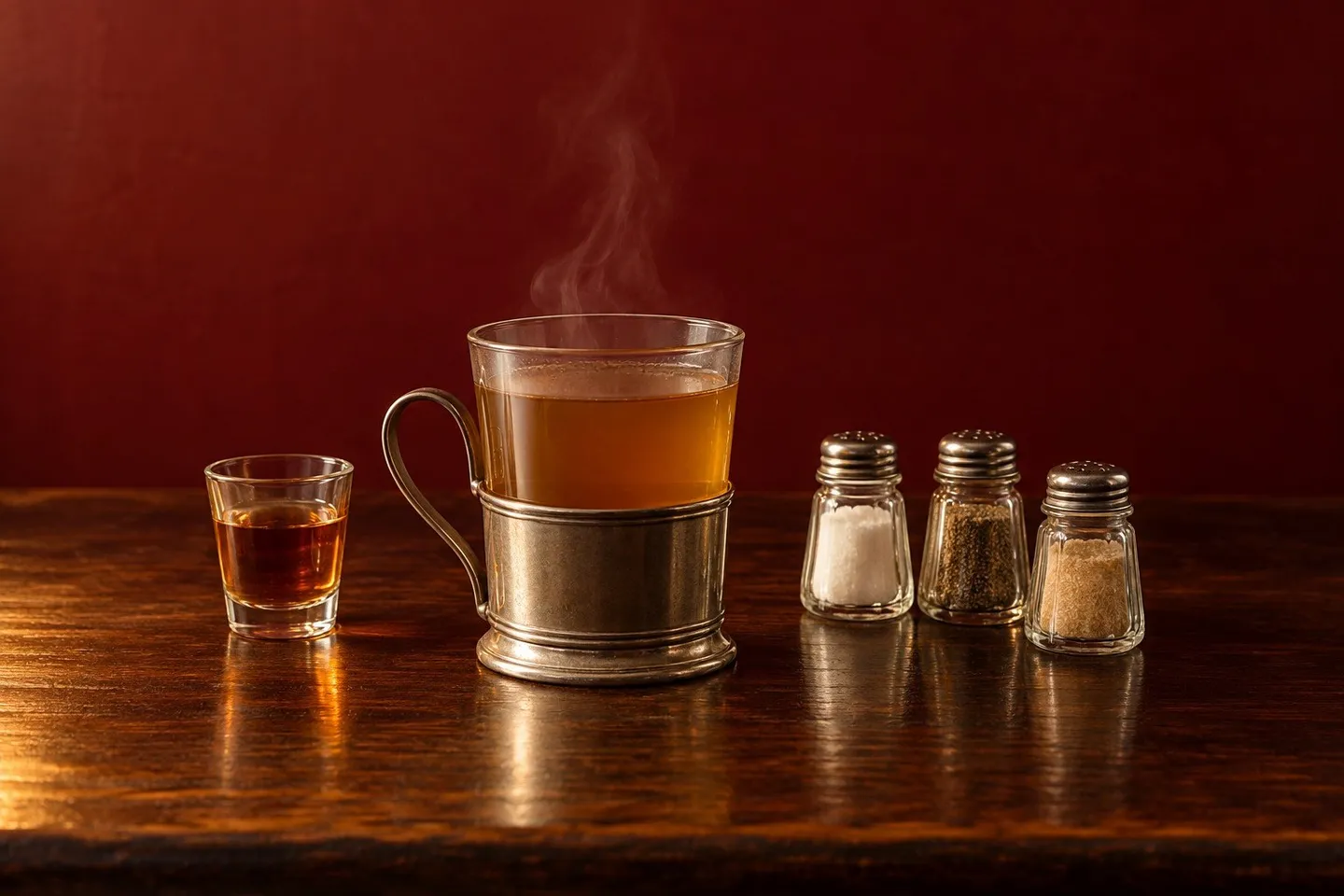
Reader ratingsBeef extract stirred into a glass of hot water, with salt, pepper and celery salt on the side and a little sherry or brandy if the customer asked: Harry Johnson’s 1900 bar beef tea.
- Recipe makes
- 1 glass
- Prep
- Total
Beef tea in a glass holder on a bar, with salt, pepper and celery salt shakers and a small glass of brandy.
The story behind the recipe
Beef tea was a bar drink in 1900 New York, and it could come with a shot in it. Harry Johnson’s New and Improved Illustrated Bartenders’ Manual gives it in one sentence: a quarter teaspoon of “the best beef extract,” a glass of hot water, stirred, and handed over with “pepper, salt and celery salt handy,” and “if the customer should require it, put in a small quantity of sherry wine or brandy, for which there should be an extra charge.”
The savory glass at the bar
Johnson’s “best beef extract” was a concentrate, like the Extract of Beef that Armour & Company sold for stirring into hot water. He served it across the bar with the seasonings set beside it, so the customer salted the glass, and the sherry or brandy, charged extra, made a stronger glass of it. A later drink, the Bullshot, put vodka into beef bouillon.
Johnson was one of the bartenders who wrote the trade down, with Jerry Thomas and others, as The Bartenders Who Wrote Down the Classic Cocktails tells. A cold sherried beef bouillon from a cookery booklet of 1905 is Iced Bouillon with Sherry from 1905.
Read more about this recipe
Making it today
Use a beef extract or a concentrated beef stock paste. Johnson’s quarter teaspoon makes a light glass; we use half a teaspoon, and many modern pastes need up to a teaspoon, so add more to taste. Leave out the sherry or brandy for his plain beef tea. Johnson’s “extra charge” for the shot is where The Bloody Mary Before It Had a Name begins, a run of savory glasses that ends with McIntyre’s gin and tomato juice of 1929.
BEEF TEA. (Use a hot water glass.)
¼ teaspoonful of the best beef extract; fill the glass with hot water; stir up well with a spoon, and hand this to the customer, place pepper, salt and celery salt handy, and if the customer should require it, put in a small quantity of sherry wine or brandy, for which there should be an extra charge.

Recipe makes: 1 glass
Ingredients
For 1 glass. Quantities are shown as written.
Quantities as written here, for 1 glass.
- Beef extract1/2 tsp
- Boiling water6 fl oz
- Salt1 pinch
- Black pepper1 pinch
- Celery salt1 pinch
- Dry sherry or brandy1/2 fl oz
Measurement notes
Ingredients as written here
- 1/2 tsp beef extract
- 6 fl oz boiling water
- 1 pinch salt
- 1 pinch black pepper
- 1 pinch celery salt
- 1/2 fl oz dry sherry or brandy
Equipment
 Kettle
 Heatproof cup or glass
Instructions
Put the beef extract in the heatproof glass and pour on the boiling water. Stir until the extract dissolves.
Season with the salt, black pepper and celery salt, or set them beside the glass, as Johnson did.
Stir in the dry sherry or brandy and serve hot.
Nutrition
30calories per serving
- Recipe makes
- 1 glass
Roughly estimated from USDA FoodData Central values for beef extract and dry sherry.
Recipe notes
When adjusting quantities
One glass. Scale by whole glasses.
Notes
Quantities mentioned in these notes don’t change when you adjust the batch.
Changes from the source: twice Johnson’s measure of beef extract, and half an ounce of sherry or brandy for his “small quantity.” The 6 fl oz of water is our size for his hot water glass, which he does not measure.
Strength: half an ounce of 15% dry sherry in about 6 1/2 fl oz is roughly 1% alcohol; with 40% brandy it is about 3%. It is low in alcohol, not free of it.
For a hot savory cup with no spirit in it, try the Hot Clam and Tomato Broth from 1919 instead: clam juice and tomato catsup in a mug of boiling water, with celery salt.
Scaling changes the ingredients only; glassware, ice and timings need their own judgment. To adapt this recipe further, try the recipe tool at TuneMyRecipe (opens in a new tab), our sister site.
Sources and attribution
Harry Johnson, New and Improved Illustrated Bartenders’ Manual (New York, 1900), “Beef Tea”, p. 193
Recipe details
- Drink
- DrinkLow-alcohol
- Drink family
- Hot Drinks
- Region
- American
- Source decade
- 1900s
- Difficulty
- Easy
- Season
- Winter