Buttered Beer, the Tudor Recipe of 1594
Reader ratingsHot beer thickened with egg yolks, sweetened, spiced with nutmeg, cloves and ginger and finished with sweet butter: buttered beer from a 1594 English cookbook.
- Recipe makes
- About 600 ml, 2 cups
- Prep
- Cook
- Total
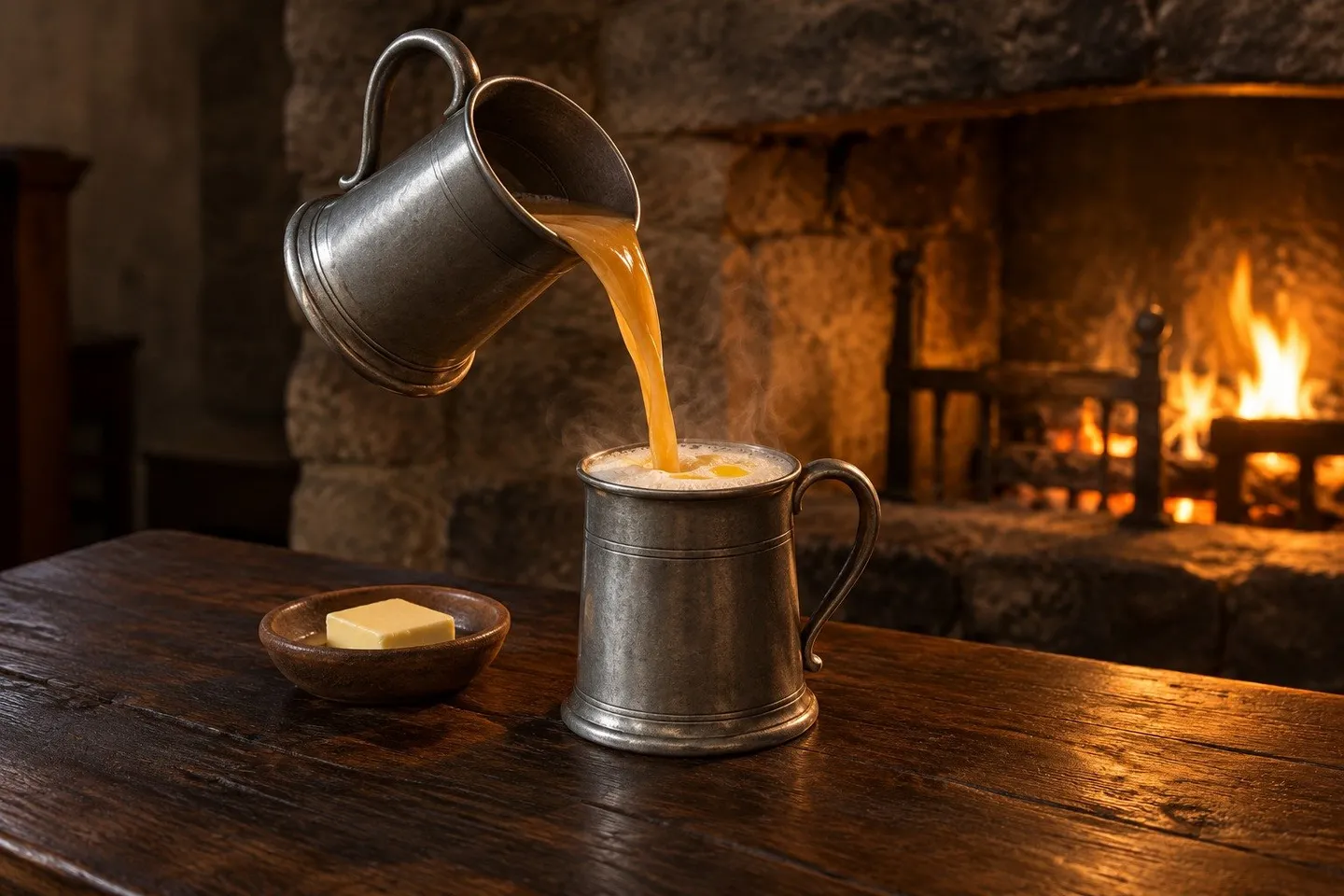
Buttered beer poured from one pewter pot to another, as the 1594 recipe directs.
The story behind the recipe
Buttered beer is hot beer thickened with egg yolks, sweetened with sugar, spiced with nutmeg, cloves and ginger, and finished with a lump of sweet butter. This version is from The Good Huswifes Handmaide for the Kitchin, a London cookbook of 1594 usually credited to Thomas Dawson, which mixes it by pouring it back and forth between two pewter pots. The name may be familiar from fiction; the real drink is four centuries older.
A drink for a lost voice
In Tudor England buttered beer was mostly a remedy. Andrew Boorde’s Breviary of Helthe (1547) told the hoarse to “drinke butterd ale or butterd beere” and keep warm for three or four days. The earliest full recipe we have found, in Thomas Cogan’s Haven of Health of 1584, is headed “good for a cough or shortnesse of winde,” with the yolks only an option: “Some put in the yolk of an egge or two toward the latter ende, and so they make it more strengthfull.”
Among its documented drinkers were schoolboys. In 1564 the boys of the Westminster grammar school played Plautus before Queen Elizabeth, and the bill for the performance includes “for butterd beere for ye children being horse xiid.” Twelve pence then was about £19 today, by UK consumer prices (Bank of England). Not every doctor approved: in 1633 the physician James Hart called “large draughts of buttered beere to bed-wards” an error that “rather furthereth and increaseth this cough or cold.”
Read more about this recipe
Our version
The 1594 recipe uses three pints of beer, about 1.7 liters in the beer measure of the time, to five yolks and half a pound of sugar. We make a third of it with two yolks, and cut the sugar to 50 grams, our choice; the full rate would be about 75. The “dish of sweet butter” has no weight, so 20 grams of unsalted butter is ours too. “Beere” by 1594 meant hopped beer, the change told in When Did English Beer Get Its Hops?, but choose a malty, gently hopped one; Robert May’s Accomplisht Cook later reprinted the recipe for “beer or ale.” The book takes it off the fire “when it is readie to boyle,” and so do we, at 71 to 75°C, safe for the yolks and short of a boil, as in our ale caudle. The sources say nothing about how it tasted. It comes out at about 4% ABV. No period version leaves out the beer; for a hot buttered drink without alcohol, make the alcohol-free hot buttered cider.
To make Buttered Beere. Take three pintes of Beere, put fiue yolkes of Egges to it, straine them together, and set it in a pewter pot to the fyre, and put to it halfe a pound of Sugar, one penniworth of Nutmegs beaten, one penniworth of Cloues beaten, and a halfepenniworth of Ginger beaten, and when it is all in, take another pewter pot and brewe them together, and set it to the fire againe, and when it is readie to boyle, take it from the fire, and put a dish of sweet butter into it, and brewe them together out of one pot into an other.

Recipe makes: About 600 ml, 2 cups
Ingredients
For About 600 ml, 2 cups. Quantities are shown as written.
Quantities as written here, for About 600 ml, 2 cups.
- Malty English beer, such as a mild or brown ale570 ml
- Large egg yolks2
- Sugar50 g
- Ground nutmeg1/4 metric tsp (5 ml per tsp)
- Ground cloves1 pinch
- Ground ginger1/4 metric tsp (5 ml per tsp)
- Unsalted butter20 g
Measurement notes
Ingredients as written here
- 570 ml malty English beer, such as a mild or brown ale
- 2 large egg yolks
- 50 g sugar
- 1/4 tsp ground nutmeg
- 1 pinch ground cloves
- 1/4 tsp ground ginger
- 20 g unsalted butter
Equipment
 Saucepan
 Whisk
 Fine sieve
 Instant-read thermometer
 Two heatproof jugs
Instructions
Whisk the egg yolks with a splash of the malty English beer until smooth, then whisk in the rest of the beer and pour it through the fine sieve into the saucepan.
Add the sugar, ground nutmeg, ground cloves and ground ginger.
Set the pan over low heat and stir constantly until the beer reaches 71 to 75°C on the thermometer and thickens very slightly, about 6 to 8 minutes. Never let it bubble; if it starts to steam hard, lift the pan off the heat and keep stirring.
Take the pan off the heat and stir in the unsalted butter until it melts.
Pour it into one of the warmed jugs, then pour it from jug to jug five or six times, from a little height, until it froths and the butter is mixed through. This is what the 1594 cook meant by “brewe them together.”
Pour into warmed cups and drink hot.
Nutrition
320calories per serving
- Recipe makes
- About 600 ml, 2 cups
- Servings
- 2
Estimated for one cup from USDA FoodData Central values for regular beer, raw egg yolk, granulated sugar and unsalted butter; the spices add almost nothing.
Recipe notes
Notes
Quantities mentioned in these notes don’t change when you adjust the batch.
The 1594 spices are given in money, not weight: a pennyworth each of nutmeg and cloves and a halfpennyworth of ginger. A pennyworth of nutmeg was about £1.15 today, so the amounts here are our estimate; add more nutmeg if you like.
Use the freshest eggs you can, or pasteurized yolks. Make it just before drinking, and don’t reheat it once the yolks are in.
If it starts to curdle, take it off the heat at once and whisk hard, then strain it.
Scaling changes the ingredients only; glassware, ice and timings need their own judgment. To adapt this recipe further, try the recipe tool at TuneMyRecipe (opens in a new tab), our sister site.
Sources and attribution
The Good Huswifes Handmaide for the Kitchin (London, 1594), usually credited to Thomas Dawson, “To make Buttered Beere”, p. 51
See the original pages (scan at Internet Archive) (opens in a new tab)
Recipe details
- Drink family
- Hot Drinks
- Region
- British
- Base
- Beer & aleSpices
- Difficulty
- Intermediate
- Season
- Winter