Aranciata Torinese, Orange Soda with a Splash of Anisette, 1936
Reader ratingsOrange juice, a spoon of sugar and soda water with a tenth part anisette, stirred in a balloon glass over one piece of ice: an Italian thirst-quencher of 1936, light on alcohol.
- Recipe makes
- 1 drink, about 8 fl oz
- Prep
- Total
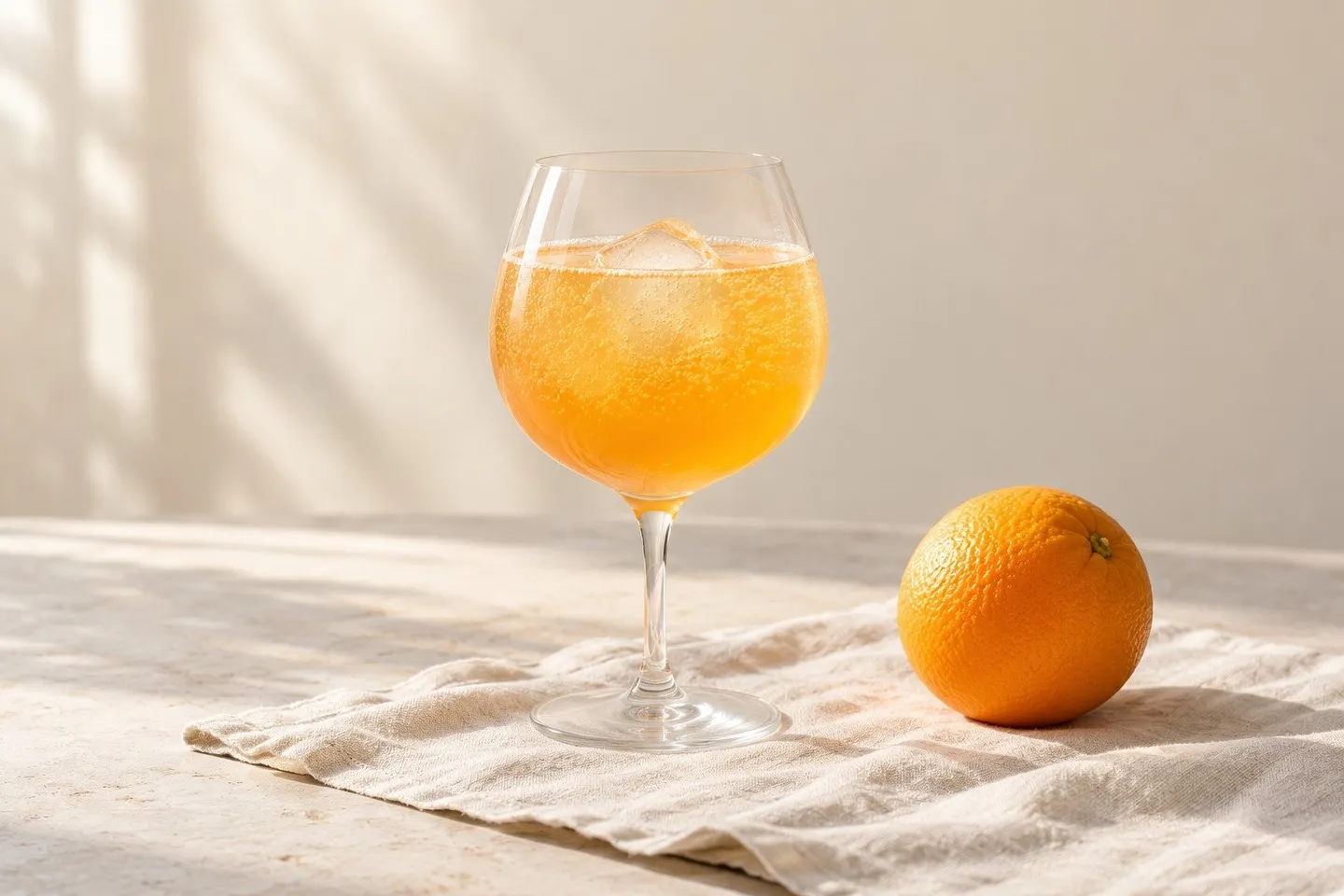
Aranciata torinese in a stemmed balloon glass with one ice cube, beside a whole orange.
The story behind the recipe
Aranciata torinese, orangeade the Turin way, is a long glass of orange juice and soda water sweetened with a spoon of sugar and lifted with a tenth part anisette, stirred over one piece of ice in a stemmed balloon glass. Elvezio Grassi, of the Bar Argentino in Lugano, printed it in 1936 in 1000 misture and filed it as “Dissetante,” a thirst-quencher. With the anisette it comes to about 2.5% alcohol.
A royal blurb
Grassi’s front pages are full of praise for his bar, all printed by Grassi himself, and one line is about this drink: “S. M. La Regina Madre è entusiasta della sua aranciata alla torinese,” Her Majesty the Queen Mother is enthusiastic about his aranciata alla torinese. The testimonial is undated and doesn’t say which queen, so it is the author’s advertising, not a royal record. Still, the drink he chose to boast about is nearly a soft drink.
Read more about this recipe
With and without
On the same page Grassi prints a thirst-quencher with no alcohol at all, Bianco e Nero, of almond and tamarind syrups and soda water. Both belong to the long tradition of drinks mixed for the guest who wanted something light, told in What Did Bartenders Mix for Non-Drinkers in the 1920s? For an orange drink with no anise and no alcohol, there is Fresh Orangeade.
Aranciata torinese (Dissetante). Si versa in un ballon: 10% Anisette. 30% Succo d’arancia. 1 Cucchiaio zucchero. 60% Seltz. 1 Pezzetto di ghiaccio. Mescolate bene e servite.
Our translation: Pour into a balloon glass: 10% anisette, 30% orange juice, 1 spoon of sugar, 60% soda water, 1 small piece of ice. Stir well and serve.

Recipe makes: 1 drink, about 8 fl oz
Ingredients
For 1 drink, about 8 fl oz. Quantities are shown as written.
Quantities as written here, for 1 drink, about 8 fl oz.
- Anisette3/4 fl oz
- Fresh orange juice2 1/2 fl oz
- Sugar1 tbsp
- Soda water, chilled5 fl oz
- Ice cube1
Measurement notes
Ingredients as written here
- 3/4 fl oz anisette
- 2 1/2 fl oz fresh orange juice
- 1 tbsp sugar
- 5 fl oz soda water, chilled
- 1 ice cube
Equipment
 Stemmed balloon glass, about 10 fl oz
 Bar spoon
Instructions
Put the sugar in a stemmed balloon glass, pour in the fresh orange juice and stir until the sugar dissolves.
Add the anisette and the ice cube.
Pour in the chilled soda water, stir well with a bar spoon and serve at once.
Nutrition
140calories per serving
- Recipe makes
- 1 drink, about 8 fl oz
Estimated from USDA FoodData Central values for orange juice and sugar and typical label values for anisette, for one drink.
Recipe notes
When adjusting quantities
This is one glass. Build each glass separately.
Notes
Quantities mentioned in these notes don’t change when you adjust the batch.
Grassi’s “ballon” is a stemmed, bomb-shaped glass of 220 to 250 grams, so the shares here add up to about 8 fl oz. His “cucchiaio” is read as a tablespoon. Anisette is a sweet anise liqueur of about 25% ABV; leave it out and the drink is a plain orangeade with no alcohol.
Leave out the anisette and you are close to a fountain drink of 1894: the Orange Phosphate, blood orange and raspberry syrup stirred into soda water.
Scaling changes the ingredients only; glassware, ice and timings need their own judgment. To adapt this recipe further, try the recipe tool at TuneMyRecipe (opens in a new tab), our sister site.
Sources and attribution
Elvezio Grassi, 1000 misture (Bologna: Licinio Cappelli, 1936), p. 147, “Aranciata torinese (Dissetante)”; translation ours
Recipe details
- Drink
- DrinkLow-alcohol
- Drink family
- Cocktails & Mixed Drinks
- Region
- Italian
- Source decade
- 1930s
- Base
- Fruit & juice
- Difficulty
- Easy
- Occasion
- Summer party
- Season
- Summer