Absinthe Frappé, Shaken until the Shaker Frosts
Reader ratingsA pony of absinthe and a pony of water with a dash of anisette, shaken with fine ice until the shaker frosts, strained and topped with seltzer: the absinthe frappé of 1895.
- Recipe makes
- 1 small drink
- Prep
- Total
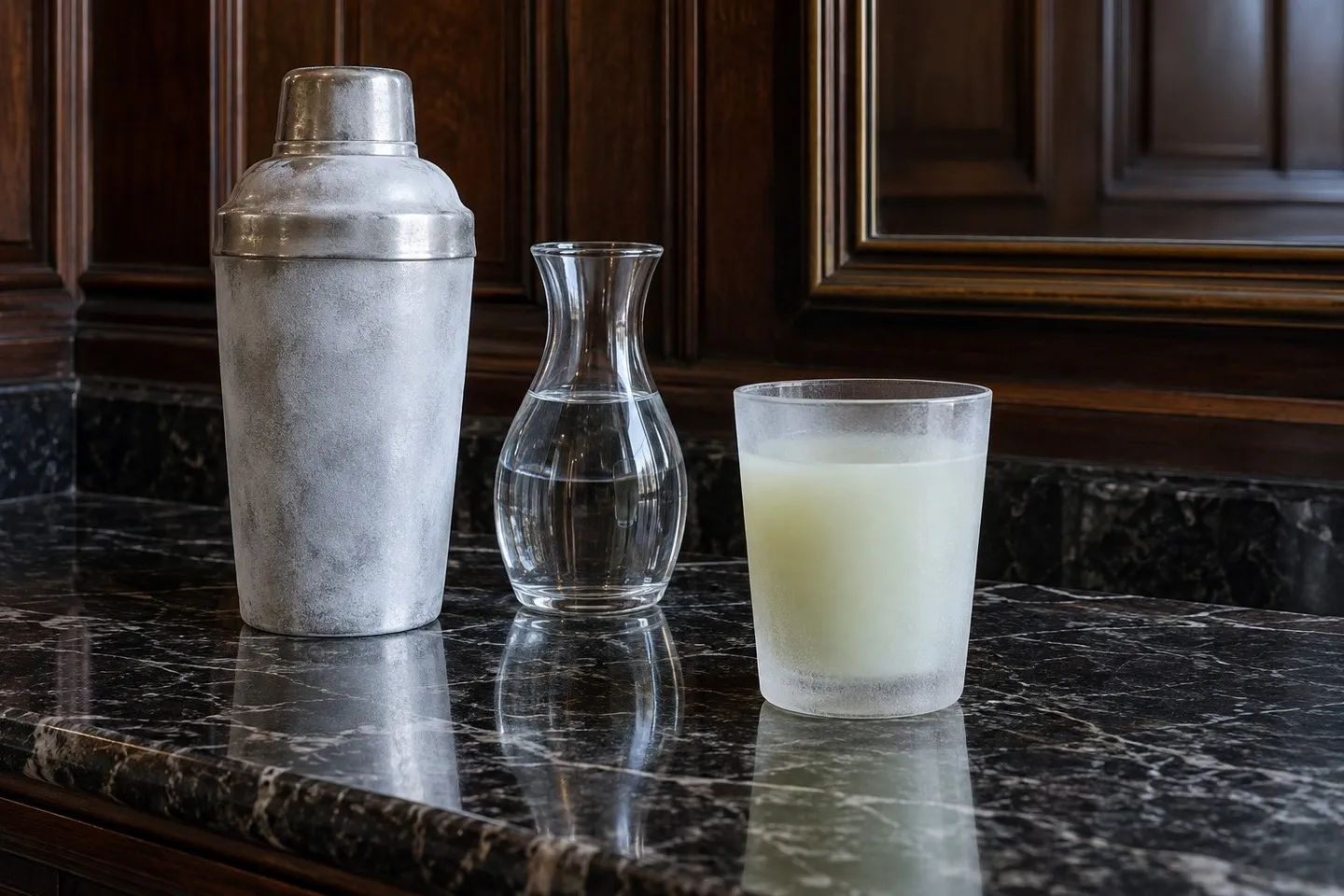
An absinthe frappé, cloudy pale jade-white, in a frosted glass beside a frosted tin shaker and a water carafe.
The story behind the recipe
An absinthe frappé is absinthe and an equal measure of water, with a drop of anisette, chilled so hard on fine ice that the shaker frosts, and finished with a squirt of seltzer. It reached print as a bartender’s grumble a decade before anyone printed a recipe.
Chicago, 1885
The National Police Gazette of July 4, 1885, quotes “a ‘fancy’ bartender at a leading Chicago house” on customers who think they have found a new drink. “The other day,” he said, “a French-looking fellow asked me for an absinthe frappe, which is simply frozen absinthe tipped with brandy, but which he evidently thought was some difficult compound. The ordinary drink costs twenty-five cents, but I charged him a half-dollar just to keep him from being disappointed.” That is about $9 and $18 in today’s money, by US consumer prices.
New Orleans tells its own story, crediting Cayetano Ferrer at the bar later called the Old Absinthe House with the first frappé in 1874. That is a tradition; the printed record starts in Chicago, eleven years later. The recipes came in 1895, two of them, in George Kappeler’s Modern American Drinks (New York), and none older has turned up. Kappeler’s book opens with a caution: “The free use of absinthe is injurious. Never serve it in any kind of drink unless called for by the customer.” In 1912 the United States banned absinthe, and US-labeled absinthe returned only in 2007.
Read more about this recipe
Measures by the pony
Kappeler defines his own measures: a jigger “holds two ounces. A pony holds half a jigger.” So the drink is 1 fl oz absinthe to 1 fl oz water. Absinthe strengths vary widely, so the label decides the result: shaken and topped up, a 45% bottle gives a frappé of about 12% ABV and a 74% bottle about 20%. The anisette adds a little sweetness; the California Style Absinthe on page 19 of Kappeler’s own book has none.
Buy absinthe from a licensed seller. In the US it must be “thujone-free,” under 10 parts per million, by TTB rules, and the EU caps thujone at 35 mg per kilo in drinks made with wormwood. Never make a wormwood extract at home.
Wormwood went into wine long before absinthe, as the Roman Absinthium, which its translator called Roman vermouth. The frappé’s place among the bar books of the 1880s and 1890s is in The Bartenders Who Wrote Down the Classic Cocktails.
1 wine glass of absinthe; 2 or 3 dashes of anisette; Fill glass with finely shaved ice; Shake up long enough, until the outside of the shaker is thoroughly covered with ice; strain into fancy bar glass; fill up glass with ice-cold syphon vichy water and serve.

Recipe makes: 1 small drink
Ingredients
For 1 small drink. Quantities are shown as written.
Quantities as written here, for 1 small drink.
- Absinthe1 fl oz
- Cold water1 fl oz
- Anisette1/4 tsp
- Chilled soda water1 fl oz
- Crushed ice1 cup
Measurement notes
Ingredients as written here
- 1 fl oz absinthe
- 1 fl oz cold water
- 1/4 tsp anisette
- 1 fl oz chilled soda water
- 1 cup crushed ice
Equipment
 Cocktail shaker
 Strainer
 Small cocktail glass
Instructions
Chill a small cocktail glass or other thin glass in the freezer.
Pour the absinthe, cold water and anisette into a cocktail shaker and add the crushed ice, filling it about half full.
Shake hard for about 20 seconds, until frost forms on the outside of the shaker.
Strain into the chilled glass, add the chilled soda water and serve at once.
Nutrition
115calories per serving
- Recipe makes
- 1 small drink
Estimated for a 68% ABV absinthe, counting alcohol at 7 calories per gram, plus the anisette; a 45% absinthe gives about 75.
Recipe notes
When adjusting quantities
Keep absinthe and water equal; shake one or two drinks at a time so each gets cold enough to frost the shaker.
Notes
Quantities mentioned in these notes don’t change when you adjust the batch.
The period text on this page is Harry Johnson’s 1900 frappé, with a whole wine glass of absinthe, about 2 fl oz, no water before the shake and vichy water to fill. The card follows Kappeler’s 1895 No. 2, a pony each of absinthe and water, which makes a lighter drink. No anisette? Use 1/2 tsp simple syrup, or leave it out for the dry California style. Kappeler’s No. 1 makes the same drink by pouring it back and forth between two mixing glasses full of fine ice until very cold, an old way of chilling without a shaker. Serving it over a glass of crushed ice is a later New Orleans habit.
For an alcohol-free frappé, steep 2 tsp aniseed and 1 tsp fennel seeds, lightly crushed, in 1/2 cup just-boiled water for 20 minutes, strain, and stir in 1/2 cup sugar; this keeps a week in the fridge. Shake 4 tsp of the syrup with 2 tbsp plus 2 tsp cold water and crushed ice until the shaker frosts, strain, and top with 2 tbsp soda water. This is a modern version. Avoid anise extracts, which are often made with alcohol.
Scaling changes the ingredients only; glassware, ice and timings need their own judgment. To adapt this recipe further, try the recipe tool at TuneMyRecipe (opens in a new tab), our sister site.
Sources and attribution
George J. Kappeler, Modern American Drinks (New York: Merriam Co., 1895), p. 64, Absinthe Frappé No. 2; earliest mention in the National Police Gazette (New York), July 4, 1885, p. 14; Original from Harry Johnson, New and Improved Illustrated Bartenders’ Manual (New York, 1900), p. 245
Recipe details
- Drink family
- Cocktails & Mixed Drinks
- Region
- American
- Era
- 19th century
- Source decade
- 1890s
- Base
- Herbs & flowers
- Difficulty
- Easy