A Million Bottles at the Crystal Palace
Tea, coffee, chocolate and Schweppe’s bottled soda water, lemonade and ginger beer, under a rule that banned wine, spirits and beer. Mostly.
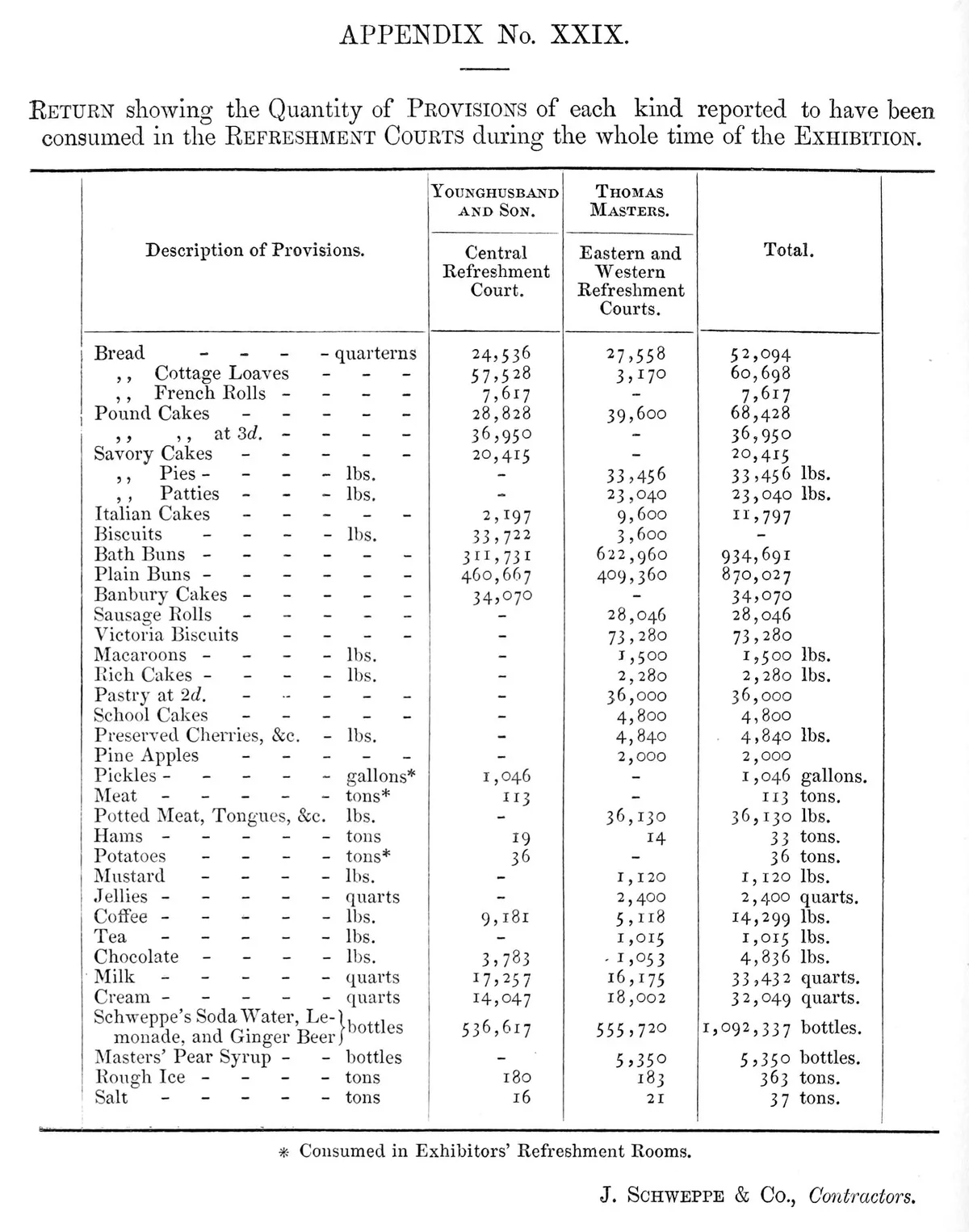
Visitors to the Great Exhibition of 1851 drank tea, coffee, chocolate and cocoa, and cold soda water, lemonade and ginger beer, because the Commissioners who ran it allowed nothing stronger in the refreshment courts. Schweppe and Co. held the catering contract, and its sub-contractors reported more than a million bottles of soda water, lemonade and ginger beer sold between them. But the event was not quite dry. The official report also notes visitors topping up their free water with “that which was forbidden.”
The Exhibition opened in its glass building in Hyde Park on May 1 and closed to the public on October 11, 1851, with three more days for exhibitors and their friends. The figures below come from the Commissioners’ First Report, published in 1852 and bound into the fourth volume of the Official Descriptive and Illustrated Catalogue.
Light and moderate refreshments
The Commissioners wanted visitors fed and watered without turning their exhibition into a public house. Their regulations said so in plain terms:
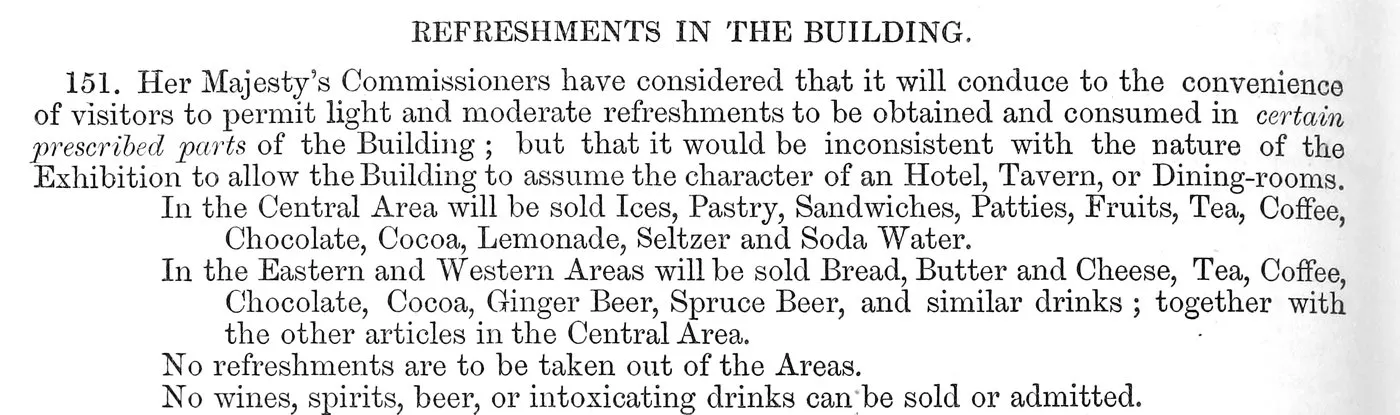 Regulation 151, First Report of the Commissioners for the Exhibition of 1851 (London, 1852), Appendix II, p. 28. Wellcome Collection, public domain.
The central court would sell ices, pastry, sandwiches, fruit, tea, coffee, chocolate, cocoa, lemonade, seltzer and soda water. The eastern and western courts added bread, butter and cheese, ginger beer, spruce beer “and similar drinks.” And the last line of the rule: “No wines, spirits, beer, or intoxicating drinks can be sold or admitted.”
Ginger beer and spruce beer on the same list as that ban show the rule sorted drinks by kind; it measured nothing. Depending on how they were made, both could hold a little alcohol, as What Were Victorian Non-Alcoholic Beers? explains; we don’t know how the Exhibition’s were made.
Schweppe’s contract
“The contract for the supply of refreshments in the Exhibition Building was undertaken by Messrs. Schweppe and Co., who paid the sum of £5,500 for the privilege, being the highest offer from responsible parties,” the report says. That is about £665,000 in 2025 money, by UK consumer prices (Bank of England). It was a fee for the right to trade, not Schweppe’s takings and not its profit. Some later accounts give the figure as £5,000; the report says £5,500.
Schweppe was the general contractor and did not run the courts itself. Younghusband and Son had the central court, and Thomas Masters the eastern and western ones. Their gross receipts for the whole run came to £75,557 15s, about £9.1 million today on the same basis.
What a million bottles means
The contractors’ return is the famous source, and it has to be read carefully. In one line it gives “Schweppe’s Soda Water, Lemonade, and Ginger Beer”: 536,617 bottles in the central court and 555,720 in the other two, 1,092,337 in all.
That is one total for three drinks. The return does not split it by flavor, give the size of a bottle, or say how many people drank them. It cannot tell us how many bottles of lemonade were sold, only that soda water, lemonade and ginger beer together ran past a million. Masters also sold 5,350 bottles of his own pear syrup, counted separately.
The hot drinks are counted the other way, by the dry pound: 14,299 pounds of coffee, 4,836 pounds of chocolate and 1,015 pounds of tea, all of it recorded in Masters’s courts. There were 33,432 quarts of milk as well, though the return doesn’t say how much went into cups and how much into everything else. The 113 tons of meat and 36 tons of potatoes on the same page carry a footnote: they were eaten in the exhibitors’ refreshment rooms, not by the public.
The Commissioners counted just over six million paid admissions. Divide the public takings by them and the average comes to about threepence an admission, about £1.50 today. That average includes everyone who bought nothing, so it is not the price of a drink. We have found no price list from the courts themselves.
Water from the fountain
Not everyone bought a drink. The building had a plentiful supply of filtered water, and visitors drank it from fountains and taps. The engineer who reported on fire security, Captain C. J. Gibb of the Royal Engineers, mentioned it in passing, and in doing so let slip something the rule couldn’t stop:
 C. J. Gibb, report dated January 28, 1852, First Report of the Commissioners for the Exhibition of 1851, Appendix XXVI, p. 131. Wellcome Collection, public domain.
“The abundant supply of filtered water was of great advantage to all connected with the Exhibition, but especially to the poorer class of visitors from the country, who came up bringing their dinner with them; a glass of water from the nearest fountain or water-tap (sometimes mixed with that which was forbidden in the Refreshment Courts), forming an indispensable auxiliary to their comfort during their long summer day’s pleasure.”
Gibb doesn’t say what went into the water, or how often. Since the courts forbade wine, spirits and beer, a flask of something strong is the natural reading, but it is a reading: the report names no drink and counts nothing. What it does show is a second way through the day, beside the courts, of packed dinners and free water.
Schweppe’s success is often told as a temperance triumph, the alcohol ban selling a million soft drinks. The report doesn’t make that argument. It has no comparison with an exhibition that sold beer, and nothing to separate the ban from the summer heat, the crowds and the lack of anyone else to buy from.
Lemonade to make today
No recipe for Schweppe’s bottled drinks survives in the report. The closest home lemonade in date is Mrs. Beeton’s Lemonade, Made with Boiling Water, from her book of 1861. Alexis Soyer printed a cheap lemonade for soldiers a few years later: Soyer’s Cheap Crimean Lemonade from 1857. For a ginger beer with no alcohol at all, Alcohol-Free Ginger Beer, the Fountain Way builds it from syrup and soda water. The longer story of lemonade is in A Short History of Lemonade.
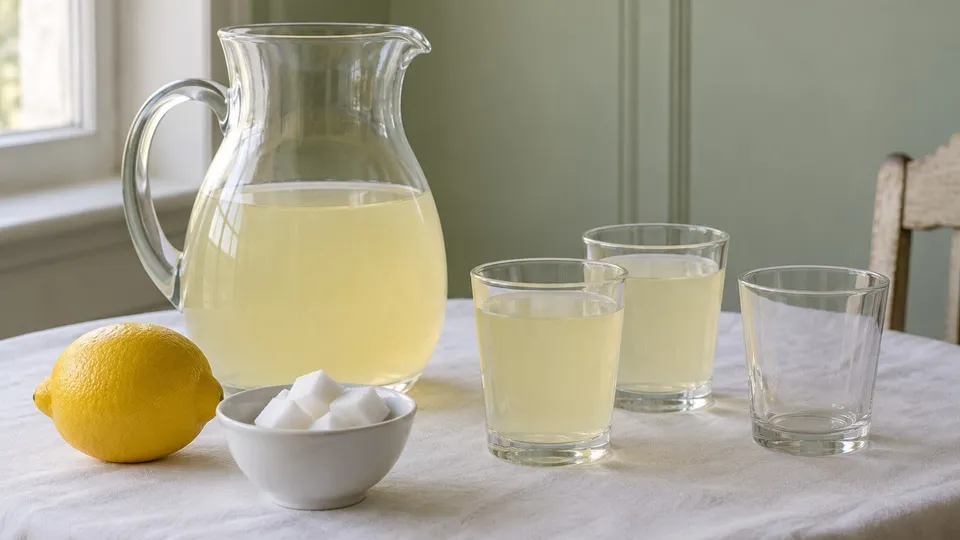 Always alcohol-freeMrs. Beeton’s Lemonade, Made with Boiling Water
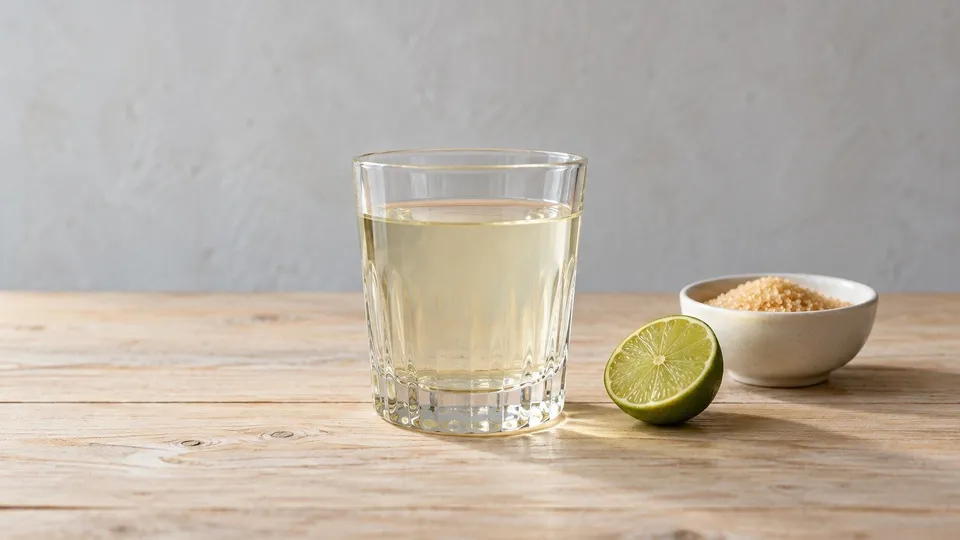 Always alcohol-freeSoyer’s Cheap Crimean Lemonade, Lime Juice, Sugar and Water from 1857
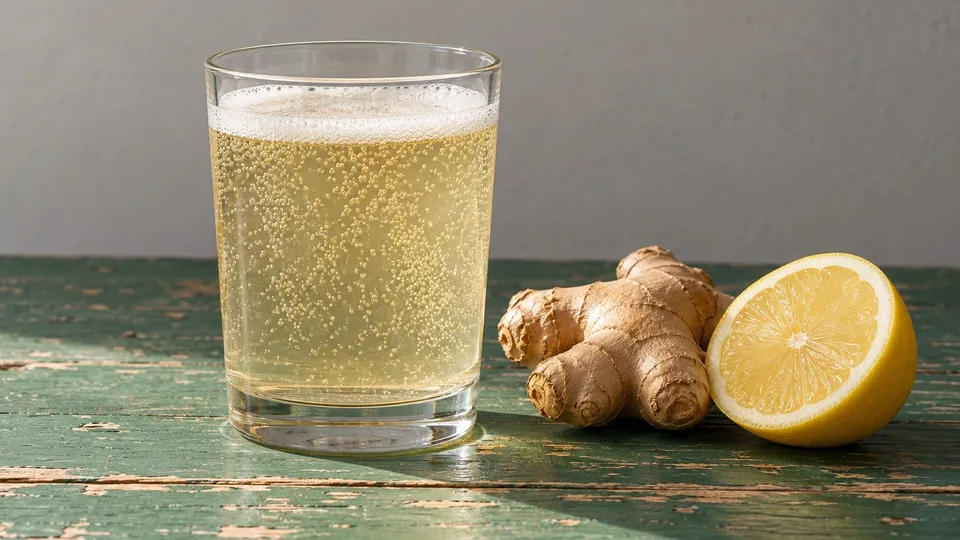 Alcohol-free versionAlcohol-Free Ginger Beer, the Fountain Way
For what was on the plate, our sister site The Forgotten Menu has the 1853 dinner inside the Crystal Palace dinosaur (opens in a new tab).
Sources
- First Report of the Commissioners for the Exhibition of 1851 (London: W. Clowes and Sons, 1852), bound in Official Descriptive and Illustrated Catalogue, vol. 4: p. l (contract); Appendix II, regulation 151, p. 28; Appendix XXVI, p. 131 (Gibb); Appendix XXVIII, pp. 147–149 (contractors, receipts, admissions); Appendix XXIX, p. 150 (return). Wellcome Collection b21495361, public domain.
- Bank of England, Inflation calculator, 1851 to 2025 annual averages, checked October 31, 2026.