- Wine
- History
The Wine Labels That Outlived Tutankhamun’s Wine
Tutankhamun’s wine jars name the year, the estate and the chief vintner. The chemistry found grape traces too, but it can’t say red or white, or what he liked.
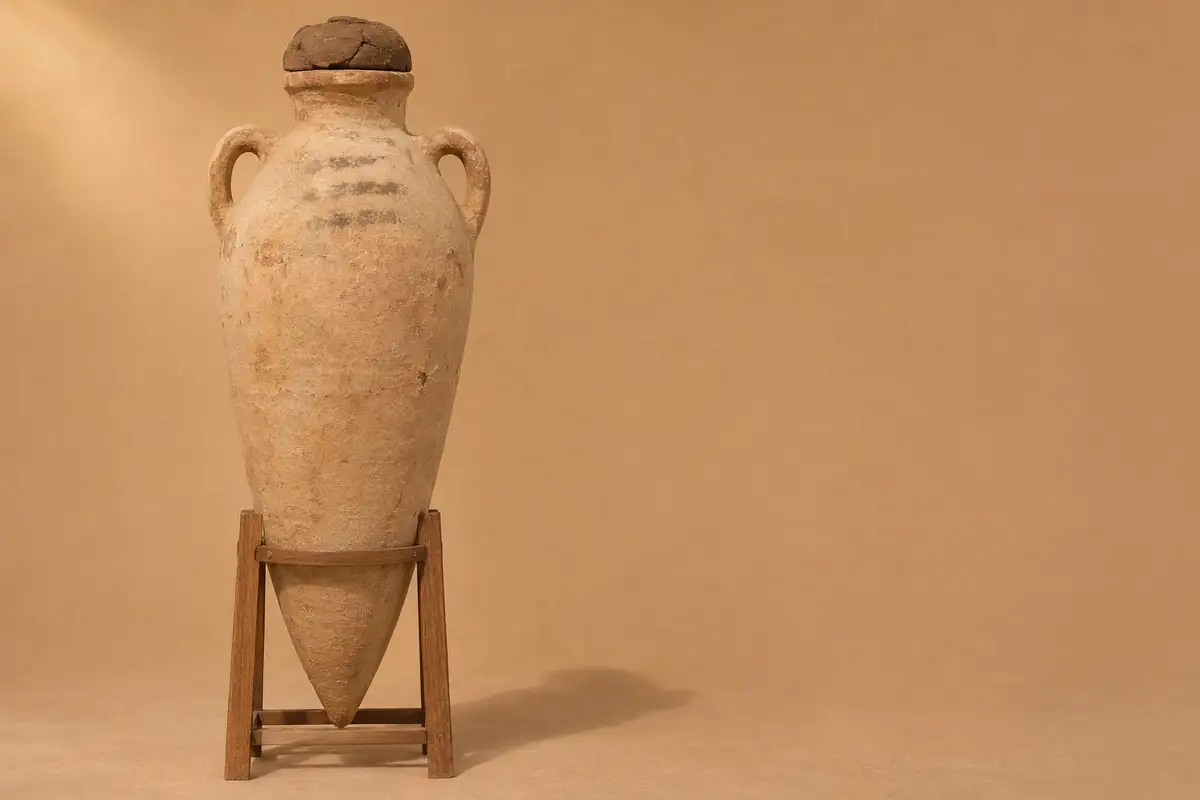
The wine in Tutankhamun’s tomb is long gone, but the labels on its jars survive, and they say more than the residue inside. Written in ink on the jars, they give a year of the king’s reign, the estate the wine came from, the region and the name of the chief vintner who answered for it. Eighty years later, chemists scraped the dried deposits from some of the same jars and found acids that point to grapes. What neither the labels nor the laboratory can tell us is the color of every wine, how strong it was, or whether the king liked it.
Wine is poured in Theban tomb paintings of the same dynasty, and one cup and its toast are in Take, Drink: A Cup of Wine in an Egyptian Tomb. This story stays with the jars of one burial and what each kind of evidence can carry.
Year 5, from the Western River
Howard Carter, who excavated the tomb, printed one label in the second volume of The Tomb of Tut·ankh·Amen in 1927. Against the east wall of the burial chamber, beside two rush baskets “collapsed with age,” stood “a wine-jar bearing the legend: ‘Year 5, wine of the house of (?) Tut·ankh·Amen, from the Western river Chief of the Vintners, Kha.’”
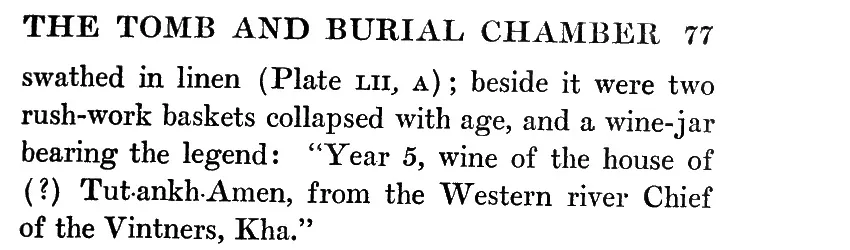
Carter’s English rendering of the Year 5 jar label, from Howard Carter, The Tomb of Tut·ankh·Amen, volume II (New York: George H. Doran, 1927), p. 77. A scan of the printed page.
Read it as a set of fields. “Year 5” is a year of a king’s reign, not a calendar date and not an age. “The house of” names an estate. “The Western river” is a region. “Chief of the Vintners, Kha” names the man responsible. Carter’s question mark is his own: he wasn’t sure of the reading, and the translations made since do not all agree. His expedition’s note card for the same jar renders the estate as belonging to Amen with a gap after it, and the chemist Maria Rosa Guasch-Jané’s 2005 thesis gives a fuller estate of Tutankhamun, Ruler of Southern Heliopolis, and the vintner as Khaa. We follow Carter’s printed wording and keep the disagreement in view.
Other jars carry other words. The card for a jar against the south wall gives, in English, a Year 5 wine called twice excellent and the word šdh, shedeh, a drink whose ingredients are still argued over. A jar on the west wall gives Year 9, or possibly 20, with an estate of the Aten. These are what the labels record: when, where, how good and who answered for it. None of them is a tasting note.
Broken seals
The burial chamber is often called intact. Carter’s own account is more careful. “A brief examination of the shrine and the objects surrounding it,” he wrote, “showed that little damage had been done in this chamber by the predatory intruders, except that the folding doors of the great shrine had been opened for the purpose of peering in, and that the sealings of the wine-jars, placed between the shrine and the walls of the chamber, had been broken.”
So the jars the chemists later sampled had been opened in antiquity. Guasch-Jané’s thesis says the same of the eight Tutankhamun jars she studied: their upper closures were broken or missing when they were found.
In his third volume, on the annexe and treasury, Carter described about three dozen pottery wine jars, with ink labels and mud seals stamped with the device of their estate, and about a dozen more of a foreign, Syrian shape that had no label but carried similar seals. He took those seals as a sign of Egyptian wine in imported jars, which was his reading, not a test. He also proposed how the wine was made: a first fermentation before it went into the jar, a second in the jar, a small vent and then the seal. His own words, “apparently” and “in all probability,” mark that as his explanation, not something he saw.
The excavation already did some chemistry. In a note on wine printed in the same volume, Lucas reported tartrate, the crust wine leaves behind, in the solid deposit at the bottom of one pottery wine jar, though he doesn’t say which jar.
Three jars around the shrine
Carter numbered every object, and his final plan of the burial chamber puts the three labeled jars on different sides of the great shrine: number 180 against the east wall, 195 against the west and 206 against the south. Each has two record cards at the Griffith Institute in Oxford, an object card and a card of language notes, and the second card of each carries a Cairo museum number written in the corner.
Here the record needs care. The numbers on Carter’s cards match the ones the chemists used: 62316 for jar 180, 62314 for 195 and 62315 for the shedeh jar, 206. The Institute’s web pages, old and new, swap the last two. Nobody has explained the difference, and we don’t guess. We follow the cards and the laboratory and note that the web pages disagree.
What the laboratory found
Guasch-Jané’s doctoral thesis, El vi a l’antic Egipte, submitted at the University of Barcelona in 2005, tested scrapings and dry deposits from eight Tutankhamun jars in the Egyptian Museum in Cairo. Her method was liquid chromatography with tandem mass spectrometry, which identifies a molecule by how it behaves in the column and how it breaks apart. It is very sensitive, and she used it to say what was present, not how much: the contents had changed over the centuries.
Two molecules carried the argument. Tartaric acid is the classic marker for grapes, and she reported it in all seven jars of the ordinary wine group. Syringic acid can be released from the pigment of red grapes, so she treated each sample with alkali to break that pigment down and looked again. Two wine jars, one of them the west-wall jar 195, gave syringic acid only after that treatment, and she read them as red wine. Five gave tartaric acid with no syringic acid, and she read them as white. Her modern controls behaved the same way: a red Cabernet Sauvignon gave more syringic acid after the treatment, a white Xarel·lo didn’t.
The shedeh jar, 206, gave both tartaric acid and syringic acid after treatment. That led her to argue that shedeh was made from red grapes and differed from ordinary wine in how it was prepared, against an older reading of shedeh as a pomegranate drink. She also suggested that red wine to the west and white to the east might mean something for the king’s rebirth.
What the chemistry can’t settle
In 2020 a team led by Léa Drieu asked, in the journal STAR, whether ancient wine can be identified from molecules at all. They called the spectrometry approach highly reliable for detecting tartaric acid, the best option available at the time. Their questions were about everything around it.
First, getting the acid out. In their trials, the alkaline extraction recovered less than 0.1 percent of a pure tartaric acid standard, while an acidic method recovered 77 percent. That was a test on a standard, not on Tutankhamun’s jars, and it doesn’t make anyone’s results false. It does mean a sensitive instrument can’t make up for an extraction that leaves most of a molecule behind.
Second, grapes aren’t the only source. Tartaric acid is high in some pomegranates and in tamarind, and the team found it in hunter-gatherer pottery in Russia, where plant remains pointed to another fruit. Syringic acid can come from lignin, the stuff of wood and plant stems, as well as from grape pigment.
Third, and this is the one that matters most here, the two markers survive in different ways. Finding tartaric acid without syringic acid doesn’t show that the original wine had no red grapes in it, so the white-wine reading fails on that basis. And neither acid proves fermentation: tartaric acid is in fresh juice, and red pigment comes out of grape skins before any yeast gets to work.
Weighed together: the jars held wine, which their labels and their setting show as much as any molecule. Red grapes in some of them is a serious reading. White wine in the other five is not established. Shedeh as a red-grape drink is a strong argument for that one jar; shedeh as pomegranate isn’t proved either, and weakening one fruit doesn’t prove the other. The red-west, white-east idea needs all three things to hold, the jar’s identity, its place and its color, and the color is the part that can’t carry it.
What the labels still tell us
None of this touches the labels. A year, an estate, a region and a named chief vintner show wine being made and recorded under someone’s responsibility, the seal shows it being closed, and its place beside the shrine shows it being chosen for the burial. Those layers hold up even where the chemistry stops.
They don’t show the king’s taste. Wine for a royal burial could be chosen by suppliers and the people who furnished the tomb, for ritual and rank as much as for anyone’s liking, and a dried deposit isn’t a drinking record. No strength, sugar level or recipe survives, and no source here says Tutankhamun preferred white or red.
No recipe from the tomb can be made today. The nearest written wine recipes come from Rome, more than a thousand years later: the Conditum Paradoxum, honey boiled with wine and spiced, and the Rosatum, wine steeped with rose petals three weeks running. They show the steps a label never records, which is why they’re comparisons, not Tutankhamun’s wine.
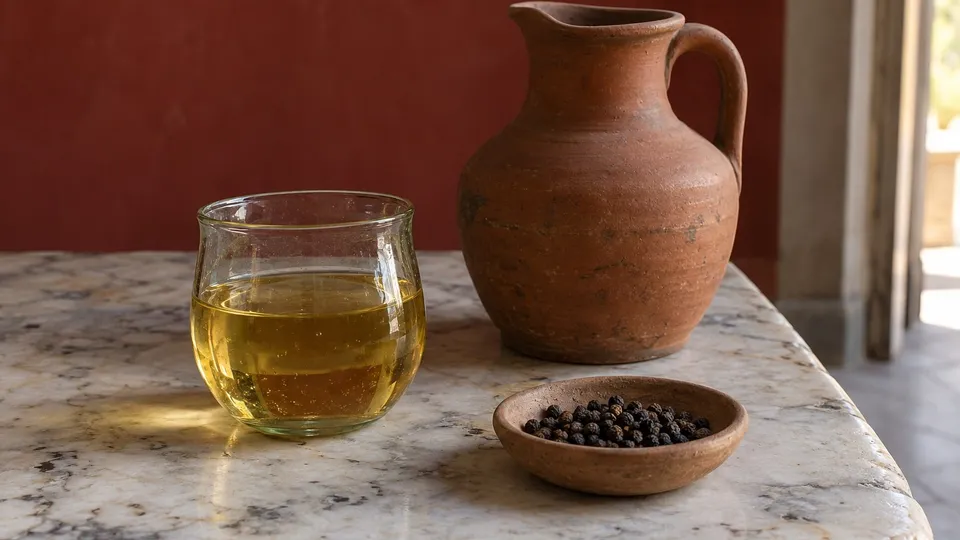 Make it todayConditum Paradoxum, Roman Spiced Honey Wine
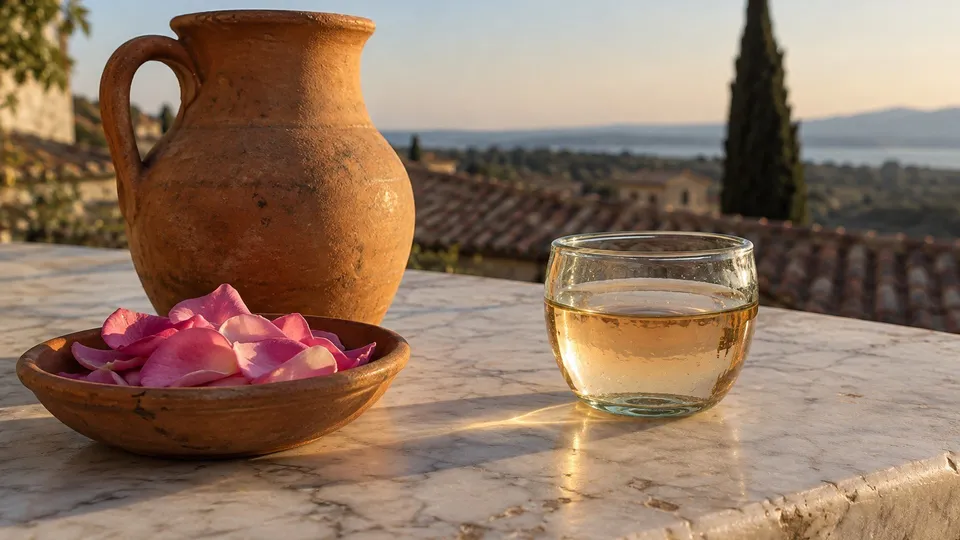 Make it todayRosatum, Roman Rose Wine
For what was on the plate, our sister site The Forgotten Menu has the meat mummies packed as food for eternity (opens in a new tab).
Sources
- Howard Carter, The Tomb of Tut·ankh·Amen, vol. II (New York: George H. Doran, 1927), pp. 74–77, the burial chamber, its broken jar seals and the Year 5 label.
- Howard Carter, The Tomb of Tut·ankh·Amen, vol. III, The Annexe and Treasury (London: Cassell, 1933; Duckworth reprint, 2000), pp. 147–149 and plate L on the wine jars, and p. 183, Alfred Lucas’s note on wine.
- Griffith Institute, University of Oxford, Carter object cards 180, 195 and 206 with their attached language notes, and Carter’s final plan of the burial chamber.
- Maria Rosa Guasch i Jané, El vi a l’antic Egipte, doctoral thesis, Universitat de Barcelona, 2005, pp. 52–83.
- Léa Drieu and others, “Is it possible to identify ancient wine production using biomolecular approaches?”, STAR: Science & Technology of Archaeological Research 6, no. 1 (2020): 16–29, doi:10.1080/20548923.2020.1738728.