The Stengah, a Straits Whisky and Soda from 1892
Reader ratingsA small whisky topped up with soda water: the stengah, Malay for half, was the first word of Malay a newcomer learned in the Straits in 1892.
- Recipe makes
- 1 tall drink, about 150 ml
- Prep
- Total
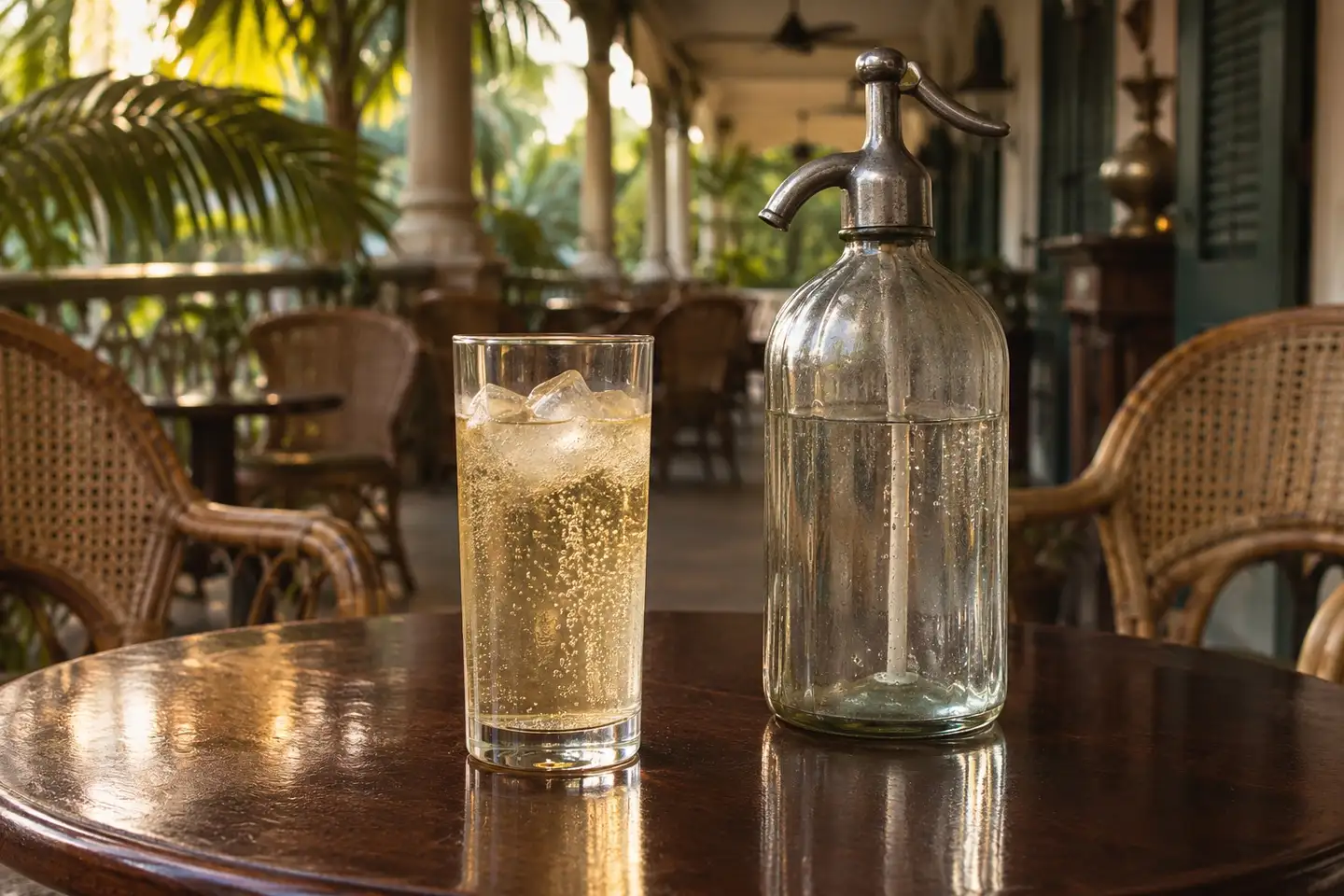
A stengah, a small whisky with soda water over ice, beside a soda siphon on a club veranda table.
The story behind the recipe
A stengah is a small whisky topped up with soda water, and in the Straits Settlements of the 1890s it was the drink a man ordered without thinking. The name is the Malay word for half. In December 1892 a newcomer signing himself Ballyhoolly Junior explained it to the readers of the Pinang Gazette: ask the club boy for a stengah, he wrote, and “he goes forthwith and fatches you the familiar small whiskey and soda.”
The first word of Malay
He was writing for readers in India, where the club drink was a “peg,” and he saw no difference but the count: “the ‘stengah’ is the peg, only more frequent.” It was, he decided, “the first word of Malay the stranger learns in the Straits.” The month before, the Straits Independent in Penang had worried about what was really in the bottle, writing that people were in the habit of “calling for our stengah, and gulping it down” without asking whether the whisky had ever seen Scotland.
The drink kept its place for decades. In 1908 Twentieth Century Impressions of British Malaya told its readers that “in so hot and trying a climate as that of Singapore,” among those “who do not adhere to teetotal principles the ‘Stengah’ whisky-soda is a favourite beverage.” The same book’s bazaar price list put Dewar’s whisky at $12.75 a dozen quarts, about £150 today, and soda water at 70 cents a dozen large bottles, about £8. A visiting Australian wrote in the Pinang Gazette in 1921 that “‘Stinger’ is English for ‘stengah,’” and that “a stinger is a weak whisky and soda,” and in 1936 a Straits Times reporter found that Singapore’s famous gin sling was “not nearly as popular as the ‘stengah.’” Gin was for the morning; for the evening, he wrote, “‘stengahs’ are a firm favourite.” How the gin sling and the stengah divided the day in old Singapore is in What Did People Drink in Old Singapore?
Read more about this recipe
Half of what?
None of these writers gives a measure. “Half” and “small” tell us only that the whisky was a short pour and the soda did the rest. We use 30 ml of Scotch whisky, our amount, and 120 ml of soda water over ice, which comes to about 8% ABV before the ice melts. The 1892 writers name whisky from Scotland, so we use Scotch; they say nothing about ice, which is our choice for a hot climate. For the other drink of the same club verandas, make the Cricket Club Gin Sling of 1913.
‘Stengah,’ I may inform such of your readers as have not had the advantage of a Malay education, means ‘half.’ You see the astonishing strides I have already made in the language. Therefore, when you say unto the club boy a ‘stengah,’ he goes forthwith and fatches you the familiar small whiskey and soda.

Original: 1 tall drink, about 150 ml
Ingredients
My drinksFor 1 tall drink, about 150 ml. Quantities are shown as written.
Quantities as written here, for 1 tall drink, about 150 ml.
- Scotch whisky30 ml
- Ice cubes
- Cold soda water120 ml
Measurement notes
Ingredients as written here
- 30 ml Scotch whisky
- Ice cubes
- 120 ml cold soda water
Equipment
 Tall tumbler
 Measuring jigger
Instructions
Fill the tall tumbler with ice cubes.
Pour in the Scotch whisky.
Top up with the cold soda water and serve at once, without stirring hard, so it keeps its fizz.
Nutrition
70calories per serving
Estimated from USDA FoodData Central values for 40% ABV whisky; soda water adds nothing.
Recipe notes
Notes
Quantities mentioned in these notes don’t change when you adjust the batch.
The 1892 article gives no measures, glass or garnish; the 30 ml of whisky, 120 ml of soda, the ice and the tall glass are all ours. A soda siphon gives the livelier fizz of a club bar, but bottled soda water works. Money is converted through sterling, using the book’s own sterling column and the Bank of England inflation calculator basis. For an alcohol-free long drink from the same era, pour Edward Spencer’s Superior Lemon Squash over soda water; lemon squash cost 20 cents a glass on a Singapore hotel card in 1907, about £2.40 today.
Scaling changes the ingredients only; glassware, ice and timings need their own judgment. To adapt this recipe further, try the recipe tool at TuneMyRecipe (opens in a new tab), our sister site.
Sources and attribution
Ballyhoolly Junior, “The Straits and the Stranger,” Pinang Gazette, December 17, 1892, p. 3, NewspaperSG, National Library Board
Recipe details
- Drink family
- Cocktails & Mixed Drinks
- Region
- Singaporean
- Era
- 19th century
- Source decade
- 1890s
- Base
- Whisky
- Difficulty
- Easy
- Season
- Summer