The Moscow Mule as First Described (1942)
Reader ratingsVodka, lime juice and ginger beer over ice: the Moscow Mule as Hollywood columns first described it in 1942, with the two-ounce shot and squeeze of lime of the first full account.
- Recipe makes
- 1 drink
- Prep
- Total
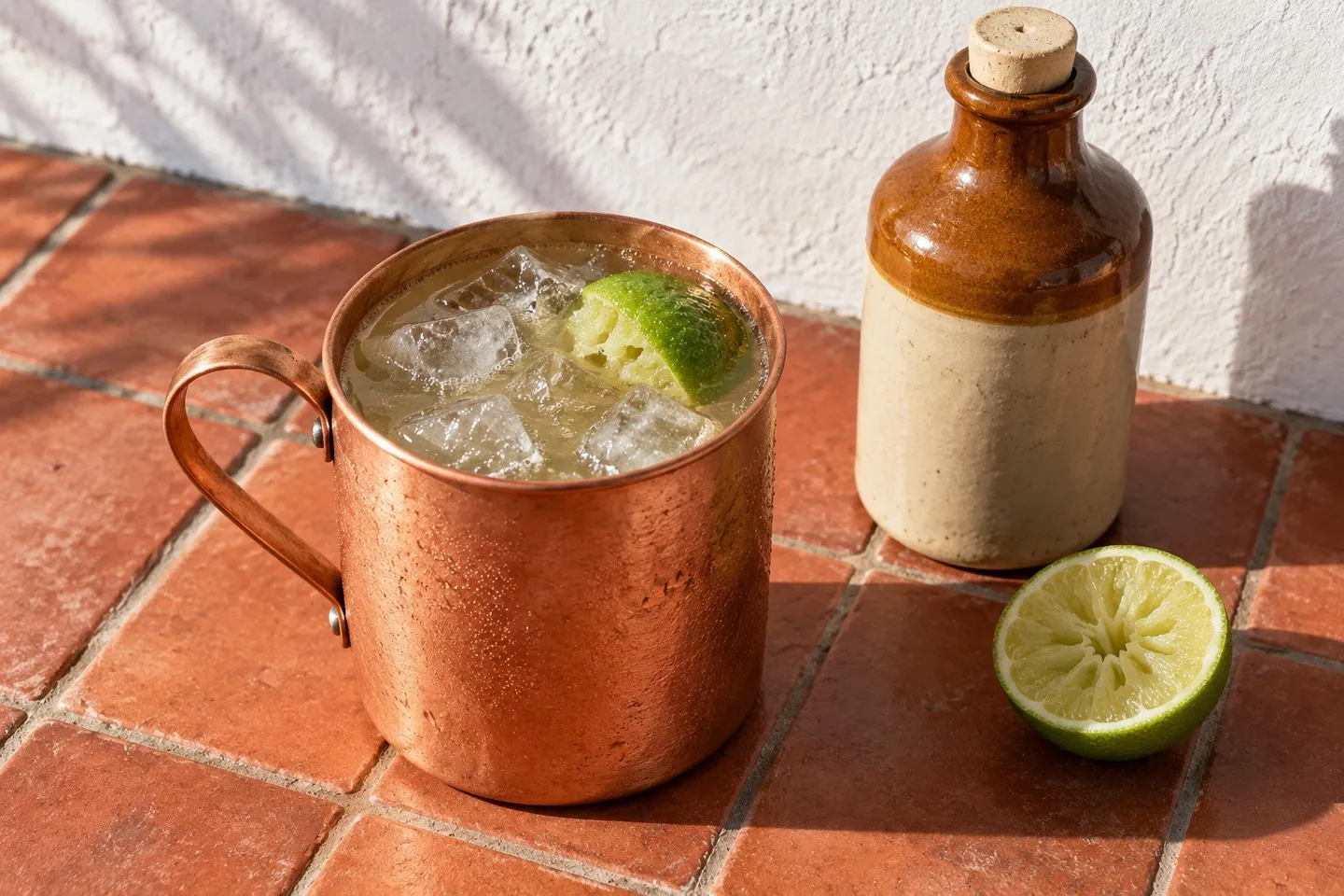
The Moscow Mule of the early 1940s in a copper mug with ice and a squeezed lime, beside a stoneware ginger beer bottle.
The story behind the recipe
The Moscow Mule was named in New York and first written down in Hollywood. A New York magazine had the name in August 1942; that November a Hollywood gossip column gave the ingredients as vodka, lime juice and ginger beer, the drink of the moment in the film colony. The copper mug arrives in a fuller account of 1948.
From a New York bar to the film colony
In August 1942 Town & Country listed a Moscow Mule among the vodka drinks at a New York hotel bar and called it a tribute to the defenders of the city in its name. On November 28, Hugh Dixon’s Hollywood column in the Pittsburgh Post-Gazette reported that the Moscow Mules served by the Collier Youngs at home were “pure dynamite” and gave the ingredients as “vodka, lime juice and ginger beer.” Two weeks later Edith Gwynn’s “Inside Hollywood” gave the proportions as equal parts of all three.
Read more about this recipe
Morgan’s ginger beer and Martin’s vodka
The first full account came in 1948, from the food writer Clementine Paddleford in the New York Herald Tribune. She brought three men together in 1941: Jack Morgan, owner of the Hollywood Cock ‘n’ Bull Restaurant, who had his own ginger beer; John G. Martin of Heublein, which sold Smirnoff vodka; and Rudolph Kunett, who had sold Heublein the American rights to Smirnoff. She placed the drink’s birth in the bar of New York’s Chatham Hotel and gave it as a two-ounce shot of vodka with Morgan’s ginger beer and a squeezed lime. The friends, she wrote, later ordered 500 copper mugs embossed with the name Little Moscows.
Later tellings move the birth to the Cock ‘n’ Bull itself, credit its bartender Wes Price, or have a woman arrive at the bar with a stock of copper mugs to sell. All of those come from decades afterward, and the papers of the 1940s mention none of them.
Over ice, in copper or glass
This recipe follows the 1942 ingredients with the measures of Paddleford’s account: 2 fl oz vodka, half a lime squeezed in with its shell and about 4 fl oz ginger beer over ice, which comes to about 11% ABV. A copper mug suits it; a tall glass works just as well. Use ginger beer, not ginger ale, as the 1942 and 1948 accounts do.
Morgan’s ginger beer, Paddleford wrote, came in crockery bottles and tasted just like the English kind. The Mule’s place among the vodka drinks first written down by columnists is in The Bartenders Who Wrote Down the Classic Cocktails.
Recipe makes: 1 drink
Ingredients
For 1 drink. Quantities are shown as written.
Quantities as written here, for 1 drink.
- Vodka2 fl oz
- Lime (about 1/2 fl oz juice)1/2
- Cold ginger beer1/2 cup
- Ice cubes
Measurement notes
Ingredients as written here
- 2 fl oz vodka
- 1/2 lime (about 1/2 fl oz juice)
- 1/2 cup cold ginger beer
- ice cubes
Equipment
 Knife
 Tall glass
 Bar spoon
Instructions
Cut the lime in half and squeeze the juice of one half into a copper mug or tall glass, then drop the squeezed shell in.
Fill the mug with ice cubes and pour in the vodka.
Top up with the cold ginger beer and stir once with a bar spoon.
Nutrition
175calories per serving
- Recipe makes
- 1 drink
Estimated from USDA FoodData Central values for 80-proof vodka (64 calories per fl oz), lime juice and ginger ale (about 34 calories per 100 ml), standing in for ginger beer.
Recipe notes
When adjusting quantities
Scale by whole drinks; build each mug separately.
Notes
Quantities mentioned in these notes don’t change when you adjust the batch.
Use a copper mug lined inside with stainless steel or nickel. Lime juice is acidic enough to draw copper out of an unlined mug, and the FDA Food Code bars bare copper from contact with food and drink more acidic than pH 6.
Gwynn’s equal parts make a much sharper drink: 1 1/2 fl oz each of vodka, lime juice and ginger beer over ice, three times the lime juice of the version above, at about 12% ABV.
To make it without alcohol, leave out the vodka and fill the mug with ginger beer and the lime; many bottled ginger beers are sodas, but check the label says 0.0%. For a homemade mug, the Alcohol-Free Ginger Beer can take lime in place of its lemon; that swap is ours.
Scaling changes the ingredients only; glassware, ice and timings need their own judgment. To adapt this recipe further, try the recipe tool at TuneMyRecipe (opens in a new tab), our sister site.
Sources and attribution
Hugh Dixon, “Hollywood”, Pittsburgh Post-Gazette, November 28, 1942, p. 18; Edith Gwynn, “Inside Hollywood”, Albuquerque Journal, December 13, 1942; Clementine Paddleford, New York Herald Tribune, July 28, 1948, p. 12
Recipe details
- Drink family
- Cocktails & Mixed Drinks
- Region
- American
- Source decade
- 1940s
- Base
- Vodka
- Difficulty
- Easy