The Daiquiri as Straub Printed It (1913)
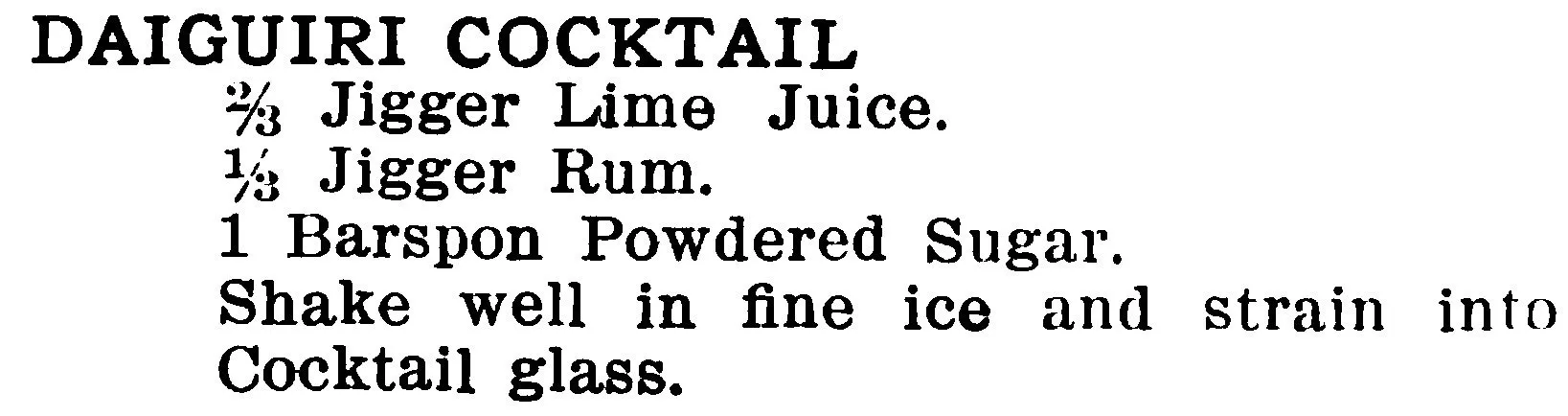
Reader ratingsTwo-thirds of a jigger of lime juice, one-third of rum and a spoon of powdered sugar, shaken with fine ice: the Daiquiri as Jacques Straub first printed it in 1913.
- Recipe makes
- 1 small drink, about 2 fl oz
- Prep
- Total
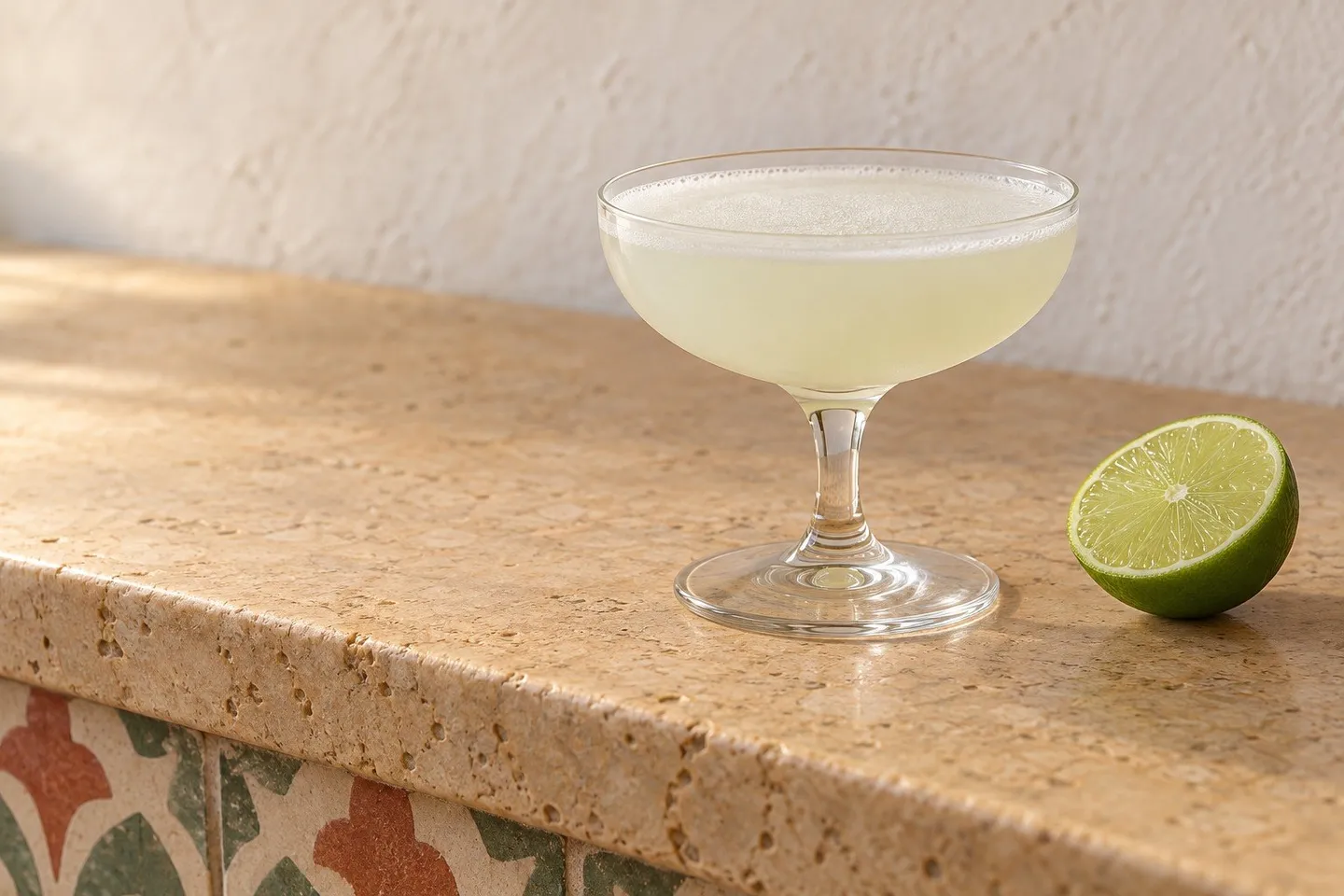
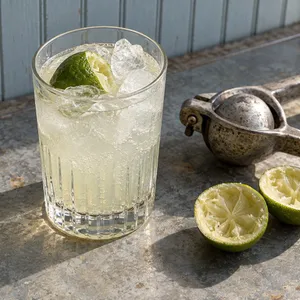
Straub’s 1913 Daiquiri in a shallow stemmed glass on a limestone counter faced with cement tiles, beside a halved lime.
The story behind the recipe
The oldest Daiquiri recipe we have found in print has twice as much lime juice as rum. In Straub’s Manual of Mixed Drinks, published in Chicago in 1913, the lime takes two-thirds of the jigger and the rum one-third, with a barspoon of powdered sugar, all shaken hard over fine ice and strained. Straub’s is the recipe to make here; the rum-heavy Daiquiri of today’s bars came later, and the Savoy’s 1930 version of it is given too.
A mining town and a Navy doctor
The drink takes its name from the iron mines at Daiquirí, outside Santiago de Cuba, which drew American engineers after 1898. Jennings Cox, the American who managed them, is said to have mixed the first one there and named it, but that account comes from later writers: Basil Woon in 1928, and a friend of Cox’s in a letter to a Havana newspaper in 1948. A handwritten recipe kept by Cox’s family is undated, so the story stays a legend, if one with a plausible address.
The Navy story is a recollection too. In 1952 Lucius W. Johnson, later a rear admiral, told the Baltimore Evening Sun that he had first tasted Cox’s drink in 1909, as a young medical officer on the battleship Minnesota, and taken it home to the Army and Navy Club in Washington. A London book of 1925, by Nina Toye and A. H. Adair, gives the fleet the credit: the recipe “was brought back by the U.S. fleet from its trip round the world as the best drink it had found.”
Read more about this recipe
From sour to strong
The proportions were no one-off misprint: Straub printed them again in his Drinks of 1914. By 1930 The Savoy Cocktail Book had reversed the balance, with “1 Glass Bacardi Rum” against half a lime’s juice. It also quoted Joseph Hergesheimer’s 1920 book on Havana on a Daiquiri held “in its shallow glass bowl slightly encrusted with undissolved sugar.” Rum had hardly appeared in an American cocktail before this. Jerry Thomas’s 1862 bar book pours it into punches and small sour drinks such as the White Lion, but into none of its cocktails, which is where From Punch Bowl to Shaker: How Rum Got Into Cocktails begins.
Straub’s jigger is read here as 1 1/2 fl oz, which makes a small, sharp drink of about 10% ABV, about a third of a US standard drink. Its sour shape is the Sidecar’s, with lime in place of lemon. The soda fountain’s 1912 Lime Rickey is the driver’s version: a whole lime squeezed over syrup and topped with soda water.
DAIGUIRI COCKTAIL
⅔ Jigger Lime Juice.
⅓ Jigger Rum.
1 Barspon [sic] Powdered Sugar.
Shake well in fine ice and strain into Cocktail glass.

Recipe makes: 1 small drink, about 2 fl oz
Ingredients
For 1 small drink, about 2 fl oz. Quantities are shown as written.
Quantities as written here, for 1 small drink, about 2 fl oz.
- Fresh lime juice1 fl oz
- White rum1/2 fl oz
- Superfine sugar1 tsp
- Crushed ice1/2 cup
Measurement notes
Ingredients as written here
- 1 fl oz fresh lime juice
- 1/2 fl oz white rum
- 1 tsp superfine sugar
- 1/2 cup crushed ice
Equipment
 Cocktail shaker and strainer
 Citrus juicer
 Small cocktail glass
Instructions
Chill a small cocktail glass in the freezer or with ice water while you mix.
Pour the fresh lime juice into the cocktail shaker, add the superfine sugar and stir until it dissolves.
Add the white rum and the crushed ice, close the shaker and shake hard for about 10 seconds, until the shaker is frosty.
Empty the glass if it holds ice water, strain the drink into it and serve at once, with no ice in the glass and no garnish.
Nutrition
55calories per serving
- Recipe makes
- 1 small drink, about 2 fl oz
Estimated from USDA FoodData Central values for 80-proof rum (64 calories per fl oz), lime juice and granulated sugar.
Recipe notes
When adjusting quantities
This is one small drink. Keep the lime at twice the rum when you scale, and shake no more than two at a time.
Notes
Quantities mentioned in these notes don’t change when you adjust the batch.
Straub only says “Rum.” Cuban white rum is what the Daiquiri’s other early printers named, so a light white rum is our choice. A barspoon is taken as 1 teaspoon. Straub’s drink is very sour; for a softer one, use up to 2 tsp sugar, our option.
The 1930 Savoy serve, the rum-forward Daiquiri: shake 2 fl oz white rum (the Savoy’s “Glass”) with the juice of half a lime, about 1/2 fl oz, and 1 tsp superfine sugar over crushed ice, and strain into a cocktail glass. It comes to about 23% ABV. Hugo Ensslin’s Recipes for Mixed Drinks (1917) sweetens the same kind of drink with two dashes of grenadine in place of sugar. For the blended ice version that came later still, TuneMyRecipe has a Frozen Lime Daiquiri (opens in a new tab).
Without the rum, lime juice and sugar lengthened with cold water make Soyer’s Cheap Crimean Lemonade, from 1857.
Scaling changes the ingredients only; glassware, ice and timings need their own judgment.
Sources and attribution
Jacques Straub, Straub’s Manual of Mixed Drinks (Chicago: R. Francis Welsh Publishing Co., 1913), p. 20, “Daiguiri Cocktail”; the 1930 serve from Harry Craddock, The Savoy Cocktail Book (London: Constable, 1930), p. 54
Recipe details
- Drink family
- Cocktails & Mixed Drinks
- Source decade
- 1910s
- Base
- Rum
- Difficulty
- Easy