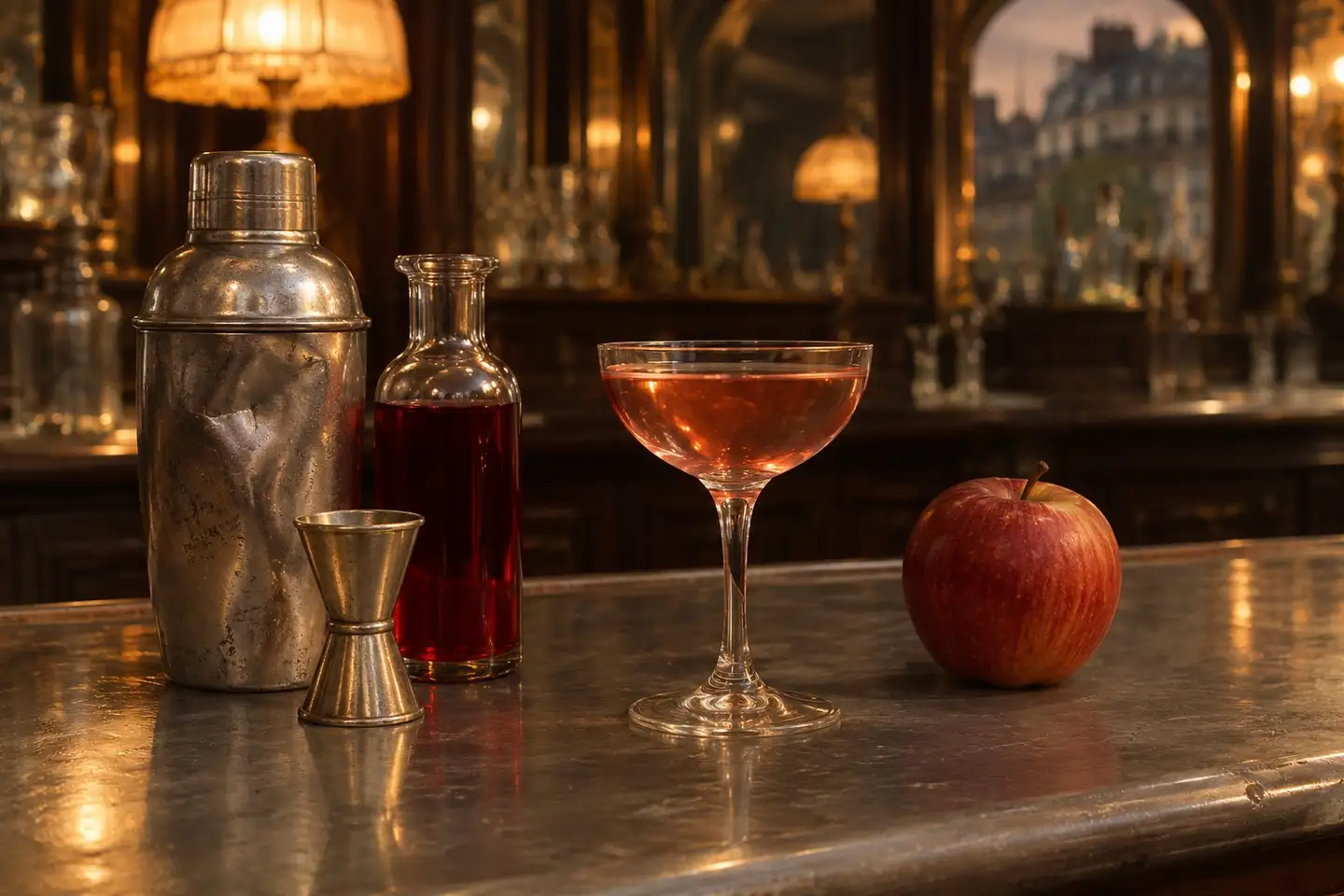
The 75 Cocktail, Calvados and Gin, from 1927
Reader ratingsTwo parts Calvados to one of gin, with a teaspoon of grenadine and two dashes of absinthe, shaken and strained: the short 75 of Harry’s bar in Paris, before the French 75 met Champagne.
- Recipe makes
- 1 drink
- Prep
- Total
A short 75 cocktail of Calvados, gin and grenadine in a stemmed glass, beside a shaker and a red apple.
The story behind the recipe
Before the French 75 had Champagne in it, the 75 was a short, shaken cocktail of apple brandy and gin. Harry MacElhone, later of Harry’s New York Bar in Paris, gave it in his ABC of Mixing Cocktails, first published in London in the early 1920s: a teaspoon of grenadine, two dashes of absinthe or the Spanish anisette Anís del Oso, and spirits in the proportion of two parts Calvados to one part gin, shaken and strained into a cocktail glass. In 1927 the Paris book Barflies and Cocktails printed it again, in the same proportions and with the same note.
The war and the gun
That note gives the drink its history in a sentence. The cocktail, it says, was very popular in France during the war and was “named after the French light field gun,” the French army’s 75 mm quick-firing gun of 1897. A newspaper column of 1915 is reported to describe a “Soixante-Quinze” of gin, grenadine and applejack, the American apple brandy, so the apple spirit may go back to the war years themselves. There is no lemon in MacElhone’s recipe, and no Champagne, though the Saratoga cocktail printed just above it on the same page fills its glass with Champagne. The tall gin and Champagne French 75 was printed in New York the same year, 1927, by a different book entirely.
Read more about this recipe
A small strong glass
The book gives fractions, not measures, so the amounts are ours: an ounce and a half of Calvados and three-quarters of an ounce of dry gin, which keeps its two to one. We use 80-proof spirits, a teaspoon of grenadine, and absinthe as the anise, measured as two small dashes. Shaken hard with ice, it comes to a little over three ounces at about 29% alcohol by our arithmetic, stronger than most drinks of its size, so it belongs in a small glass.
How the two 75s grew apart, and why the early ones use gin rather than cognac, is in What Was the Original French 75?. Another short Calvados drink from the same Paris book is the Murderer’s Cocktail.
Original: 1 drink
Ingredients
My drinksFor 1 drink. Quantities are shown as written.
Quantities as written here, for 1 drink.
- Calvados1 1/2 fl oz
- Dry gin3/4 fl oz
- Grenadine1 tsp
- Absinthe2 dashes
- Ice cubes
Measurement notes
Ingredients as written here
- 1 1/2 fl oz Calvados
- 3/4 fl oz dry gin
- 1 tsp grenadine
- 2 dashes absinthe
- ice cubes
Equipment
 Cocktail shaker
 Strainer
 Jigger
 Cocktail glass
Instructions
Chill a small cocktail glass with ice water while you mix.
Fill a cocktail shaker two-thirds with ice cubes. Add the Calvados, dry gin, grenadine and absinthe.
Shake hard for about 10 seconds, until the shaker is very cold.
Empty the glass and strain the drink into it. Serve at once, without garnish.
Nutrition
170calories per serving
Estimated from published values for 80-proof Calvados and gin, counting alcohol at 7 calories per gram plus the grenadine’s sugar.
Recipe notes
When adjusting quantities
Keep twice as much Calvados as gin; shake no more than two drinks at a time.
Notes
Quantities mentioned in these notes don’t change when you adjust the batch.
Changes from the source: the measures, which the book gives only as two-thirds and one-third, the spirit strengths and the length of the shake are ours; absinthe stands for “absinthe or Anis-del-Oso,” and a sweet anisette in its place makes a softer drink. Robert Vermeire’s version in Cocktails: How to Mix Them swaps the balance, with twice as much gin as Calvados, and adds a teaspoon of lemon juice. The tall 1927 French 75 of gin, lemon, sugar and Champagne becomes a Tom Collins if you top it with club soda instead, as the New York book itself pointed out. For a sparkling glass with no alcohol at all, try Sparkling Apple Juice.
Scaling changes the ingredients only; glassware, ice and timings need their own judgment. To adapt this recipe further, try the recipe tool at TuneMyRecipe (opens in a new tab), our sister site.
Sources and attribution
Harry MacElhone, “Harry” of Ciro’s ABC of Mixing Cocktails (London: Dean & Son, undated, 1923 or later), no. 228, p. 55; repeated in Barflies and Cocktails (Paris: Lecram Press, 1927), p. 64
Recipe details
- Drink family
- Cocktails & Mixed Drinks
- Region
- French
- Era
- Jazz Age
- Source decade
- 1920s
- Difficulty
- Easy
- Occasion
- 1920s party