Murderer’s Cocktail, Calvados, Swedish Punch and Rum from 1927
Reader ratingsCalvados, Swedish punch and rum in equal thirds, with bitters and absinthe: the Murderer’s Cocktail printed in Barflies and Cocktails in Paris in 1927, with a joke about fire extinguishers.
- Recipe makes
- 1 drink
- Prep
- Total
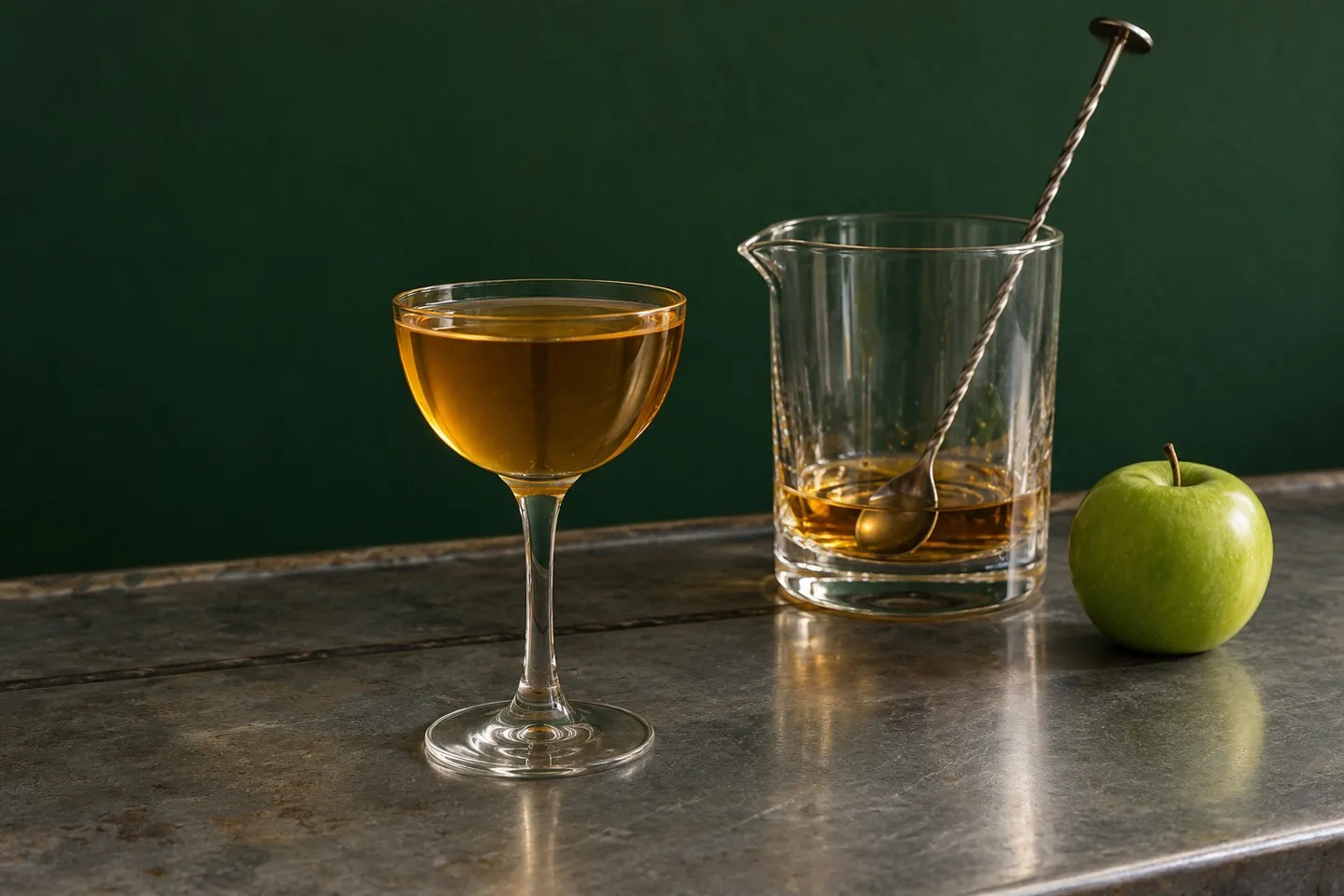
A Murderer’s Cocktail of Calvados, Swedish punsch and rum in a small stemmed glass, with a mixing jug, bar spoon and green apple on a zinc bar.
The story behind the recipe
Fire extinguishers were the joke attached to the Murderer’s Cocktail, a stirred drink of Calvados, Swedish punch and rum in equal thirds with a dash of bitters and two of absinthe. It was printed in Paris in 1927 in Barflies and Cocktails, the book from Harry’s New York Bar, in a column by Arthur Moss that matched each of the bar’s regulars with a drink.
A plot-inspirer
Moss gives this one to Bob Coates, the American writer whose novel The Eater of Darkness came out in Paris the year before. Coates, he says, takes the typewriter off his lap and pounds out the recipe as a “plot-inspirer,” with “asbestos shaker advised.” Then comes a mock safety notice about exits and extinguishers. Nothing in the recipe is set alight.
The page is a crowd of such drinks, each with its owner: a Boulevardier for Erskine Gwynne, a Black Bottom Cooler of champagne, cola and stout for the jazzband impresario Billy Arnold, and a glass of cola on ice for a boxer. Many of the same men belonged to the bar’s mock fraternity, told in The International Bar Flies of Harry’s New York Bar.
Read more about this recipe
Mixing it today
Moss gives proportions and no method. A drink of spirits and liqueur alone is best stirred with ice, which chills it and keeps it clear; the shaker stays in the joke. Swedish punsch, the sweet bottled Swedish liqueur built on arrack, is still made, usually at about 25% alcohol. Calvados is apple brandy from Normandy. Moss names no rum; we use an aged rum, our choice, to sit with the apple brandy and the punsch.
With the Calvados and rum at 40% and a punsch at 26%, the stirred drink comes to about 29% alcohol, about one and a half US standard drinks. Serve it small. For a guest who isn’t drinking, Moss’s own alcohol-free entry is the simplest drink on the page: a tall glass packed with ice and filled with cola.
Recipe makes: 1 drink
Ingredients
For 1 drink. Quantities are shown as written.
Quantities as written here, for 1 drink.
- Calvados3/4 fl oz
- Swedish punsch3/4 fl oz
- Rum3/4 fl oz
- Aromatic bitters1 dash
- Absinthe2 dashes
- Ice cubes
Measurement notes
Ingredients as written here
- 3/4 fl oz Calvados
- 3/4 fl oz Swedish punsch
- 3/4 fl oz rum
- 1 dash aromatic bitters
- 2 dashes absinthe
- ice cubes
Equipment
 Mixing glass or jug
 Bar spoon
 Strainer
 Small cocktail glass
Instructions
Chill a small cocktail glass in the freezer or with ice water.
Pour the Calvados, Swedish punsch and rum into a mixing glass, add the aromatic bitters and absinthe, and fill the glass two-thirds with ice cubes.
Stir steadily for about 30 seconds, until the mixing glass is very cold to the touch.
Strain into the chilled glass and serve.
Nutrition
165calories per serving
- Recipe makes
- 1 drink
Estimated from published values for 80-proof Calvados and rum and a 26% Swedish punsch, counting alcohol at 7 calories per gram plus the punsch’s sugar.
Recipe notes
When adjusting quantities
Keep the three spirits in equal parts; stir no more than two drinks at a time.
Notes
Quantities mentioned in these notes don’t change when you adjust the batch.
The 1927 text gives a third each of Calvados, Swedish punch and rum, one dash of bitters and two dashes of absinthe, and nothing more. The stir, the strain and the cocktail glass are ours, as is the 3/4 fl oz measure for each third (about 22 ml), which makes a 2 1/4 fl oz drink before ice. “Bitters” is read as aromatic bitters such as Angostura.
Swedish punsch brands differ in sweetness and strength; a sweeter one makes a rounder drink. If you can’t find it, the drink is not the same without it, since it is a third of the glass.
Absinthe is strong (often 60 to 70%) and only two dashes go in. Rinsing the glass with it instead gives a lighter anise note.
Scaling changes the ingredients only; glassware, ice and timings need their own judgment. To adapt this recipe further, try the recipe tool at TuneMyRecipe (opens in a new tab), our sister site.
Sources and attribution
Arthur Moss, “Cocktails Round Town”, in Harry McElhone, Barflies and Cocktails (Paris: Lecram Press, 1927), p. 80
Recipe details
- Drink family
- Cocktails & Mixed Drinks
- Region
- French
- Era
- Jazz Age
- Source decade
- 1920s
- Difficulty
- Easy
- Occasion
- 1920s party