Prune Kompot for a Polish Christmas Eve, from 1913
Reader ratingsDried plums cooked soft with sugar and cinnamon: the prune kompot of a 1913 Polish-Lithuanian cookbook, served then as a dessert and poured today as a drink at Christmas Eve supper.
- Recipe makes
- About 1 liter, 4 glasses
- Prep
- Cook
- Total
About 35 minutes, plus cooling if you serve it cold.
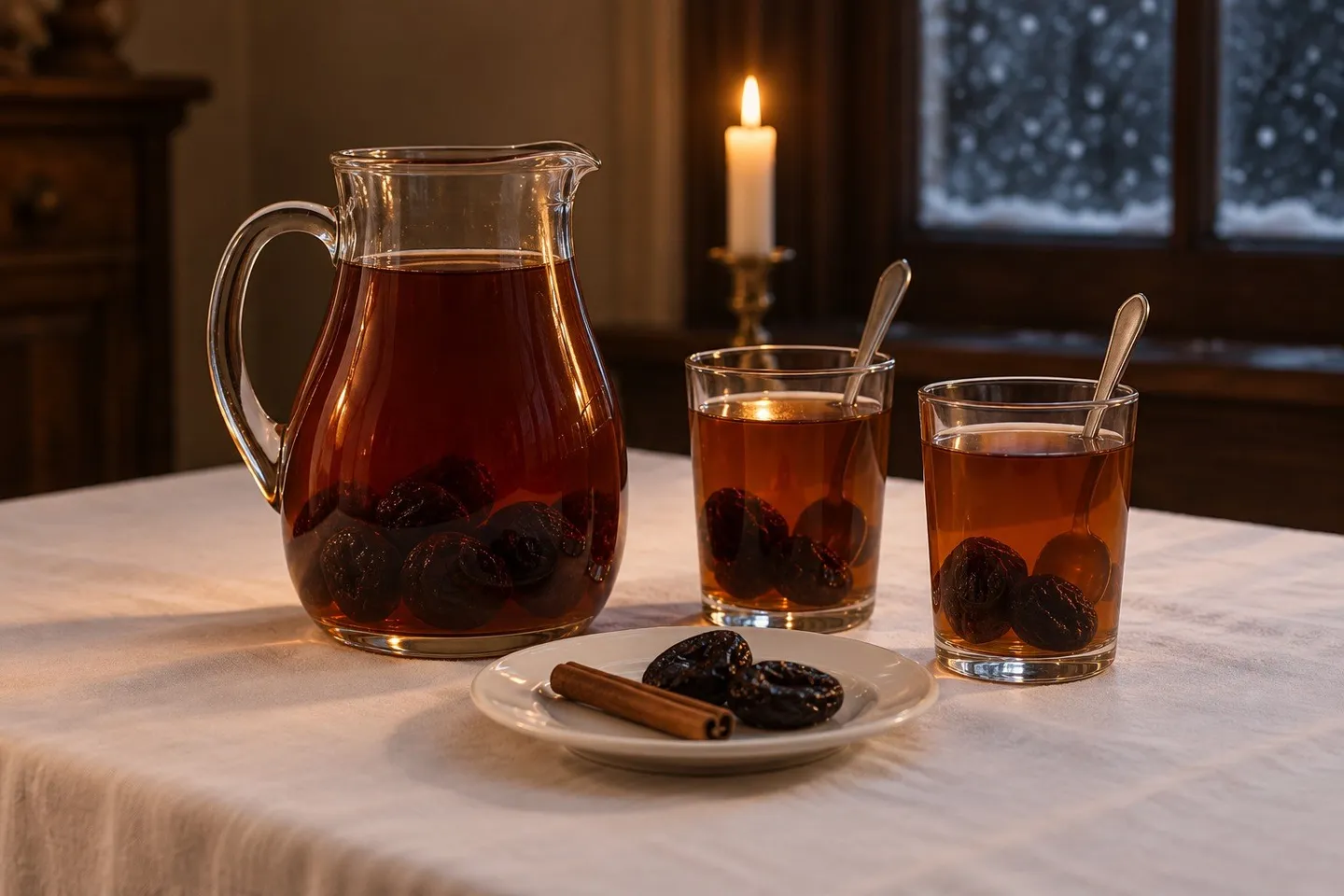
Prune kompot in a glass jug and two glasses, with dry prunes and a cinnamon stick, on a white Christmas Eve tablecloth.
The story behind the recipe
Kompot of dried fruit has a place on many Polish Christmas Eve tables, and the oldest menu we have found with it dates from 1911. That December the Warsaw weekly Tygodnik Mód i Powieści printed four Christmas Eve suppers “for different walks of life,” from a plain one of mushroom barley soup, fried pike, cabbage with mushrooms and noodles with poppy seed to a grand one with caviar and oysters. The third, of eight numbered courses, ends with “Kompot z owoców suszonych,” compote of dried fruit, then a punch jelly and the dried fruit and nuts called bakalie. None of the four menus lists anything to drink.
Spooned in 1913
The menu doesn’t say how the kompot was made. Two years later, the eleventh edition of Kucharka litewska, a Polish cookbook published in Wilno (today’s Vilnius), gave a dried-plum kompot in its chapter of compotes. A pound of dried plums, either the plums called katrynki or the white ones “called Greek,” cooked soft with half their weight of sugar and some cinnamon. The plums were then lifted into a salad bowl, and the liquid was strained, boiled down hard and poured over them. It was a dessert, eaten with a spoon.
Read more about this recipe
Making it today
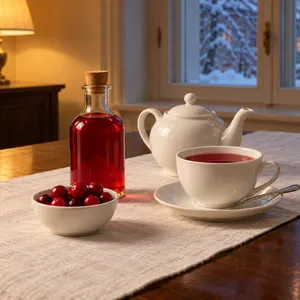
Today many Polish families serve kompot z suszu on Christmas Eve as a drink, poured cold into glasses with a few pieces of fruit, and often made with dried apples and pears as well as plums. That is how we serve this one: the 1913 fruit and spice, cooked in plenty of water and left thin, sweet, and tasting of cinnamon. Boiled down as the book says, the same pan makes the 1913 dessert. For a hot drink in the same season, stir a spoonful of Sok Żurawinowy, a Warsaw cranberry syrup of 1885, into a glass of tea. Poland’s stronger drinks are in How Poland Made Vodka.
8. Kompot z suszonych śliwek katrynek, lub białych, zwanych greckiemi. Proporcja: 1 f. śliwek suszon., ½ f. cukru, cynamonu.

Recipe makes: About 1 liter, 4 glasses
Ingredients
For About 1 liter, 4 glasses. Quantities are shown as written.
Quantities as written here, for About 1 liter, 4 glasses.
- Prunes200 g
- White sugar100 g
- Cinnamon stick1
- Water1 l
Measurement notes
Ingredients as written here
- 200 g prunes
- 100 g white sugar
- 1 cinnamon stick
- 1 liter water
Equipment
 Saucepan with a lid
 Large jug or bowl
 Glass or tumbler
 Teaspoon
Instructions
Put the prunes, white sugar and cinnamon stick in the saucepan and pour on the water.
Bring to the boil, then cover and simmer gently for 25 to 30 minutes, until the prunes are soft and plump.
Take out the cinnamon stick and pour the kompot into the jug or bowl. Serve it warm, or let it cool and chill it.
Pour it into the glasses with two or three prunes in each, and put a teaspoon in each glass for the fruit.
Nutrition
220calories per serving
- Recipe makes
- About 1 liter, 4 glasses
- Servings
- 4
Roughly estimated from USDA FoodData Central values for prunes and granulated sugar, for one glass with its share of the fruit.
Recipe notes
When adjusting quantities
Four glasses. Keep the sugar at half the weight of the prunes, as in the 1913 book.
Notes
Quantities mentioned in these notes don’t change when you adjust the batch.
Measures: the book’s f. is a funt, a pound of about 400 g. The Polish and Russian pounds in use in 1913 differed by only a few grams.
Changes from the source: we make half of the 1913 pound of plums, keep the sugar at half their weight, and use one cinnamon stick for the book’s “some cinnamon.” The book doesn’t say how much water to use, and it boils the liquid down to a thick syrup; we use a liter and leave it thin, to drink. Serving it as a drink is today’s custom, not the book’s. For the 1913 dessert, lift the prunes into a bowl, boil the liquid down hard until syrupy and pour it back over them. Prunes with stones or without both work; warn guests about the stones.
Storage
Keep it covered in the fridge.
Scaling changes the ingredients only; glassware, ice and timings need their own judgment. To adapt this recipe further, try the recipe tool at TuneMyRecipe (opens in a new tab), our sister site.
Sources and attribution
Kucharka litewska, 11th ed., revised and enlarged (Wilno: Józef Zawadzki, 1913), No. 8, “Kompot z suszonych śliwek katrynek, lub białych, zwanych greckiemi”, p. 455; with the Christmas Eve menus of “Wieczerza wigilijna”, Tygodnik Mód i Powieści (Warsaw), December 9, 1911, p. 14
Recipe details
- Drink
- Alcohol-free
- Region
- Polish
- Source decade
- 1910s
- Base
- Fruit & juice
- Difficulty
- Easy
- Occasion
- Christmas
- Season
- Winter