Negroni, Gin, Campari and Vermouth
Reader ratingsEqual parts gin, Campari and sweet vermouth, stirred over ice with an orange slice: a modern recipe for the Negroni, with what the record shows about Count Negroni’s Florence.
- Recipe makes
- 1 drink
- Prep
- Total
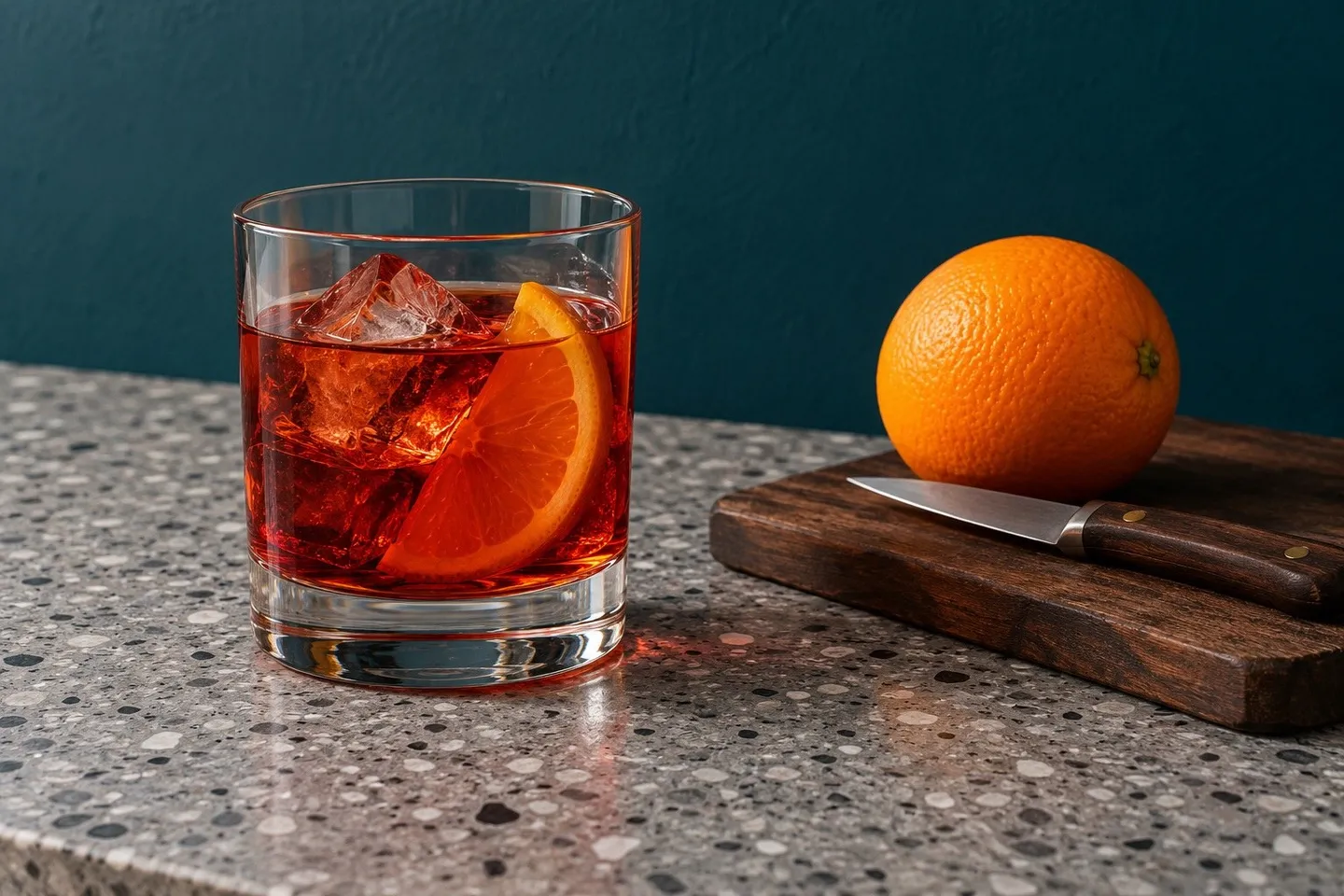
A Negroni over ice in a heavy tumbler with a half slice of orange, beside a whole orange and a paring knife.
The story behind the recipe
Equal parts gin, Campari and sweet vermouth, over ice with a slice of orange, make the drink that Florentine tradition credits to Count Camillo Negroni around 1919. The recipe here is the modern standard: we found no Negroni in any bar book old enough to be out of copyright, and the first printed recipes under the name, which drink histories date to the 1940s, are too recent to quote.
Florence, about 1920
The early evidence for the Count is a letter, not a recipe. According to the Florentine historian Luca Picchi, whose 2002 book on the Count reproduces it, a London correspondent, Frances Harper, wrote to Camillo Negroni in October 1920 with a reference to his drinking. The story goes that the Count asked Fosco Scarselli, bartender at the Caffè Casoni, to strengthen his Americano with gin in place of the soda water. That account rests largely on a magazine interview of 1962 and Picchi’s research, and it stays a tradition. The tales of Negroni as a cowboy in the American West, and the rival claim for a French general of the same name, are legends.
What the bar books show is the drink’s neighbors. Mazzon Ferruccio’s Americano, from an Italian guide of about 1920, is vermouth with a spoonful of bitter and no gin. In 1929 Cocktails de Paris printed a Camparinete of Campari, Italian vermouth and twice as much gin as either, with lemon zest, credited to Albert of the Chatham bar.
Read more about this recipe
Equal thirds
Equal parts make a strong, bitter-sweet drink: stirred over ice it comes to about 21% ABV. Use a London dry gin, Campari or another Italian red bitter, and a sweet red vermouth, freshly opened if you can. For the Camparinete’s proportions, use 1 1/2 fl oz gin with 3/4 fl oz each of Campari and vermouth.
Equal thirds of Campari, Italian vermouth and bourbon were already recorded in Paris in 1927, as the Boulevardier. Cocktails in 1920s London and Paris covers the London and Paris bar books of the decade, where the Negroni’s relatives appear and the Negroni itself does not.
Recipe makes: 1 drink
Ingredients
For 1 drink. Quantities are shown as written.
Quantities as written here, for 1 drink.
- London dry gin1 fl oz
- Campari1 fl oz
- Sweet vermouth1 fl oz
- Orange1 slice
- Ice cubes
Measurement notes
Ingredients as written here
- 1 fl oz London dry gin
- 1 fl oz Campari
- 1 fl oz sweet vermouth
- 1 slice orange
- ice cubes
Equipment
 Mixing glass
 Bar spoon
 Strainer
 Tumbler
Instructions
Pour the London dry gin, Campari and sweet vermouth into a mixing glass and fill it two-thirds with ice cubes.
Stir steadily with a bar spoon for about 30 seconds.
Strain into a tumbler over fresh ice and add the orange slice.
Nutrition
180calories per serving
- Recipe makes
- 1 drink
Estimated from USDA FoodData Central values for 80-proof gin and sweet dessert wine (for the vermouth), and an estimate for Campari at 25% ABV with about 24 g sugar per 100 ml.
Recipe notes
When adjusting quantities
Keep the three in equal parts when you scale; stir no more than two drinks at a time.
Notes
Quantities mentioned in these notes don’t change when you adjust the batch.
The Negroni is also served straight up, strained into a chilled cocktail glass. Campari’s strength varies by country, from about 20 to 28%; check the label.
For an alcohol-free Negroni, stir equal parts (1 fl oz each) of a bottled alcohol-free Italian-style red bitter, an alcohol-free red vermouth alternative and cold juniper tea (1 tsp crushed juniper berries steeped 10 minutes in 1/2 cup just-boiled water, then cooled) with ice, and add an orange slice. Check the labels say 0.0%; a drink labeled “alcohol-free” or “dealcoholized” can still hold up to 0.5%. This is a modern version. Juniper is considered safe in food amounts, but medical references advise against medicinal doses in pregnancy, so if you are pregnant, leave out the juniper tea.
Scaling changes the ingredients only; glassware, ice and timings need their own judgment. To adapt this recipe further, try the recipe tool at TuneMyRecipe (opens in a new tab), our sister site.
Sources and attribution
Modern equal-parts recipe; no public-domain printed Negroni recipe found. Nearest early relative: the Camparinete in Cocktails de Paris (Paris: Demangel, 1929)
Recipe details
- Drink family
- Cocktails & Mixed Drinks
- Region
- Italian
- Era
- Jazz Age
- Base
- Gin
- Difficulty
- Easy