Black Bottom Cooler, Champagne, Cola and Stout from 1927
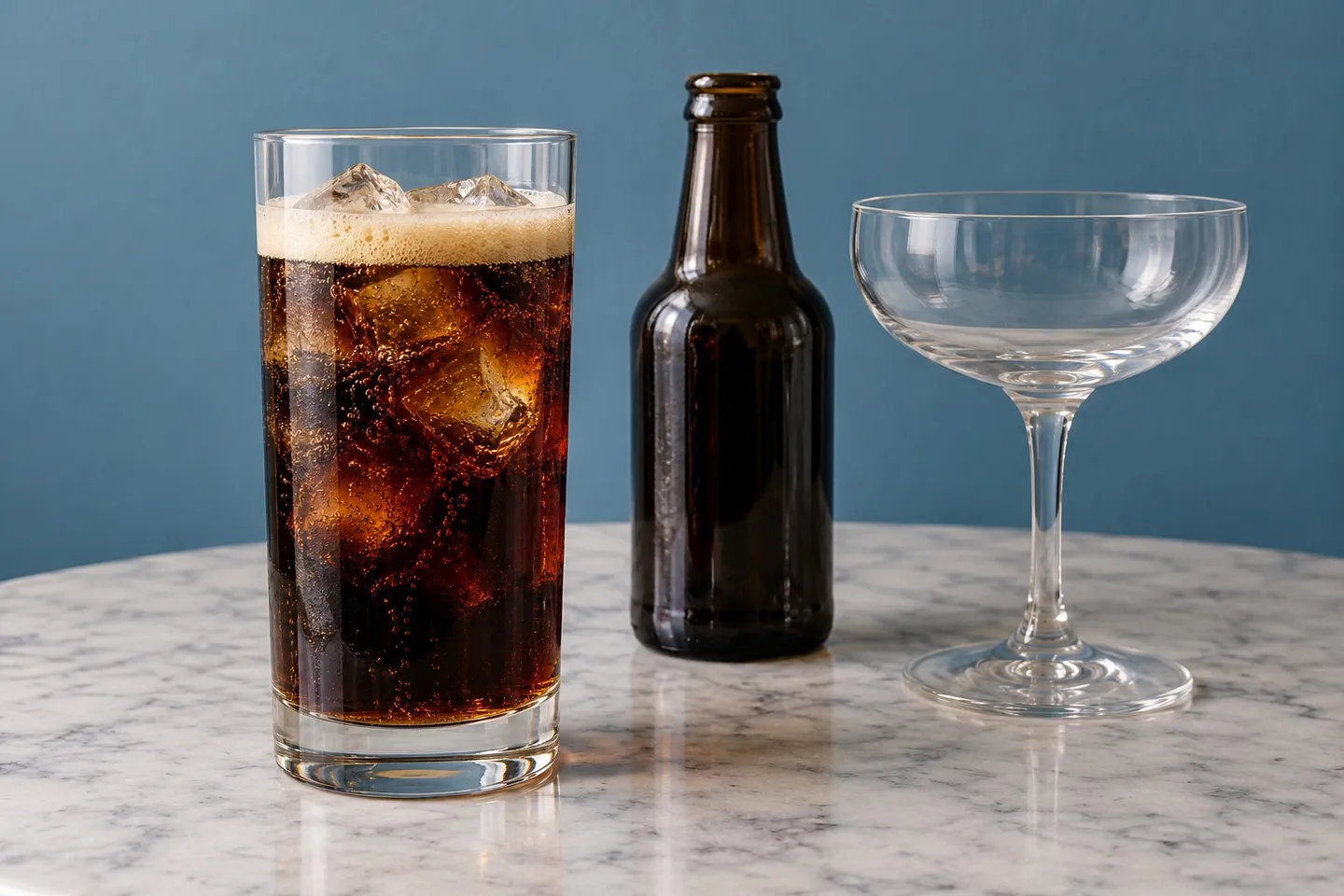
Reader ratingsChampagne, cola and stout in equal thirds, all well iced: the Black Bottom Cooler that Barflies and Cocktails credited to the jazzband impresario Billy Arnold in Paris in 1927.
- Recipe makes
- 1 tall drink
- Prep
- Total
A Black Bottom Cooler of champagne, cola and stout over ice in a tall glass, with a small dark bottle and an empty coupe on marble.
The story behind the recipe
Champagne, cola and stout in equal thirds, “all well iced,” is about as odd a mix as a 1920s bar book prints, and it has a name: the Black Bottom Cooler. It comes from Barflies and Cocktails, the 1927 book from Harry’s New York Bar in Paris, where Arthur Moss’s column credits it to Billy Arnold.
An impresario’s drink
Moss calls Arnold a jazzband impresario and says it is only natural for him “to take to the ‘Black Bottom Cooler.’” The Black Bottom was a dance of the jazz years, and Moss leaves the reader to make the connection. On the same page a detective novelist gets the Murderer’s Cocktail and Erskine Gwynne his Boulevardier: each regular at the bar has his own glass. The circle behind them, a mock fraternity with rules mostly about who pays, is in The International Bar Flies of Harry’s New York Bar.
Cola turns up twice on that page. The other drink is the alcohol-free Santa Monica, a tall glass packed with ice and filled with cola, which Moss gives to a boxer.
Read more about this recipe
Pouring it today
Moss gives only the thirds and the ice. Three fizzy drinks foam when they meet, so we pour the cola first, then the stout, then the champagne, each slowly down the side of the glass, and give one gentle stir. A dry Irish stout and a brut champagne or other dry sparkling wine keep it from turning sweet; the cola brings the sugar.
With champagne at 12% and stout at about 4%, the glass comes to about 5% alcohol, the strength of a beer, and about half a US standard drink. For the same glass without alcohol, make Moss’s Santa Monica, or a jug of Ginger Ale Punch from the same decade.
Recipe makes: 1 tall drink
Ingredients
For 1 tall drink. Quantities are shown as written.
Quantities as written here, for 1 tall drink.
- Ice cubes
- Chilled cola2 fl oz
- Chilled stout2 fl oz
- Chilled Champagne2 fl oz
Measurement notes
Ingredients as written here
- ice cubes
- 2 fl oz chilled cola
- 2 fl oz chilled stout
- 2 fl oz chilled Champagne
Equipment
 Tall glass, about 10 fl oz
 Bar spoon
Instructions
Fill a tall glass about half full with ice cubes.
Pour in the chilled cola slowly, down the side of the glass.
Add the chilled stout the same way and let the foam settle.
Top up with the chilled Champagne, give one gentle stir and serve at once.
Nutrition
95calories per serving
- Recipe makes
- 1 tall drink
Estimated from published values for brut Champagne, cola and dry Irish stout, about 2 fl oz of each.
Recipe notes
When adjusting quantities
Make it one glass at a time, so the bubbles last.
Notes
Quantities mentioned in these notes don’t change when you adjust the batch.
The 1927 text gives a third each of champagne, Coca-Cola and stout, “all well iced,” and no method. Reading “well iced” as chilled drinks over ice, the pouring order, the stir and the 2 fl oz measures (a 6 fl oz drink before ice) are ours.
Any dry sparkling wine works in place of Champagne. A sweet milk stout makes it much sweeter.
Never shake it or stir it hard: the bubbles are most of the drink.
Scaling changes the ingredients only; glassware, ice and timings need their own judgment. To adapt this recipe further, try the recipe tool at TuneMyRecipe (opens in a new tab), our sister site.
Sources and attribution
Arthur Moss, “Cocktails Round Town”, in Harry McElhone, Barflies and Cocktails (Paris: Lecram Press, 1927), p. 80
Recipe details
- Drink family
- Cocktails & Mixed Drinks
- Region
- French
- Era
- Jazz Age
- Source decade
- 1920s
- Base
- WineBeer & ale
- Difficulty
- Easy
- Occasion
- 1920s party