Fine Lemonade for Parties, Jerry Thomas’s Gallon from 1887
Reader ratingsLemon rinds rubbed on loaf sugar until it takes up their oil, the juice of a dozen lemons and boiling water, strained through muslin and cooled: the gallon of party lemonade in Jerry Thomas’s 1887 bar guide, made here at half size.
- Recipe makes
- About 2.2 liters, 9 glasses
- Prep
- Total
Includes about 2 hours for the lemonade to cool before it is chilled or served over ice.
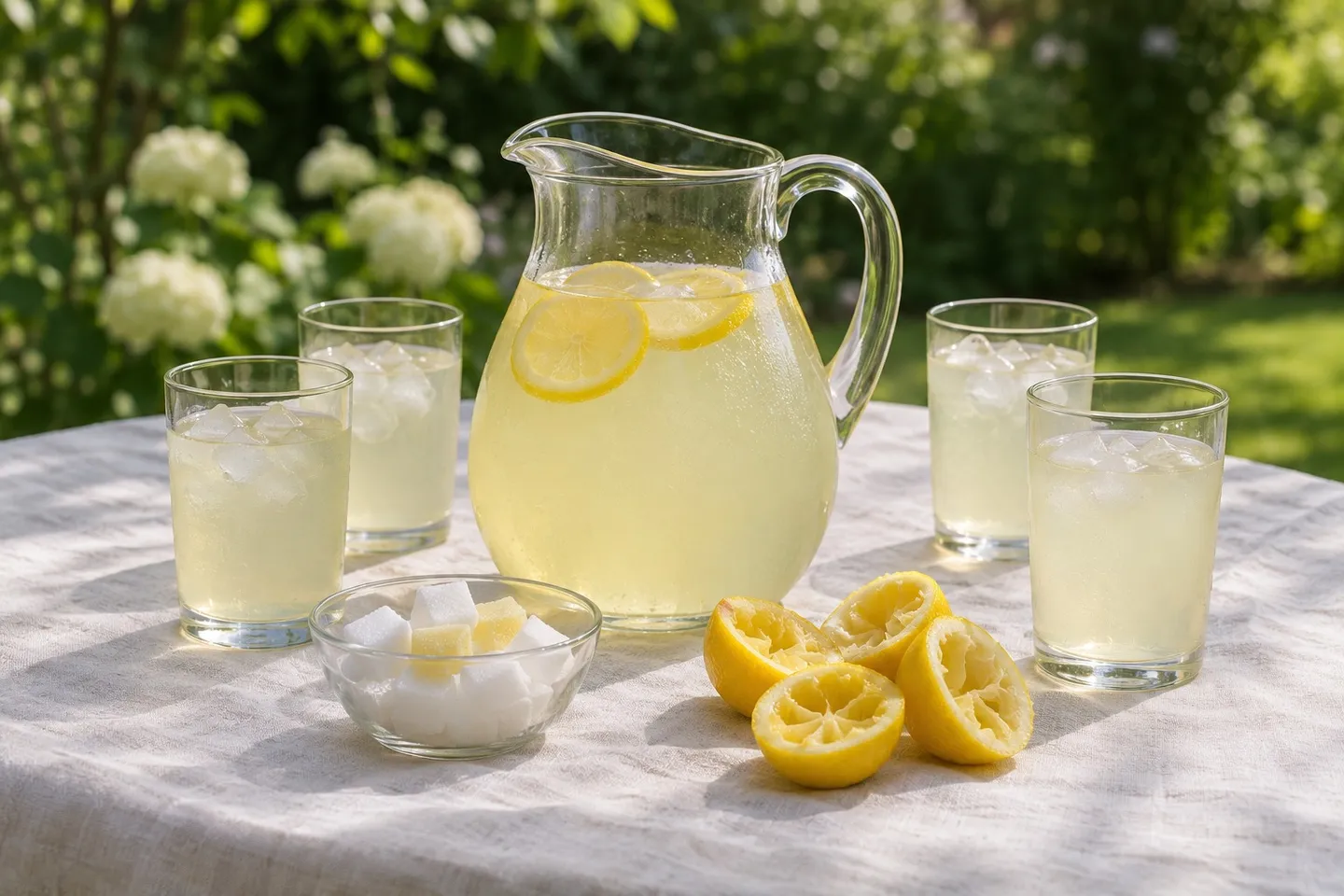
A jug of party lemonade with filled glasses, sugar cubes and squeezed lemons on a garden table.
The story behind the recipe
Jerry Thomas’s party lemonade gets its lemon flavor twice: from the juice of twelve lemons and from the rinds of eight more, rubbed on lumps of loaf sugar “until they have absorbed all the oil from them.” Boiling water goes over the lot, the jug is strained through muslin, and “when cool, it will be ready for use.” It makes a gallon, and it is on page 108 of his Bar-Tender’s Guide of 1887.
The sherry goes, the egg whites come in
The book already had a party lemonade in 1862. In How to Mix Drinks, No. 224 was a “Lemonade (Fine for parties.),” and Thomas added that “a little sherry mixed with it also makes this beverage much nicer,” which put wine in a recipe filed under temperance drinks. The 1887 recipe has no sherry in it. Its suggestion is egg whites: “The lemonade will be much improved by having the whites of four eggs beaten up with it.” His last line is the host’s friend: “A larger or smaller quantity of this lemonade may be made by increasing or diminishing the quantity of the ingredients used.”
Thomas used the same trick in the 1862 book, rubbing a few lumps of sugar over lemon peel for his hot Tea Punch “in order to increase the flavor.” The single-glass lemonades on the pages around this one, Soda Lemonade, Egg Lemonade and Orgeat Lemonade, are made to order, one glass at a time; this one is made ahead for a crowd.
Read more about this recipe
Making it today
We make half his gallon, about 2.2 liters with the juice, enough for nine glasses. Sugar cubes stand in for his loaf sugar and take up the lemon oil the same way. It is a sweet lemonade: by our arithmetic about 20 grams of sugar in every 100 ml, which is why it serves well over plenty of ice. Cut the sugar to 300 g if you want it sharper, our suggestion. How lemonade went from a Paris guild to the soda fountain is told in A Short History of Lemonade.
Fine Lemonade for Parties.
(One gallon.)
Take the rind of eight lemons.
Juice of twelve lemons.
2 pounds of loaf-sugar.
1 gallon of boiling water.
Rub the rinds of the eight lemons on the sugar until they have absorbed all the oil from them, and put it with the remainder of the sugar into a jug; add the lemon juice (but no pips), and pour over the whole the boiling water.
When the sugar is dissolved, strain the lemonade through a piece of muslin, and, when cool, it will be ready for use.
The lemonade will be much improved by having the whites of four eggs beaten up with it.
A larger or smaller quantity of this lemonade may be made by increasing or diminishing the quantity of the ingredients used.

Recipe makes: About 2.2 liters, 9 glasses
Ingredients
My drinksFor About 2.2 liters, 9 glasses. Quantities are shown as written.
Quantities as written here, for About 2.2 liters, 9 glasses.
- Lemons, for the rind4
- Sugar cubes450 g
- Fresh lemon juice (about 6 lemons)270 ml
- Boiling water1.9 l
Measurement notes
Ingredients as written here
- 4 lemons, for the rind
- 450 g sugar cubes
- 270 ml fresh lemon juice (about 6 lemons)
- 1.9 l boiling water
Equipment
 Citrus juicer
 Large heatproof jug or bowl
 Kettle
 Sieve lined with muslin
- Serving jug
Instructions
Wash and dry the lemons, for the rind. Rub each lemon firmly all over with the sugar cubes, one cube at a time, until the cubes turn yellow and smell of lemon. Rub only the colored skin; stop when you reach the white.
Put the rubbed cubes and the rest of the sugar into the large heatproof jug.
Add the fresh lemon juice, catching any pips in a sieve.
Pour on the boiling water and stir until all the sugar has dissolved.
Strain it through the muslin-lined sieve into the serving jug and leave it to cool, about 2 hours.
Chill it, and serve it in glasses over ice.
Nutrition
200calories per serving
- Recipe makes
- About 2.2 liters, 9 glasses
- Servings
- 9
Roughly estimated from USDA FoodData Central values for granulated sugar and lemon juice, for one 240 ml glass.
Recipe notes
When adjusting quantities
This is half of Thomas’s gallon. He says it scales either way: keep the rind of 1 lemon and the juice of 1 1/2 to every 110 g sugar and 475 ml water.
Notes
Quantities mentioned in these notes don’t change when you adjust the batch.
Changes from the source: half of Thomas’s quantities. His gallon is the US gallon, about 3.8 liters, so half is 1.9 liters; his 2 pounds of loaf sugar, about 910 g, becomes 450 g. Six lemons give about 270 ml of juice. Sugar cubes in place of loaf sugar, the cooling time and the ice are ours.
The rubbed lemons still have their juice; squeeze them for the 270 ml.
Thomas’s egg whites are optional, and the recipe stays vegan without them. If you try them, use 2 pasteurized egg whites for this half batch, beaten to a light froth and whisked into the cold lemonade just before serving, since the whites are not cooked.
Scaling changes the ingredients only; glassware, ice and timings need their own judgment. To adapt this recipe further, try the recipe tool at TuneMyRecipe (opens in a new tab), our sister site.
Sources and attribution
Jerry Thomas, The Bar-Tender’s Guide; or, How to Mix All Kinds of Plain and Fancy Drinks (New York: Dick & Fitzgerald, 1887), “Fine Lemonade for Parties,” p. 108
See the original pages (scan at Internet Archive) (opens in a new tab)
Recipe details
- Drink
- Alcohol-free
- Drink family
- Sodas & Soft Drinks
- Region
- American
- Era
- 19th century
- Source decade
- 1880s
- Base
- Fruit & juice
- Difficulty
- Easy
- Occasion
- Summer party
- Season
- Summer