An 1886 Chocolate Cup with an Equal Weight of Sugar
Reader ratingsAn ounce of chocolate scraped fine with its own weight of sugar, thrown into a pint of boiling milk and water and milled until it dissolves: the chocolate drink of a Massachusetts chocolate maker’s 1886 booklet.
- Recipe makes
- About 2 cups
- Prep
- Cook
- Total
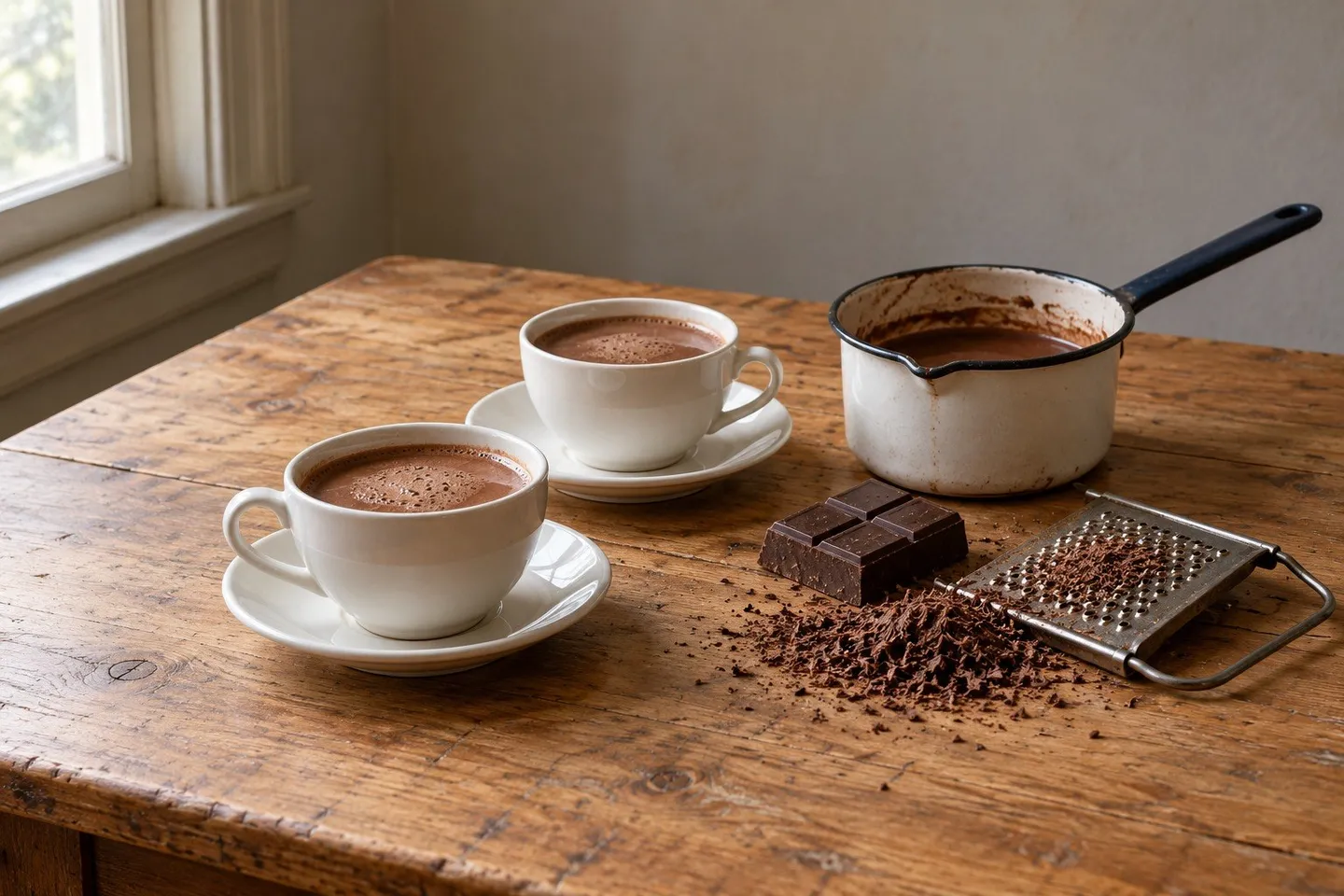
Two cups of hot chocolate beside the saucepan, a block of chocolate and the grater used to scrape it.
The story behind the recipe
This is the plain chocolate drink of 1880s America: an ounce of unsweetened chocolate scraped fine with about the same weight of sugar, thrown into a pint of boiling milk and water, half and half, and whisked for two or three minutes “until the sugar and chocolate are well dissolved.” The recipe comes from a booklet that Walter Baker & Company of Dorchester, Massachusetts, published in 1886 to go with the chocolate it sold in cakes marked off in one-ounce squares.
A cake in a blue wrapper
By then the Dorchester chocolate had been sold for decades in a blue wrapper with a yellow label, and shoppers asked for it simply as “Baker’s Chocolate.” That was the trouble when a New York wholesale grocer named William P. Baker began, in 1896, to buy chocolate from a Newark maker in 10-pound cakes, remold it into half-pound cakes, and wrap them in blue with a label reading “W. P. Baker’s.” Shops handed it over, the court found, “in response to requests for ‘Baker’s Chocolate.’” The whole case is in The Grocer Called Baker.
Read more about this recipe
Making it today
The booklet’s “square of a cake” was an ounce of unsweetened chocolate, and modern unsweetened baking chocolate is the same thing. Grating it fine, as the booklet says, lets it melt in a minute in the boiling liquid. With equal weights of chocolate and sugar it comes out dark and fairly sweet; cut the sugar if you prefer. “Some think ten or twelve minutes’ boiling improves it,” the booklet says, which thickens the cup a little. For the lighter cup made from cocoa powder on the next page, see Breakfast Cocoa the 1886 Way.
Baker’s Premium No. 1 Chocolate. Scrape fine about one square of a cake, which is one ounce; add to it about an equal weight of sugar; put these into a pint of perfectly boiling milk and water, of each one-half, and immediately mill or stir them well for two or three minutes, until the sugar and chocolate are well dissolved. Some think ten or twelve minutes’ boiling improves it.

Recipe makes: About 2 cups
Ingredients
For About 2 cups. Quantities are shown as written.
Quantities as written here, for About 2 cups.
- Unsweetened chocolate28 g
- Sugar28 g
- Whole milk1 cup
- Water1 cup
Measurement notes
Ingredients as written here
- 28 g unsweetened chocolate
- 28 g sugar
- 1 cup whole milk
- 1 cup water
Equipment
 Grater
 Small saucepan
 Wooden chocolate whisk (molinillo) or a small balloon whisk
 Teacups
Instructions
Grate the unsweetened chocolate finely and mix it with the sugar.
Bring the whole milk and the water to a full boil in the small saucepan.
Take the pan off the heat, add the chocolate and sugar at once, and whisk hard for 2 to 3 minutes, until it has all dissolved and the top is frothy.
For a thicker cup, put it back on a low heat and let it bubble gently for 10 to 12 minutes, stirring often. Pour into the teacups.
Nutrition
200calories per serving
- Recipe makes
- About 2 cups
- Servings
- 2
Roughly estimated from USDA FoodData Central values for unsweetened baking chocolate, whole milk and granulated sugar, for one cup.
Recipe notes
When adjusting quantities
The booklet’s pint, for two cups. Keep the chocolate and sugar equal by weight, and the milk and water equal.
Notes
Quantities mentioned in these notes don’t change when you adjust the batch.
Changes from the source: the booklet’s “pint” is the US pint of 2 cups, which we keep. We take the pan off the heat while whisking so the milk doesn’t boil over; the booklet just says to mill it at once. Its “about an equal weight of sugar” is kept at 28 g. The booklet was written to sell the company’s own chocolate; any unsweetened baking chocolate works.
Scaling changes the ingredients only; glassware, ice and timings need their own judgment. To adapt this recipe further, try the recipe tool at TuneMyRecipe (opens in a new tab), our sister site.
Sources and attribution
Walter Baker & Company, Cocoa and Chocolate: A Short History of Their Production and Use (Dorchester, Mass.: Walter Baker & Company, 1886), “Premium No. 1 Chocolate”, p. 98
Recipe details
- Drink
- Alcohol-free
- Drink family
- Hot Drinks
- Region
- American
- Era
- 19th century
- Source decade
- 1880s
- Difficulty
- Easy
- Season
- Winter