The Wine List at Willard’s Hotel
Champagne at $3, claret by the quart or pint, a dollar for corkage and wine cards with pencils: Willard’s Hotel wine list, its 1864 dinner and Lincoln’s bill.
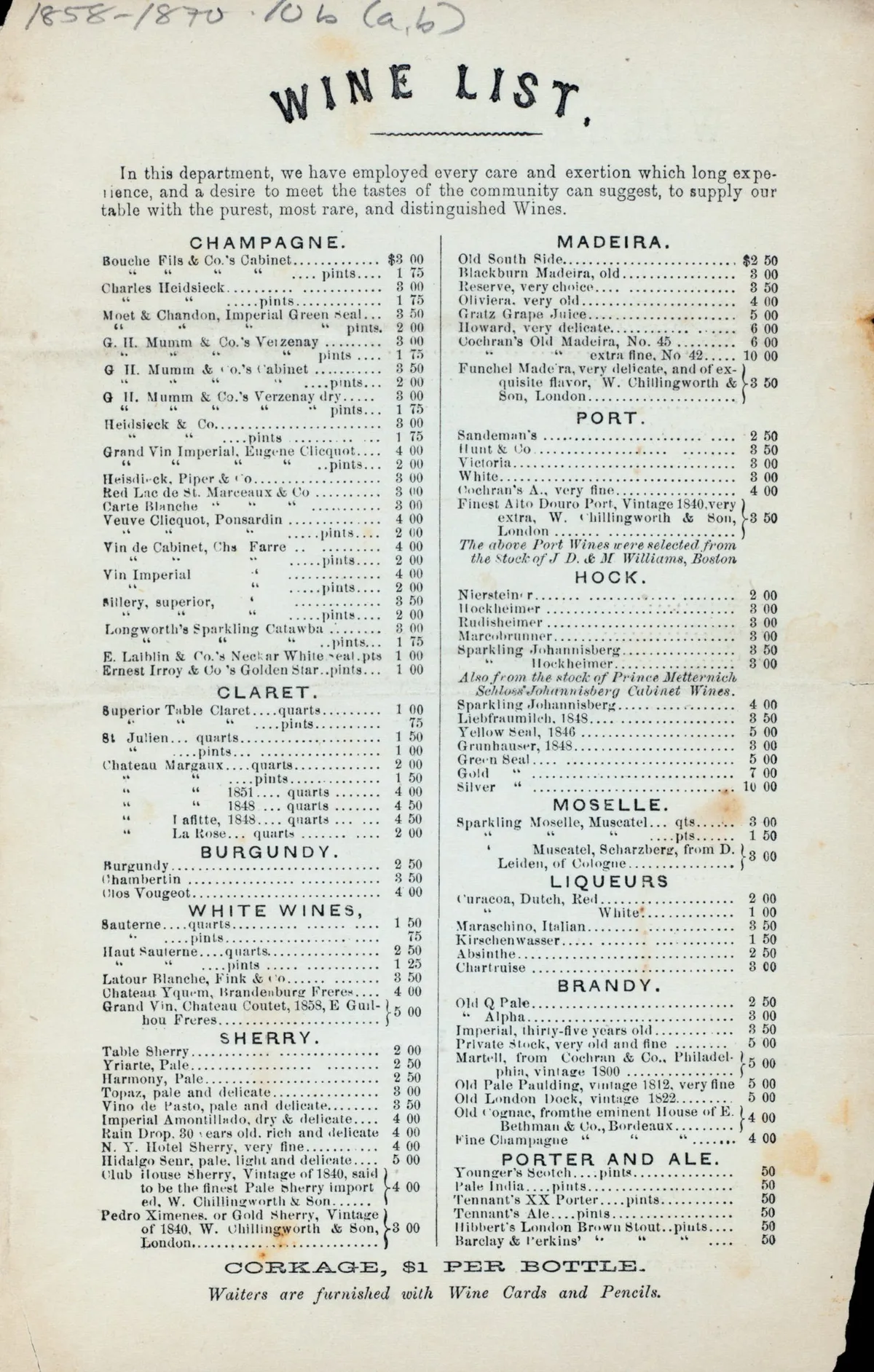
Willard’s wine list offered some ninety-six wines, spirits and beers under twelve headings, from $10 Madeira and hock down to 50-cent porter, and it closed with two lines about service: “CORKAGE, $1 PER BOTTLE,” and “Waiters are furnished with Wine Cards and Pencils.” The card itself carries no date. The New York Public Library keeps it with a Willard’s dinner bill printed for Friday, February 12, 1864. If the prices belong to that winter, each dollar on the card is about $21 in today’s money, by US consumer prices; on 1861 prices it would be about $36.
Neither leaf prints the hotel’s name. The library catalogues them together under Willard’s Hotel, Washington, D.C., in its Buttolph Collection of Menus, and a collector’s pencil note on each gives the span “1858–1870.” That span is as close as the card can be dated, and the dinner is the only piece of the set that names a day.
Champagne first
The list opens with a promise. “In this department, we have employed every care and exertion which long experience, and a desire to meet the tastes of the community can suggest, to supply our table with the purest, most rare, and distinguished Wines.” That is the hotel speaking for itself.
Champagne takes the longest column: eighteen entries, among them Moët & Chandon’s Imperial Green Seal, three wines from G. H. Mumm, Heidsieck and Veuve Clicquot. Most cost $3 to $4 a bottle, about $62 to $82 today, and most pints $1.75 to $2, about $36 to $41. In the middle of the French houses sits “Longworth’s Sparkling Catawba,” an American sparkling wine, at $3 a bottle and $1.75 a pint (about $62 and $36 today), the same as Bouché Fils’ Cabinet at the top of the column. The hotel filed it under Champagne and priced it level with the imports. American “champagne” could mean several things in those years, some of it made from apples, the subject of What Was Champagne Cider?.
The rest of the card runs to the same pattern of names, sources and the odd vintage. Eleven sherries go from Table Sherry at $2 (about $41 today) to Hidalgo at $5 (about $100), with an Imperial Amontillado, a “N. Y. Hotel Sherry, very fine,” and a Club House Sherry of 1840 “said to be the finest Pale Sherry imported.” The ports were “selected from the Stock of J. D. & M. Williams, Boston,” and some of the hocks came “from the stock of Prince Metternich.” The dearest lines are $10: Cochran’s Old Madeira No. 42 and a Silver Seal hock, about $210 today. At the bottom of the second column, the porter and ale section prices Younger’s Scotch, Tennant’s XX Porter and Hibbert’s London Brown Stout at 50 cents a pint, about $10.
Quarts and pints
Several wines came in two sizes, and the card prints both prices. Superior Table Claret was $1 for a quart and 75 cents for a pint (about $21 and $15 today). Two pints, then, cost $1.50 (about $31) against a dollar for the quart. St. Julien was $1.50 and $1 (about $31 and $21). Sauterne, by contrast, was $1.50 a quart and 75 cents a pint (about $31 and $15), and Haut Sauterne $2.50 and $1.25 (about $52 and $26): there the pint was exactly half. In champagne, two pints at $1.75 came to fifty cents (about $10) more than the $3 bottle. The card doesn’t say how much its “quart” or “pint” held, or why one half bottle cost extra and another didn’t.
A dollar a bottle for corkage
The charge in capitals at the foot of the card is a different kind of price. “CORKAGE, $1 PER BOTTLE” is a fee for a service, the same dollar as a quart of the table claret. Corkage was, and is, usually what a house charges to open and serve a bottle the guest has brought, but the card doesn’t spell out what it covered or who paid it, and nothing in the set shows it charged.
Waiters carried wine cards and pencils, so an order from ninety-odd lines went down in writing, by guest or waiter.
The dinner it came with
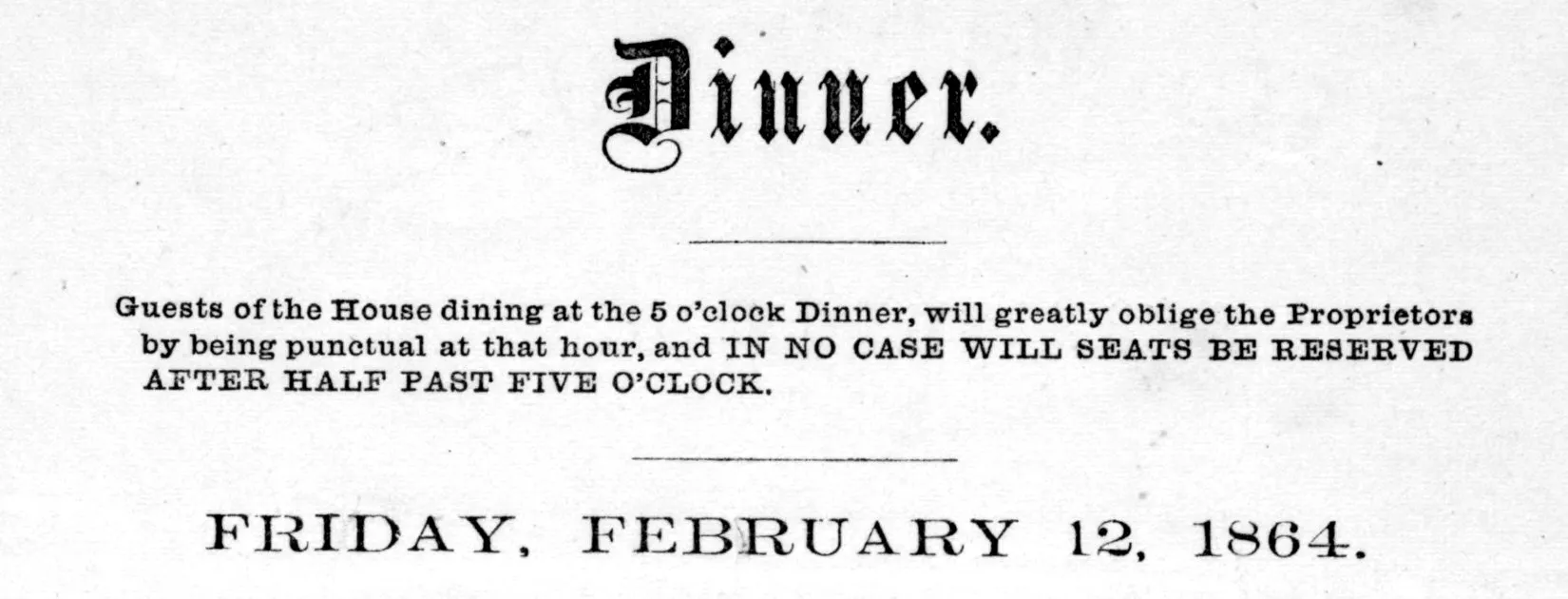
Head of the Willard’s dinner bill for Friday, February 12, 1864. The New York Public Library, Rare Book Division, Buttolph Collection of Menus.
The dinner bill begins with a rule. “Guests of the House dining at the 5 o’clock Dinner, will greatly oblige the Proprietors by being punctual at that hour, and IN NO CASE WILL SEATS BE RESERVED AFTER HALF PAST FIVE O’CLOCK.” Below the date come oyster and rice soups, baked pike with claret sauce, boiled turkey with oyster sauce, ham with champagne sauce, venison with currant jelly, quails, oyster patties, apple fritters, a long run of pies and puddings, pineapple ice cream, nuts, raisins and figs, and coffee. Wine was in the kitchen as well as on the card.
A third leaf, the house rules, adds an early breakfast for guests catching early trains and an extra charge for meals or fruit sent to a room or carried away from the table. Like corkage, it priced the service around the food.
The building has changed since. The Willard brothers, Henry and Edwin, began keeping the hotel in 1847, the National Park Service records, and after buying the neighboring Kearney property in 1858 built a six-story addition; the hotel on the site today was completed in 1904. In July 1862 Nathaniel Hawthorne, writing in The Atlantic Monthly, suggested that the old Willard’s might more justly be called the center of Washington and the Union than the Capitol, the White House or the State Department.
Lincoln’s bill
A separate kind of paper connects Willard’s to its most famous guest. Abraham Lincoln arrived on February 23, 1861, as president-elect. Lincoln Day by Day, the chronology the Lincoln Sesquicentennial Commission published in 1960, quotes the hotel register: “Hon. A. Lincoln & Family 5 persons Meals in Room for 6,” assigned to “No. 6.” Its editors add that “private dinners, entertaining, liquor and cigars for numerous visitors” brought the bill to $773.75, about $28,000 today. That summary is the editors’, drawn from the register.
On April 19, 1861, the day he proclaimed the blockade of the Southern ports, Lincoln wrote to “Messrs. Willards” from the Executive Mansion: “I am annoyed to know that my Bill at your house has not yet been paid. Receipt it & hand it to Mr. Nicolay & he will give a check for the amount.” The signed letter is in the Shapell Manuscript Collection (SMC 907).
The letter and the stay are 1861; the dinner is 1864; the wine list has no date at all. Nothing ties Lincoln to any line on the card, and the editors list liquor among the charges for numerous visitors, so it says nothing about what he drank.
From the bottle to the glass
The card sells bottles. Jerry Thomas’s How to Mix Drinks, published in New York in 1862, shows what a bar did with the same wines. Its cobblers are wine, sugar and fruit over shaved ice, drunk through a straw, and several of the wines on Willard’s list have one: the Sherry Cobbler, the Champagne Cobbler, and Catawba, hock, claret and Sauterne cobblers on the same page. TuneMyRecipe (opens in a new tab) makes the sherry version with muddled orange.
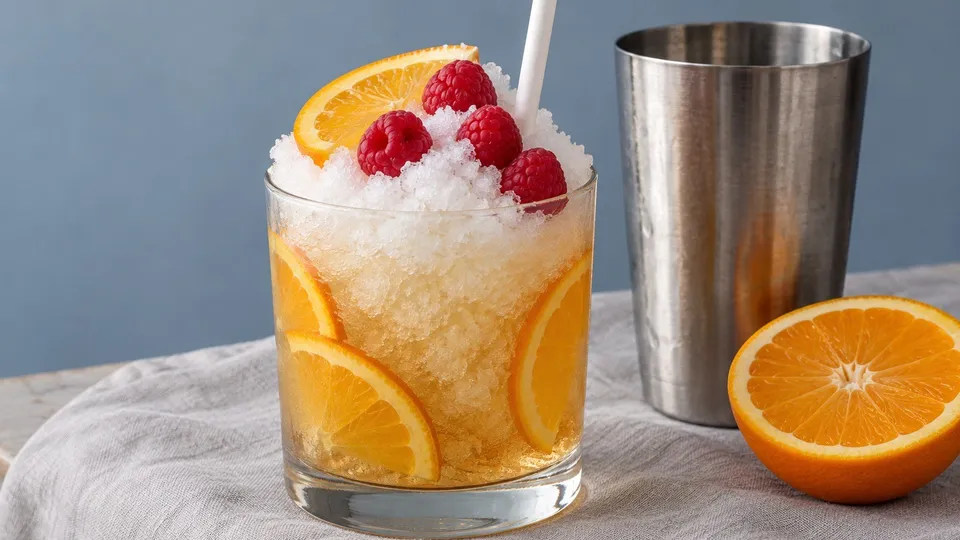 Make it todaySherry Cobbler, the 1862 Bar Recipe
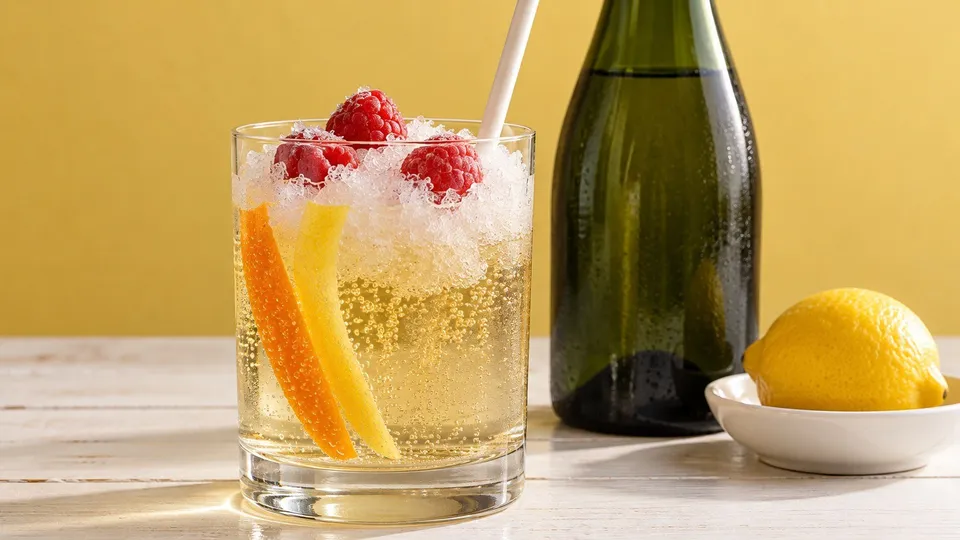 Make it todayChampagne Cobbler, a Bottle to Four Glasses
Willard’s card lists no mixed drinks, and Thomas never mentions Willard’s. Our own arithmetic is the closest the two come: Thomas pours “one bottle of wine to four large bar glasses,” so a $3 bottle of champagne from the card would make four cobblers at 75 cents of wine each, about $15 today, before the hotel’s charge for anything else. For an alcohol-free glass in the same spirit, the grape juice highball is grape juice and soda water over a little ice, and the Champagne Cobbler’s notes give a version with sparkling grape juice.
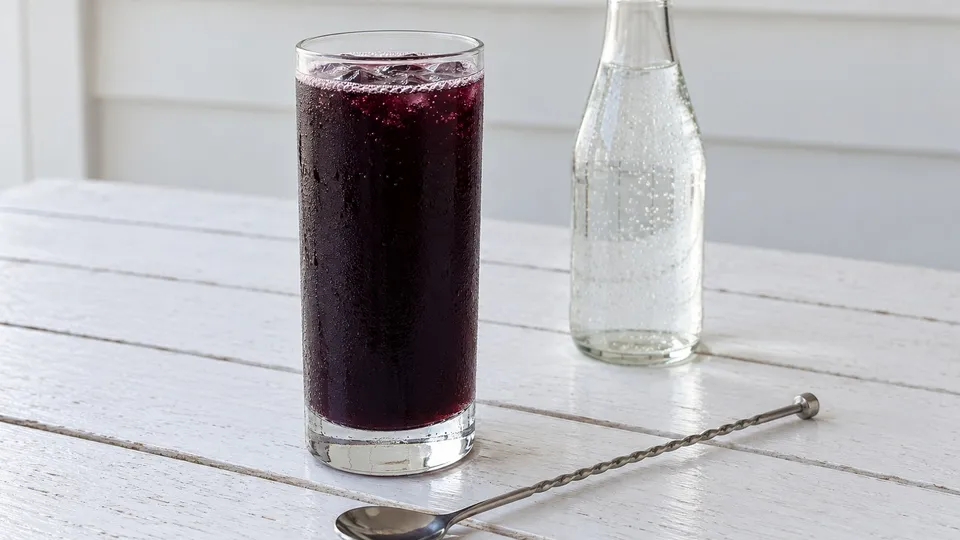 Always alcohol-freeGrape Juice Highball, the Prohibition Soft Drink
One American wine is on both pages. Thomas’s Rochester Punch, for a party of twenty, starts with two bottles of sparkling Catawba, and Willard’s card files Longworth’s Sparkling Catawba among the champagnes, at $3 a bottle (about $62 today). That one bottle, split four ways over ice with sugar and peel, is Thomas’s Champagne Cobbler: a round for a table of four in ten minutes.
Sources
- Wine list, dinner bill (Friday, February 12, 1864) and house rules, Willard’s Hotel, Washington, D.C. The New York Public Library, Rare Book Division, Buttolph Collection of Menus, images 4000000050, 4000000049 and 4000000051; catalogue record (opens in a new tab). Scans via Wikimedia Commons (opens in a new tab).
- Abraham Lincoln to Messrs. Willards, Executive Mansion, April 19, 1861. Shapell Manuscript Collection, SMC 907 (opens in a new tab).
- Earl Schenck Miers, ed., Lincoln Day by Day: A Chronology, 1809–1865, vol. III, 1861–1865, ed. C. Percy Powell (Washington: Lincoln Sesquicentennial Commission, 1960), pp. 22 and 36.
- Jerry Thomas, How to Mix Drinks, or, The Bon-Vivant’s Companion (New York: Dick & Fitzgerald, 1862), pp. 26, 47–48.
- National Park Service, “Willard Hotel, Washington DC (opens in a new tab).”
- Nathaniel Hawthorne, “Chiefly About War-Matters (opens in a new tab),” The Atlantic Monthly, July 1862.
- Today’s values: Federal Reserve Bank of Minneapolis, Consumer Price Index 1800– (annual averages, 1967 = 100; 1861 = 27, 1864 = 47, 2025 = 967.5).