What Did Schiedam Promise on a Bottle of Jenever?
In 1901 and 1902 the Dutch town of Schiedam put its name on jenever made by one malt-wine method, even outside the town, and argued over what that promised.
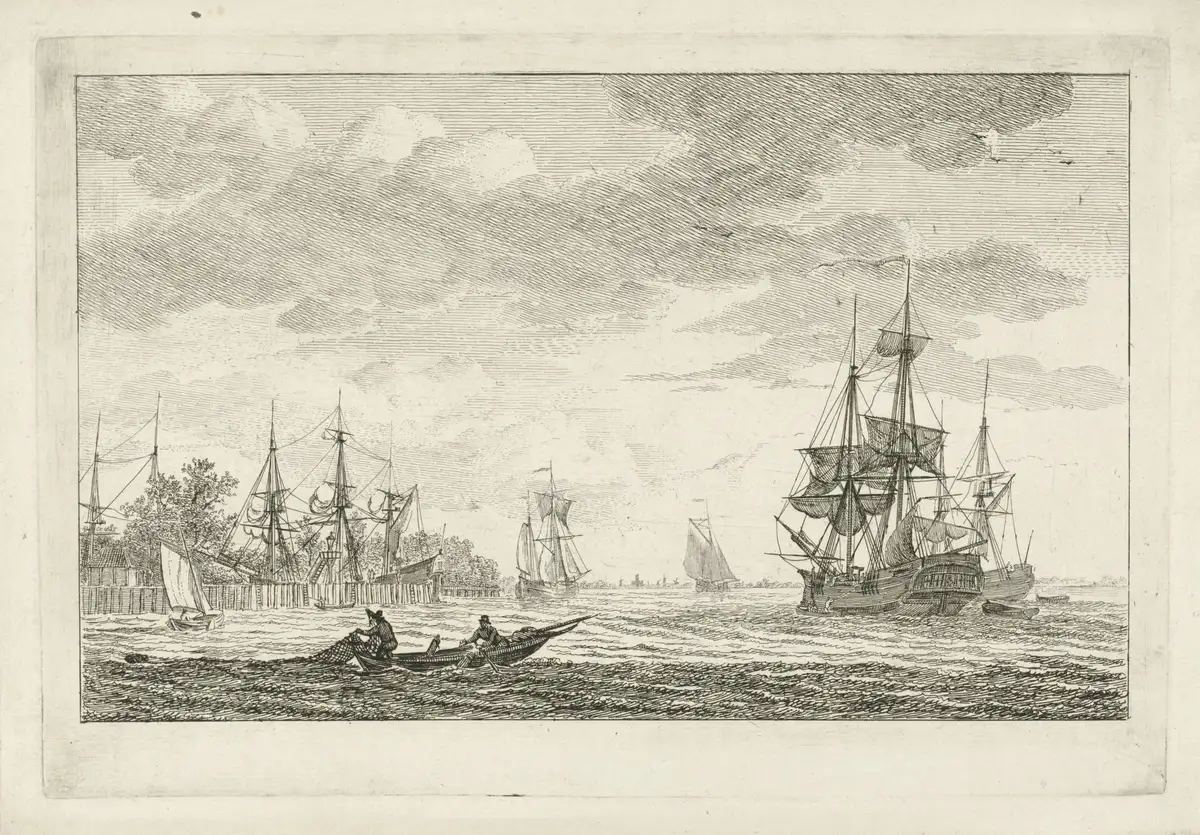
Schiedam promised a method. In 1901 and 1902 the town council of Schiedam, the Dutch distilling town just west of Rotterdam, set up a municipal guarantee for jenever, the Dutch juniper spirit, with the mayor’s and the town secretary’s signatures on the label. It did not promise that the bottle came from Schiedam. It promised that the jenever was made in one prescribed way, from malt wine, under the town’s inspection, and a distillery elsewhere in the Netherlands could join if it followed the rules. Not everyone on the council agreed that a signature on a bottle of strong drink could promise even that.
The distillers’ complaint
The request came from the distillers. On February 24, 1900, the Brandersbond, Schiedam’s association of distillers, petitioned the council. Mixtures and other spirit, they complained, were being sold under the Schiedam name. They asked for a municipal guarantee on casks, bottles and cases, so that buyers could recognize the real malt-wine product, and they hoped a name buyers could trust would bring a better price.
That was the producers’ own account of their trouble, and it was an interested one. The petition, printed in the council’s appendices that September, does not measure how much false Schiedam was on the market. It is still a clear request: put the town’s name behind ours.
A city mark, and the abstainers’ letter
Not everyone in Schiedam wanted the town to bless jenever. At the council meeting of May 7, 1901, a letter from the local Christian total-abstinence association was read out, asking the council not to grant an official mark, and the local women’s total-abstinence association endorsed it. The minutes record the letters arriving but not their full text or their members. They do show women’s organizations taking a public part in a decision about the town’s drink trade.
The council voted for the first ordinance anyway, 12 to 7, and it came into force on July 1, 1901. By early 1902 it was working: the mayor could name firms under control and give the town’s accounts for the scheme.
One method, not one town
The guarantee then ran into questions from The Hague. In a proposal dated February 13, 1902, the mayor and aldermen reported that the national government had asked about neutrality and private agreements. Would labels for both kinds of jenever, the malt-wine kind and the other, be fairer? Could private contracts do the job instead? The town’s answer was that only one method deserved the Schiedam name, and a second label would mark something other than the product it meant to protect. The revised scheme split into an ordinance that made the guarantee possible and a set of conditions for each firm’s agreement.
The definition was all about production. Guaranteed jenever had to come exclusively from malt wine. The grain mash went through three named stages, ruwnat, enkelnat and moutwijn, over a fire or with closed steam, and a qualifying distillery could not keep equipment for distilling its mash any other way. The premises did not have to be in Schiedam: anywhere in the Netherlands would do. The control ran on paper as much as on stills: inspectors with right of entry, excise documents, registers, and labels that could be used only once.
The meeting of February 25, 1902
The council debated the revised scheme on February 25, 1902. M. C. M. de Groot objected to attaching the mayor’s and secretary’s signatures to strong drink at all. He also challenged the wording: the town checked the equipment, he argued, not the making itself, so the label promised more than the inspection could. Other councillors defended the controlled premises and the production rules. The mayor promised to have the wording looked at again. The minutes record the promise; whether a new label followed is not in them.
P. Loopuyt worried about firms that made more than one product, since everything leaving controlled premises had to go out as jenever. He also doubted the scheme was catching on. “Van hen die zich onder contrôle konden stellen omdat zij geen spiritus verbruiken hebben slechts weinigen die contrôle aangevraagd,” he said: of those who could have come under inspection because they used no spiritus, the bought-in alcohol the guarantee shut out, only a few had applied.
The mayor saw it differently. Four distilling firms were under control, and he put the town’s costs “tot heden,” to date, at ƒ627.18 against receipts of ƒ345.16, about €11,000 and €6,000 today by Dutch consumer prices (IISG and CBS), with labels still in hand. Firms, he said, had held back partly because they were waiting to see how the national question would end. Both men were giving their own reading of the same small numbers, and neither the accounts nor the unused labels say how many bottles anyone bought.
The revised ordinance passed 12 to 8. The conditions passed 12 to 6, after one councillor had left. Schiedam had voted for a guarantee that was still argued over, not proved that it worked.
Jenever’s older reputation
The town was trying to fix a reputation that had always been mixed. No one can name the day jenever was invented. The linguist Nicoline van der Sijs, citing earlier scholarship, reports the word used for the drink in a text of 1606 by Caspar Coolhaes, among the medicinal waters, which is earlier than the life of Franciscus Sylvius, the physician often given the credit. That is a word in a book, not one recipe running unchanged to the present.
An anonymous song, the “Testament van Kortjakje,” made fun of the drink’s darker side. Its dead heroine wants a big bottle of jenever in her coffin for the journey, her friends must drink before they carry her off, two by two, each with a bottle, and the jenever sellers mourn a customer of rare capacity. The song ends on a sorry list of her broken belongings. It survives in a collection of booklets now in Leiden, which its modern editor dates probably to the first decade of the 1700s. It is a comic song, not evidence of how the Dutch buried anyone.
Praise could be just as hard to read. The scholar Karel Bostoen reads Robert Hennebo’s poem De lof der jeneever (1718), “In praise of jenever,” as mock praise, where the claims for the drink’s powers are part of the joke. Half a century after Schiedam’s vote, the poem came back to bother the government. On March 27, 1952, a member of parliament asked about a choral setting of it by B. van den Sigtenhorst Meyer, commissioned and paid for by the state. The state secretary, Cals, answered that a request for money to publish it had been refused, and that the composer had later dedicated the work to an Amsterdam distillery, which he regretted.
Hollands abroad
Outside the Netherlands the spirit went by other names, and into other glasses. English and American bar books called it Hollands or Holland gin. William Terrington’s London book of 1869 has a “Hollands, Gin, or Whisky Smash”: “3 sprigs of mint, 1 of verbena, 1 gill of Hollands; tablespoonful of white sugar; fill up with shaven Lake ice; use straws.” Harry Johnson’s New York bartenders’ manual of 1900 has a Hot Gin Sling: a lump of sugar dissolved in a little water, “1 wine glass of Holland gin,” hot water to fill, nutmeg on top, and “a slice of lemon if the customer desires it.” One is cold and full of herbs, the other hot. Neither says anything about how people in Schiedam drank their jenever, and neither book asks where the Hollands was made or how. The town’s label said something narrower: made this way, from malt wine, under inspection. To taste the difference the gin makes in a glass, mix Tom Collins, the 1876 Gin and Soda: by 1895 a New York bartender told it from the John Collins only by its gin, Old Tom in one and Holland gin in the other. What the Dutch drank in their colony on the Hudson two centuries earlier, from beer to brandy, is in What Did People Drink in New Netherland?
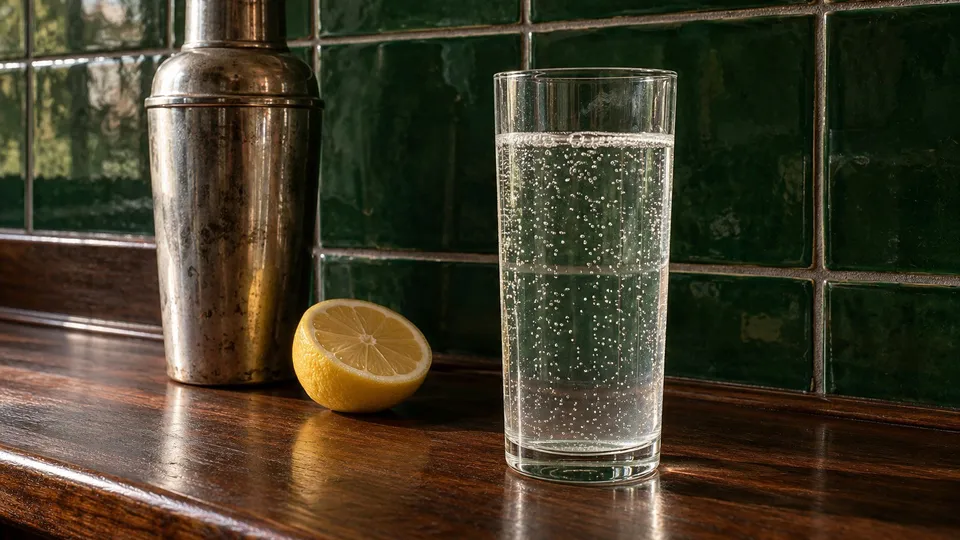 Make it todayTom Collins, the 1876 Gin and Soda
Sources
- Schiedam town council, proceedings of February 25, 1902 (Tweede zitting): debate, item LIII, pp. 56–62; proposal of the mayor and aldermen, February 13, 1902, appendix VIIIa, pp. 26–29; draft ordinance, appendix VIIIb, pp. 30–31; conditions, appendix VIIIc, pp. 32–38. Schiedam municipal archive, via Raadswerk.
- Brandersbond, petition of February 24, 1900, printed in Schiedam council proceedings, September 4, 1900, appendix XXXIVb, pp. 162–163.
- Schiedam town council, proceedings of May 7, 1901, items XI–XII, pp. 119–120, and vote, pp. 143–144.
- Nicoline van der Sijs, Geleend en uitgeleend (Amsterdam: Contact, 1998), pp. 136–138.
- Anonymous, “Testament van Kortjakje,” Nijhoff song collection, Leiden University Library, 1497 H 16, pp. 47–48, via DBNL.
- Karel Bostoen, “Robert Hennebo’s lof van de jenever. Een Nederlandse eigenaardigheid?”, in Remke Kruk and Sjef Houppermans, eds., Een vis in een fles raki (Amsterdam, 2005), pp. 69–92; revised DBNL version, 2006.
- William Terrington, Cooling Cups and Dainty Drinks (London: George Routledge and Sons, 1869), “Hollands, Gin, or Whisky Smash,” p. 196.
- Harry Johnson, New and Improved Illustrated Bartenders’ Manual, revised edition (New York, 1900), “Hot Gin Sling,” p. 218.
- Handelingen der Tweede Kamer, 68th meeting, March 27, 1952, pp. 2051–2052.
- Gerrit Groenewegen, Westerhavenhoofd te Schiedam, etching, 1797, Rijksmuseum, RP-P-OB-55.989.