A Drop of Chocolate at the South Pole
Hot chocolate on the march, coffee in the hut and a glass of toddy every Saturday: what Roald Amundsen’s men drank in 1911, by his own account.
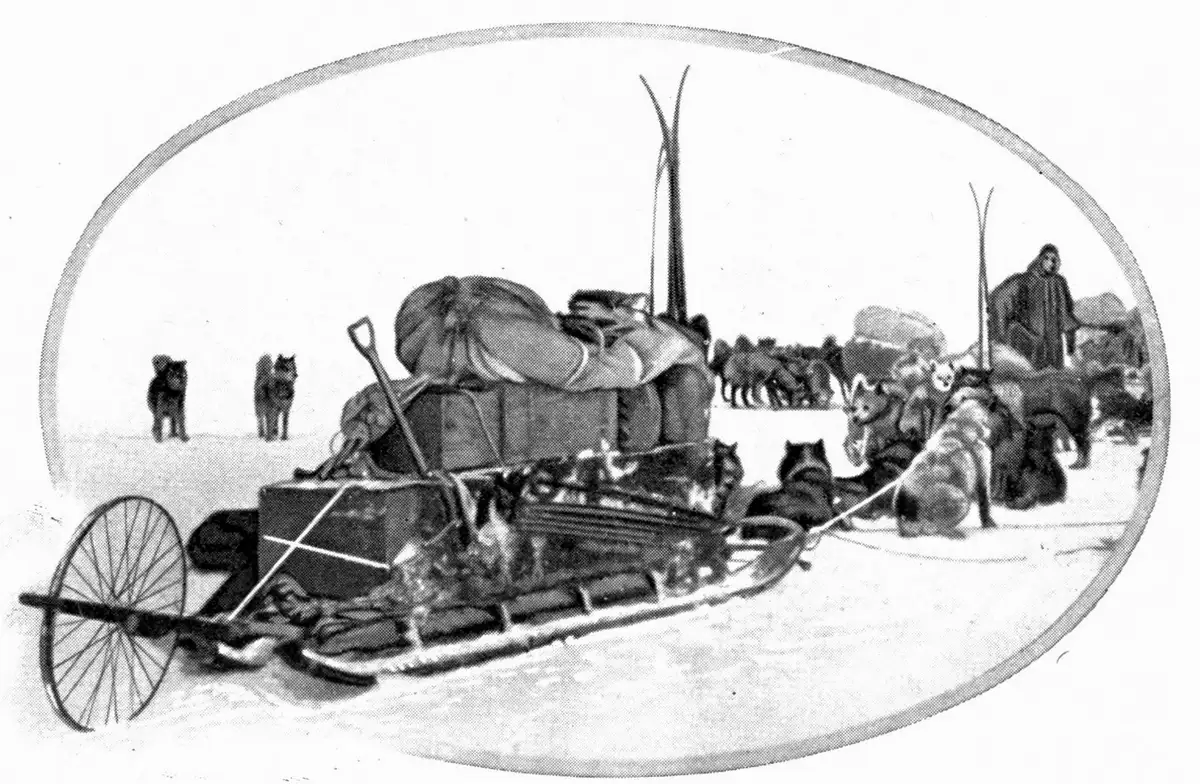
Roald Amundsen’s men drank hot chocolate and water from melted snow on their way to the South Pole, and no alcohol at all. Amundsen kept it off the sledges, he wrote, “on account of the weight and space,” not because he disapproved of it. Back in the hut it was a different story: coffee at every meal and, every Saturday evening, a glass of toddy and a cigar. When his party reached the Pole on December 14, 1911, they celebrated with a piece of seal meat each.
Everything here comes from Amundsen’s own account, The South Pole, published in 1912 and read in A. G. Chater’s English translation. The words, and units such as “a quart,” are the translator’s.
Weight and space
Amundsen set out his views on drink before he described a single sledge. The expedition was “well supplied with wines and spirits, thanks to one of the largest firms of wine-merchants in Christiania,” as Oslo was then called. But the supplies stayed at the base.
“Personally, I regard alcohol, used in moderation, as a medicine in the Polar regions,” he wrote, “I mean, of course, so long as one is in winter quarters. It is another matter on sledge journeys: there we all know from experience that alcohol must be banished.” Not, he went on, “because a drink of spirits can do any harm, but on account of the weight and space.”
It is a practical argument, and he made it with some heat. He expected an objection: “A total abstainer will no doubt turn up his nose and ask whether a cup of good warm coffee would not do as well.” His answer was that coffee did more harm. “For my part, I think the quantity of coffee people pour into themselves at such times is far more harmful than a little Lysholmer snaps,” a Norwegian aquavit.
A glass of toddy on Saturday evenings
He went further on the next page. Two men who had fallen out during the week, he wrote, were “reconciled at once by the scent of rum.” Then the line that sums him up: “I am for a glass of toddy. Let who will eat plum-cake and swill hot coffee.” Heartburn, he added, “and other troubles are often the result of this kind of refreshment. A little toddy doesn’t hurt anybody.”
He gave the ship’s allowance exactly. “The consumption of alcohol on the Fram’s third voyage was as follows: One dram and fifteen drops at dinner on Wednesdays and Sundays, and a glass of toddy on Saturday evenings. On holidays there was an additional allowance.”
At Framheim, the hut at the Bay of Whales where the men spent the winter of 1911, the routine held. His diary for March 25 lists the day’s meals: hot cakes with jam, bread, butter, cheese and coffee at breakfast, and “for supper, seal-steak, with whortleberry jam, cheese, bread, butter, and coffee. Every Saturday evening a glass of toddy and a cigar. I must frankly confess that I have never lived so well.”
The book gives no recipe for the toddy. The Hot Toddy as Jerry Thomas Made It, from his New York bar book of 1862, is whiskey, sugar and boiling water, but it is an American recipe, not the one mixed at Framheim.
 Make it todayThe Hot Toddy as Jerry Thomas Made It (1862)
The hut had a soft drink too. “An establishment at Drammen gave us as much fruit syrup as we could drink,” Amundsen wrote, and on the way back from the Pole “we looked forward every day to getting nearer to our supply of syrup.”
Pemmican, biscuits, milk powder and chocolate
The sledge diet was short. “Besides the pemmican, we had biscuits, milk-powder, and chocolate,” Amundsen wrote, and the milk was a dried milk from a firm in Wisconsin, “with an addition of malt and sugar.” It came “put up in bags of 10½ ounces,” one bag to a meal.
When the party divided its stores at a camp in the mountains in November 1911, Amundsen printed the load of one sledge. Among the pemmican and biscuits it held “Chocolate, 12¾ pounds (40 grams, or 1·4 ounces per man per day). Milk-powder, 13½ pounds (60 grams, or 2·1 ounces per man per day).”
The chocolate was drunk as well as eaten, made on the Primus stove. Amundsen never says exactly how the chocolate was made, but he says plenty about how it felt. After one hard climb, “soon the Primus was humming in a way that told us it would not be long before the chocolate was ready. It was a heavenly treat, that drink. We had all walked ourselves warm, and our throats were as dry as tinder.” Another day it was “good exercise after a quart of chocolate.” Not every cook was generous: once the drink Hanssen made “was what he called chocolate, but I had some difficulty in believing him. He was economical, was Hanssen.”
The only recipe in the book is a joke. Oscar Wisting’s “chocolate pudding,” cooked on the way home: “biscuit-crumbs, dried milk and chocolate are put into a kettle of boiling water. What happens afterwards, I don’t know; for further information apply to Wisting.”
Not that champagne corks were popping
The party reached the Pole on December 14, 1911. “Of course, there was a festivity in the tent that evening,” Amundsen wrote, “not that champagne corks were popping and wine flowing.” Instead, “we contented ourselves with a little piece of seal meat each, and it tasted well and did us good.”
They stayed to take observations, and the chocolate came out again. After a cold spell outside, “we put the kettle on to give ourselves a drop of chocolate; the pleasure of standing out there in rather light attire had not exactly put warmth into our bodies.” Bjaaland, one of the party, had brought cigars and handed them round. “A cigar at the Pole! What do you say to that?”
A tot for the Queen
There was one exception to the dry rule, and it happened far from the Pole. While Amundsen’s party went south, Lieutenant Prestrud led a smaller sledge journey east, and on November 26 his men marked Queen Maud’s birthday. “Her Majesty’s health was drunk in a very small, but, at the same time, very good tot of aquavit, served in enamelled iron mugs.”
The book admits it was against orders. “Carrying alcohol was, of course, against regulations, strictly speaking; but, as everyone knows, prohibition is not an easy thing to put into practice. Even in Antarctica this proved to be the case.”
Shackleton’s men, three years earlier, had drunk tea and cocoa on the march too, but opened champagne and whisky at midwinter in their hut, as told in Tea on the March, Whisky at Midwinter. Amundsen’s rule was steadier: a little every week at base, and none at all on the trail.
A cup for December 14
Make Sledge Chocolate from Amundsen’s 1911 Ration, because it is the drink the men described most warmly on the way to the Pole: dark chocolate and whole-milk powder whisked into just-boiled water, built from the 40 grams of chocolate in each man’s daily ration, with no alcohol and ready in five minutes.
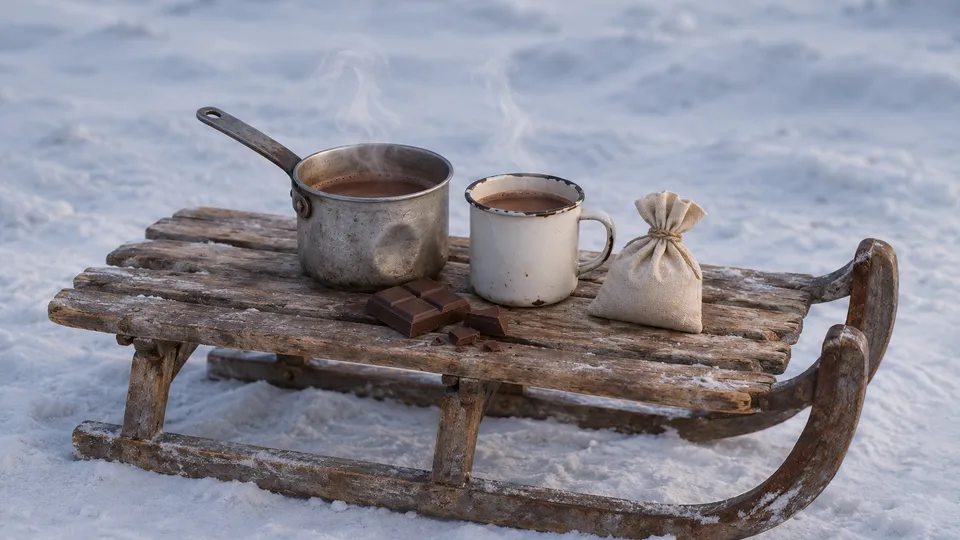 Always alcohol-freeSledge Chocolate from Amundsen’s 1911 Ration
For what was on the plate, our sister site The Forgotten Menu has what Amundsen’s rival, Scott, ate at Midwinter 1911 (opens in a new tab).
Sources
- Roald Amundsen, The South Pole: An Account of the Norwegian Antarctic Expedition in the “Fram,” 1910–1912, translated by A. G. Chater, 2 vols. (London: John Murray, 1912), vol. 1, pp. 69–71, 88–89 and 253; vol. 2, pp. 36, 44, 59, 67, 123, 126, 132, 170 and 237, and the photograph facing vol. 2, p. 70. University of Toronto copy, Internet Archive.