Tea on the March, Whisky at Midwinter
Tea and cocoa every day, champagne and whisky at midwinter: what Shackleton’s Nimrod expedition of 1907–09 drank, and what the whisky under the hut proves.
Mostly tea and cocoa. On Ernest Shackleton’s Nimrod expedition of 1907 to 1909, the men drank tea in the hut at Cape Royds and tea and cocoa on the sledging journeys, with coffee in the stores as well. Alcohol came out for celebrations: champagne when a party came home, whisky and champagne on the midwinter menu. The whisky famously found under the hut a century later proves the expedition stored it. It doesn’t prove anyone drank it every day.
This is the Nimrod expedition, not the later voyage of the Endurance. Shackleton’s own account, The Heart of the Antarctic, came out in London in 1909, and it is the source for the expedition’s side of the story.
Cocoa, tea and coffee in the stores
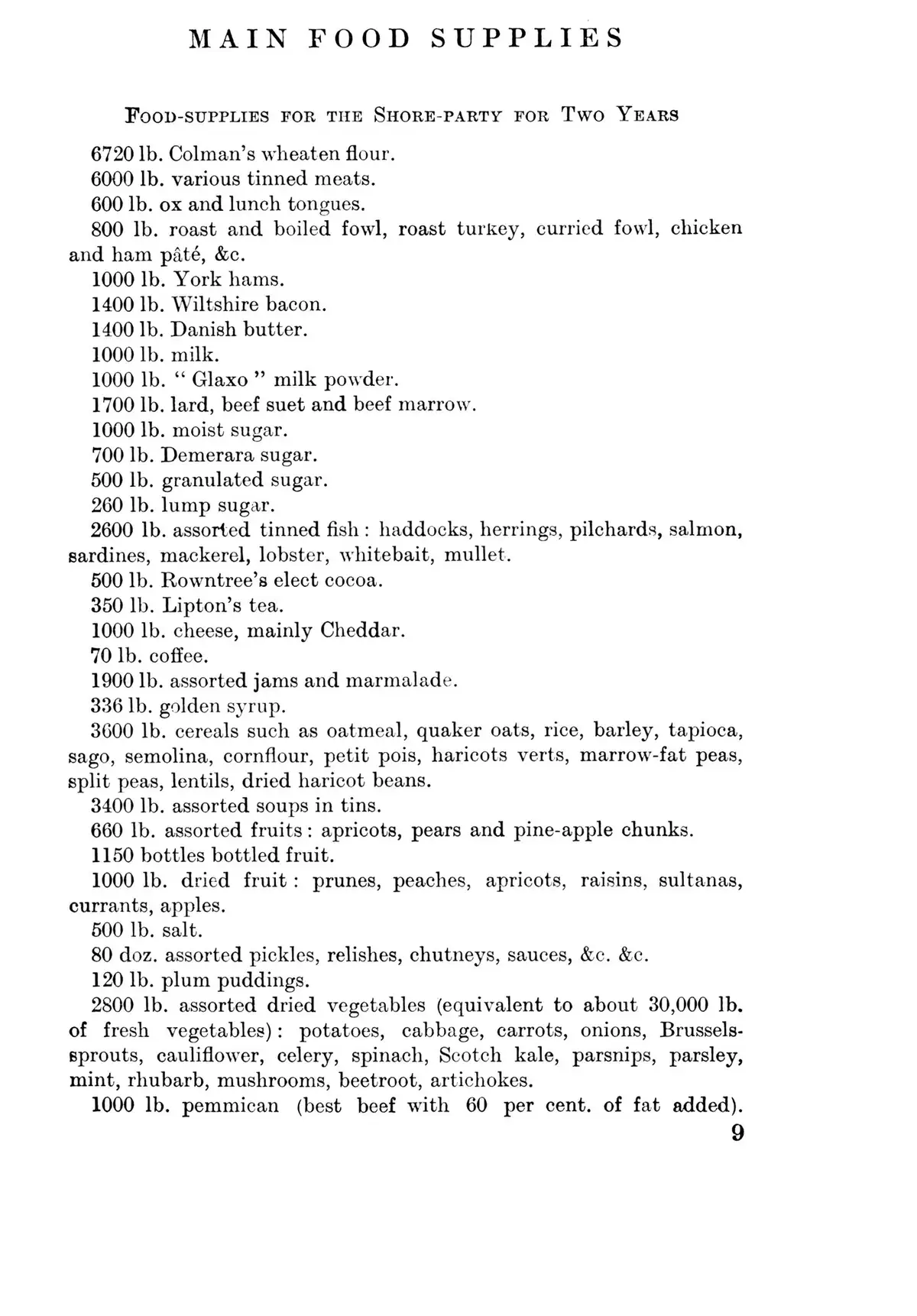
The book prints the stores list. For “the Shore-party for Two Years” it gives, among the flour, hams, butter and pemmican, 500 pounds of Rowntree’s elect cocoa, 350 pounds of Lipton’s tea and 70 pounds of coffee, with milk and Glaxo milk powder, and six dozen tins of plasmon cocoa further down.
Those are amounts packed, not cups drunk. A footnote thanking the donors names larger figures, 1,700 pounds of cocoa among them, and 27 cases of Montserrat lime juice; the two lists have different purposes and shouldn’t be added together. A third list, of relief stores for thirty-eight men for a year in case the ship was trapped and had to winter, adds 100 pounds of tea, 50 pounds of coffee and 1,000 pounds of cocoa. It is a contingency, not the hut’s menu.
Water from ice
A dry store only becomes a hot drink with water, fuel and work, and in the Antarctic the water had to be melted. Shackleton describes the hut’s day. The messman kept the ice melting pots filled, dealt with the ashes and brought in coal, and at twenty minutes to one he put the water on for the midday tea. There was tea after dinner too. In bad weather even fetching ice was hard. Frank Wild, the storekeeper, issued supplies to the cook, William Roberts.
None of that is a recipe. It is the reason a mug of tea at Cape Royds was somebody’s job.
Tea at noon, cocoa at night
On the sledging journeys the drinks were set by the clock:
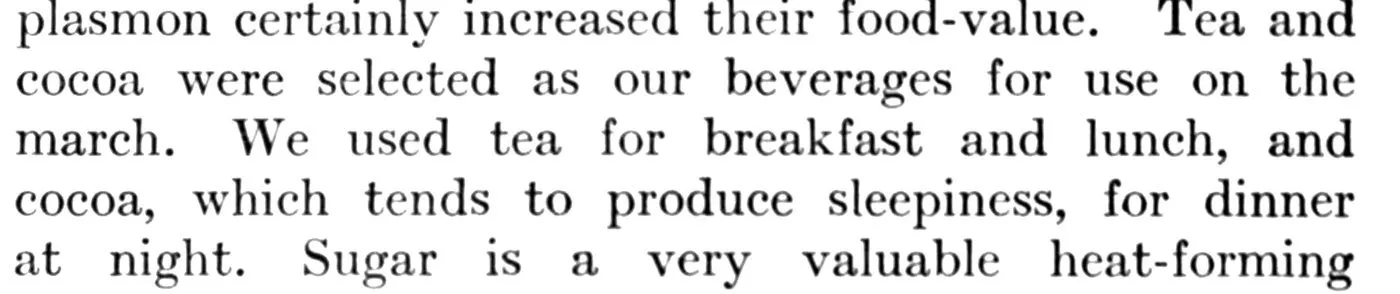 Ernest Shackleton, The Heart of the Antarctic, vol. 1 (London, 1909), p. 160. University of Toronto copy via Internet Archive, public domain.
“Tea and cocoa were selected as our beverages for use on the march. We used tea for breakfast and lunch, and cocoa, which tends to produce sleepiness, for dinner at night.” The sleepiness is Shackleton’s explanation.
The ration table for the southern journey gives the weights. At full ration each man had 0.7 ounce of cocoa a day, about 20 grams, inside a daily allowance of 34 ounces of food. Tea sat outside that allowance: about two ounces a day for the four men together, roughly 14 grams each. Those are dry weights. The table doesn’t say how much water went with them, and the rations were cut as the journey went on.
A mild spree
The hut was dry most of the time, by Shackleton’s account. “Mid-winter’s day and birthdays were the occasions of festivals, when our teetotal régime was broken through and a sort of mild spree indulged in.”
The printed program for the 1908 midwinter celebration survives, and it is not modest on paper: whisky beside the soup, champagne beside the penguin and seal, more whisky later and coffee at the end, with jokes about the whisky running through it. A menu card is a program, though, not a tally of glasses.
Other celebrations are on record too. When the Erebus party came back, Shackleton wrote, “We shook hands all round and opened some champagne, which tasted like nectar to the way-worn people.” And on Christmas Day 1908, far out on the southern journey, Shackleton’s party of four boiled a small plum pudding in the cocoa water, and had it with a drop of medical brandy and a spoonful of crème de menthe. That is about as much alcohol as the parts of the sledging record we checked show: a drop and a spoonful, on Christmas Day, beside the cocoa.
The whisky under the hut
In the 2000s, conservators at Cape Royds found crates under the hut: three of whisky and two of brandy, according to the Antarctic Heritage Trust, which looks after the site. They were first seen in 2006, exposed and identified over 2006 and 2007, and dug out in 2010. Three bottles went to Scotland in 2011 for study and came back to Antarctica in 2013.
The scientists who tested them, writing in the Journal of the Institute of Brewing in 2011, found the whisky at about 47.2 percent alcohol and more lightly peated than many expected of an old malt. Their figure of 25 cases for the original order comes from a trade report of 1957, not a surviving invoice. And the bottles show what was put by, not what was poured. Against them stand Shackleton’s own words for the hut’s ordinary days: teetotal.
Making it at home
The expedition’s cocoa recipe isn’t in the book, only its weight. For a household cup from a generation earlier, Breakfast Cocoa the 1886 Way, Half Milk and Half Water works cocoa to a paste with boiling water and makes it up with milk. Fresh milk is our home choice, something the record does not put on the sledges. The story of the drink behind it is A Short History of Hot Chocolate.
 Always alcohol-freeBreakfast Cocoa the 1886 Way, Half Milk and Half Water
For what was on the plate, our sister site The Forgotten Menu has Scott’s midwinter dinner in the Antarctic, 1911 (opens in a new tab).
Sources
- Ernest Shackleton, The Heart of the Antarctic, vol. 1 (London: William Heinemann, 1909), pp. 9–11, 160, 192, 214–216, 250–251, 335–336. University of Toronto copy, Internet Archive heartofantarctic01shacuoft.
- Midwinter Celebration at Winter Quarters, Cape Royds (printed menu, 1908), as photographed by Jonkers Rare Books, item 39225.
- Antarctic Heritage Trust (New Zealand), account of the Cape Royds whisky, https://nzaht.org/shackletons-whisky/ (opens in a new tab).
- Nigel Watson, “Shackleton’s Whisky,” James Caird Society Journal 7, pp. 44–49.
- J. Pryde and nine coauthors, study of the recovered Mackinlay whisky, Journal of the Institute of Brewing 117 (2011), pp. 156–165.