Sledge Chocolate from Amundsen’s 1911 Ration
Reader ratingsDark chocolate and whole-milk powder whisked into just-boiled water, built from the daily chocolate and milk ration of Roald Amundsen’s South Pole party in 1911.
- Recipe makes
- About 500 ml, 1 large mug or 2 small cups
- Prep
- Total
Bring the water just to the boil and take it off the heat before the chocolate goes in, so it melts without catching.
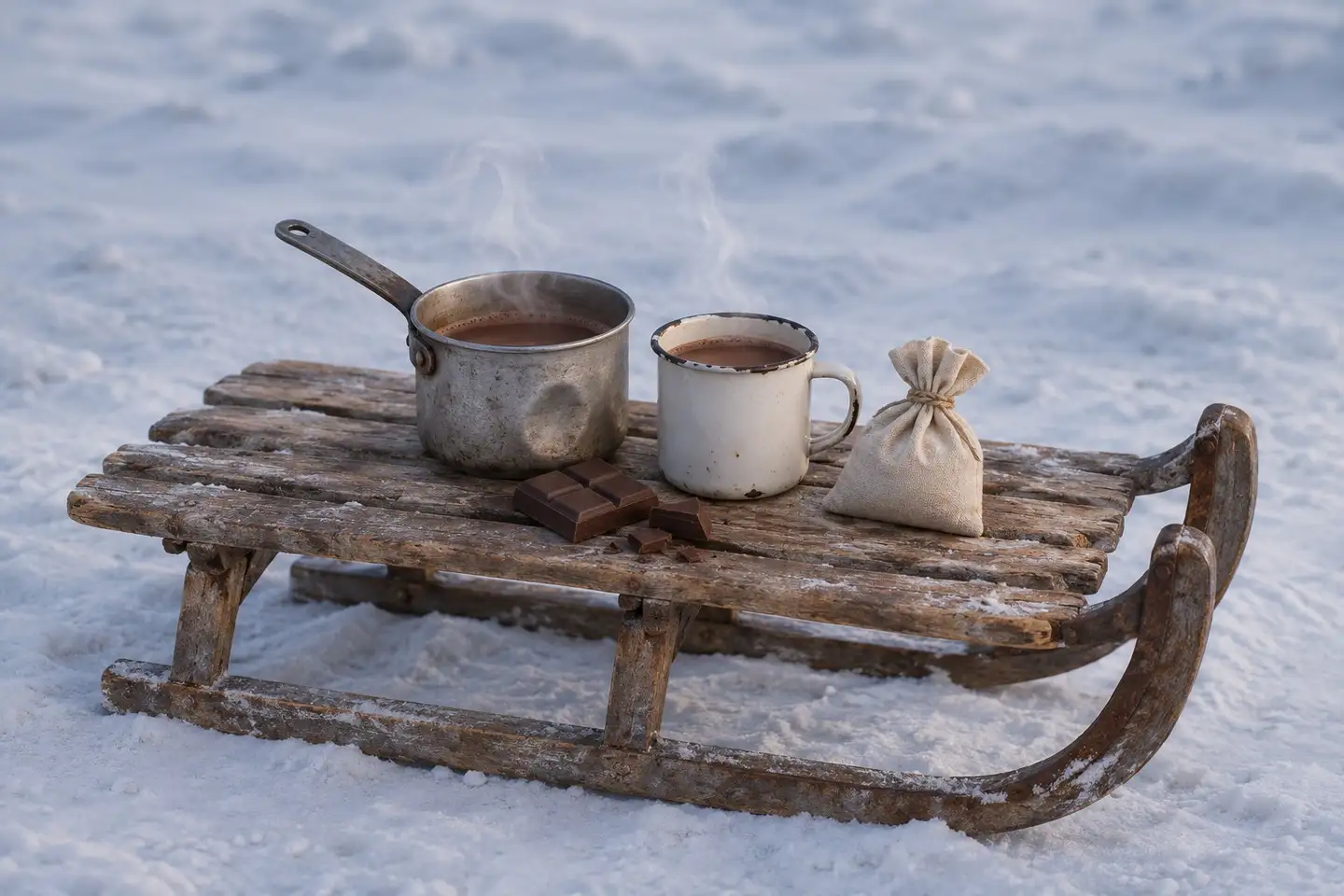
Hot chocolate in an aluminum pot and an enamel mug, with broken dark chocolate and a cloth bag, on a sledge in the snow.
The story behind the recipe
Roald Amundsen’s men carried 40 grams of chocolate per man per day to the South Pole in 1911, with dried milk alongside, and this hot chocolate is built from that ration, whisked into hot water. Amundsen printed the ration, not a method, so the method and the water are ours.
A heavenly treat
On the sledges there were only four foods, pemmican, biscuits, milk powder and chocolate, and no alcohol at all; Amundsen kept it off the sledges for its weight. When the party divided its stores in the mountains in November 1911, he printed one sledge’s load: “Chocolate, 12¾ pounds (40 grams, or 1·4 ounces per man per day). Milk-powder, 13½ pounds (60 grams, or 2·1 ounces per man per day).”
The chocolate drink is the one he writes about most warmly. After a hard climb, with the men walked warm and thirsty, the Primus hummed until it was ready: “It was a heavenly treat, that drink.” He mentions it again at the Pole itself, made after the men had stood out in the cold taking observations, and he grumbles once about a cook who made it far too thin.
The book’s only recipe is Wisting’s “chocolate pudding” of biscuit crumbs, dried milk and chocolate boiled in a kettle, which Amundsen leaves to Wisting to explain. The whole story of the drinks, from the Saturday toddy in the hut to the aquavit one party smuggled, is in A Drop of Chocolate at the South Pole.
Read more about this recipe
Making it today
We use the full 40 grams of chocolate for one large mug and half of the 60-gram milk ration, which is our choice: the book doesn’t say whether the milk went into the chocolate, or how much. Half a liter of water gives a thin, hot drink, closer to the “quart of chocolate” of the English edition than to a thick café cup. Their dried milk came from a firm in Wisconsin and had “an addition of malt and sugar”; a spoonful of malted milk powder in place of some of the milk powder comes nearer to it.
To go with it, our sister site The Forgotten Menu has hoosh, the sledging stew Scott’s men ate the same year (opens in a new tab).
Original: About 500 ml, 1 large mug or 2 small cups
Ingredients
My drinksFor About 500 ml, 1 large mug or 2 small cups. Quantities are shown as written.
Quantities as written here, for About 500 ml, 1 large mug or 2 small cups.
- Dark chocolate, 60 to 70%40 g
- Whole-milk powder30 g
- Water500 ml
- Of salt (optional)1 pinch
Measurement notes
Ingredients as written here
- 40 g dark chocolate, 60 to 70%
- 30 g whole-milk powder
- 500 ml water
- 1 pinch of salt (optional)
Equipment
 Small saucepan
 Whisk
 Knife and board
Instructions
Chop the dark chocolate finely.
Bring the water just to the boil in a small saucepan, then take it off the heat.
Whisk in the chocolate until it has melted, then whisk in the whole-milk powder a spoonful at a time so it doesn’t clump.
Add the salt, if using, set the pan back over low heat and whisk for a minute until the drink is smooth and steaming. Pour into a large mug.
Nutrition
370calories per serving
Estimated from typical label values for 70% dark chocolate (about 550 kcal per 100 g) and whole-milk powder (about 500 kcal per 100 g), for 40 g chocolate and 30 g milk powder.
Recipe notes
When adjusting quantities
One day’s chocolate ration makes one large mug. Scale by the mug, and keep the chocolate at about 8 g for every 100 ml of water.
Notes
Quantities mentioned in these notes don’t change when you adjust the batch.
The changes from the ration are all ours: the amount of water, using half the day’s milk powder, and the order of melting the chocolate first. Amundsen’s English edition doesn’t say how dark the chocolate was; a 60 to 70% bar is our choice, and a sweeter milk chocolate makes a sweeter cup with the same weight.
For a richer cup in the style of the hut rather than the trail, make Rundell’s Chocolate of 1806, boiled up in milk.
Scaling changes the ingredients only; glassware, ice and timings need their own judgment. To adapt this recipe further, try the recipe tool at TuneMyRecipe (opens in a new tab), our sister site.

Sources and attribution
Built from the sledge ration in Roald Amundsen, The South Pole, trans. A. G. Chater (London: John Murray, 1912), vol. 2, p. 67: 40 grams of chocolate and 60 grams of milk powder per man per day
See the original pages (scan at Internet Archive) (opens in a new tab)