The Oldest Dry Martini We Found (1904)
Reader ratingsHalf Tom gin, half Italian vermouth, two dashes of orange bitters and a piece of lemon peel, stirred with ice and strained: the oldest recipe we have found printed as a dry Martini, from 1904, when dry meant no syrup.
- Recipe makes
- 1 drink, about 2 3/4 fl oz
- Prep
- Total
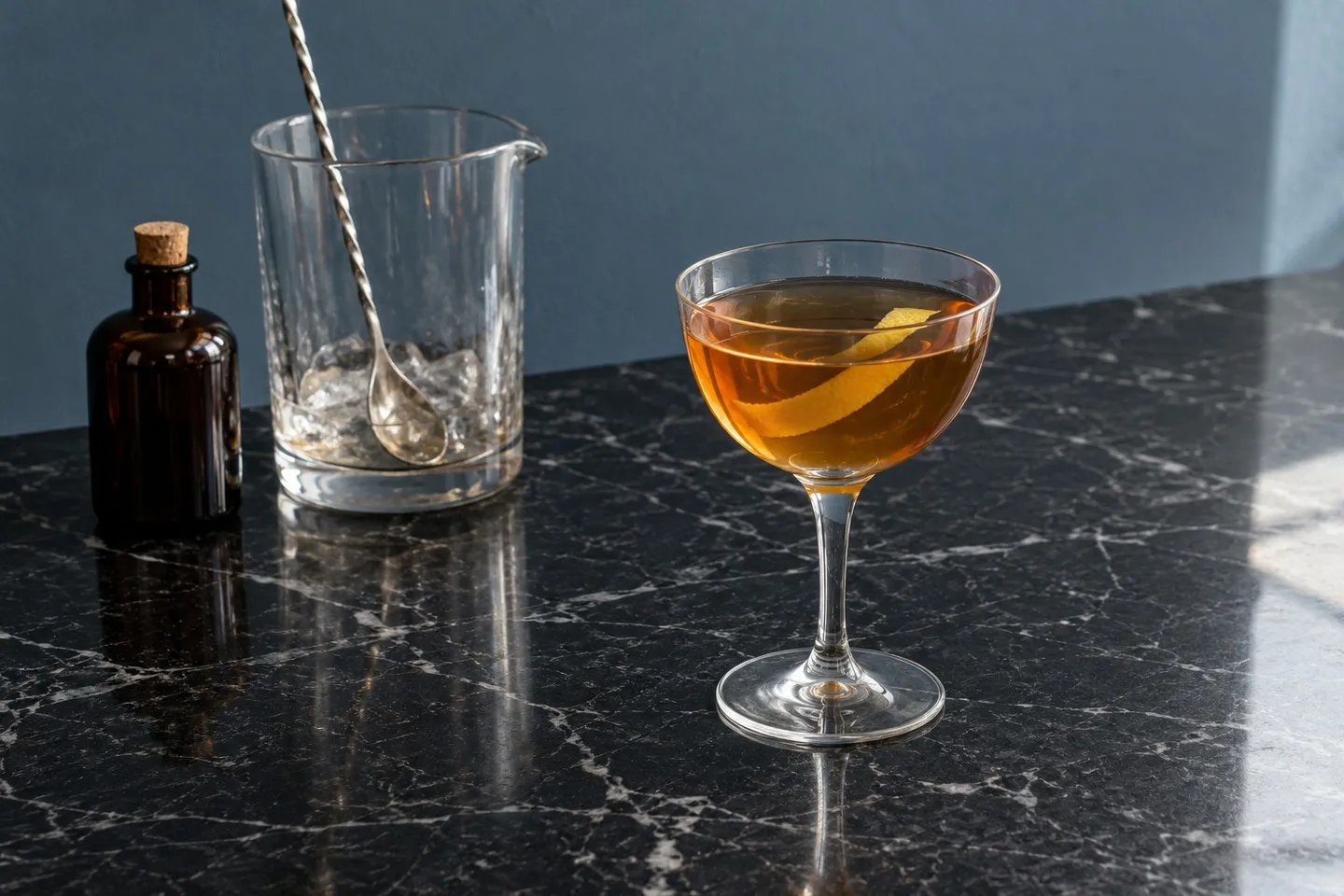
The 1904 dry Martini, Tom gin and Italian vermouth with lemon peel, in a small stemmed cocktail glass beside a mixing glass.
The story behind the recipe
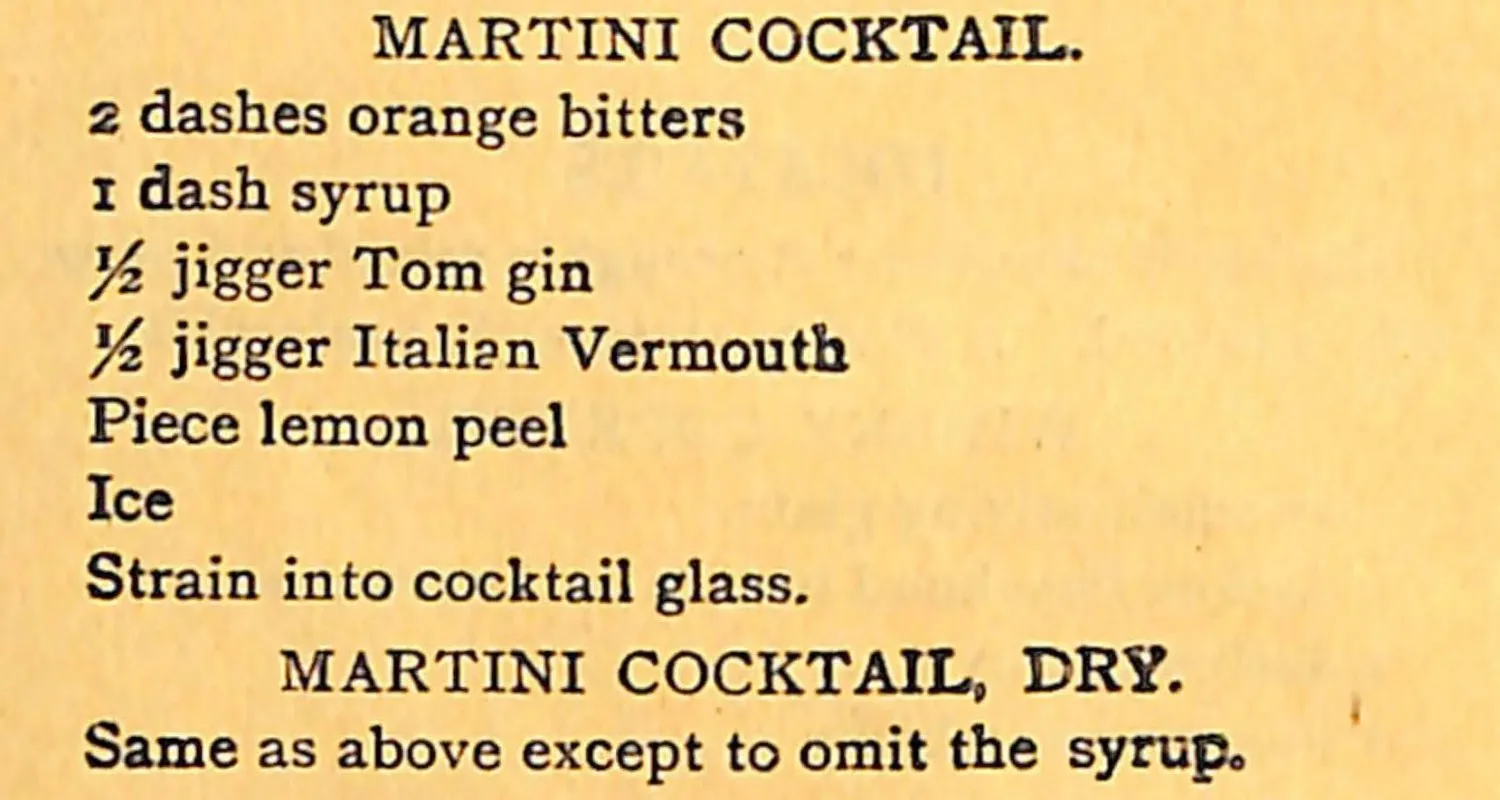
Sweet red vermouth goes into the earliest dry Martini on record that we know of. In the revised 1904 edition of Applegreen’s Barkeeper’s Guide, published in Chicago, John Applegreen gives a Martini Cocktail of half a jigger of Tom gin and half a jigger of Italian vermouth, with two dashes of orange bitters, a dash of syrup and a piece of lemon peel. On the same page, under it, Applegreen prints the Martini Cocktail, Dry: “Same as above except to omit the syrup.” In 1904, dry meant unsweetened, and the red vermouth stayed in the glass.
The clear one had other names
Applegreen, “formerly of Kinsley’s, Chicago and Holland House, New York,” already knew the drink that took over the name. Two pages later his Crisp Cocktail, a Kinsley’s specialty, is Plymouth gin and French vermouth in equal halves with orange bitters and lemon peel, and his Olivette is much the same with an olive dropped in. Thomas Stuart’s Fancy Drinks and How to Mix Them, in a 1904 printing, calls two parts Plymouth gin to one of French vermouth the Marguerite. In Paris that year, Frank Newman’s American-Bar is reported to print a Dry Martini Cocktail of gin and dry French vermouth, though we have not seen that book. The modern Martini was on the bar by 1904, mostly under other names.
The sweet line ran back further. The Martinez of 1887 took twice as much vermouth as Old Tom gin, and Applegreen’s book was first copyrighted in 1899, so his dry Martini may be older than the 1904 revision that prints it. How “dry” came into the bar book, and what came before it, is traced in The Bartenders Who Wrote Down the Classic Cocktails.
Read more about this recipe
A small drink, stirred
Applegreen’s jigger is taken here as 2 fl oz, so each half is 1 fl oz and the drink is small. Stirred with ice, it comes to about 2 3/4 fl oz at roughly 21% ABV, about one US standard drink, and it pours clear amber-red from the vermouth. Tom gin, the lightly sweetened Old Tom style, is the gin he names. He gives no method beyond ice and a strainer; stirring is our choice, as he directs for the Crisp.
The modern dry Martini is a different balance, five or more parts London dry gin to one of dry vermouth, and its measures close this page. Between the two sits the Savoy’s equal-parts Fifty-Fifty of 1930, on TuneMyRecipe (opens in a new tab).
MARTINI COCKTAIL. 2 dashes orange bitters 1 dash syrup ...
MARTINI COCKTAIL, DRY.
Same as above except to omit the syrup.

Recipe makes: 1 drink, about 2 3/4 fl oz
Ingredients
For 1 drink, about 2 3/4 fl oz. Quantities are shown as written.
Quantities as written here, for 1 drink, about 2 3/4 fl oz.
- Old Tom gin1 fl oz
- Italian (sweet red) vermouth1 fl oz
- Orange bitters2 dashes
- Strip lemon peel1
- Ice cubes
Measurement notes
Ingredients as written here
- 1 fl oz Old Tom gin
- 1 fl oz Italian (sweet red) vermouth
- 2 dashes orange bitters
- 1 strip lemon peel
- ice cubes
Equipment
 Mixing glass
 Bar spoon
 Strainer
 Cocktail glass
Instructions
Chill a cocktail glass in the freezer or with ice water.
Pour the Old Tom gin, Italian (sweet red) vermouth and orange bitters into a mixing glass and fill it two-thirds with ice cubes.
Stir steadily for about 30 seconds, until the mixing glass is very cold to the touch.
Strain into the chilled glass, twist the lemon peel over the drink and drop it in.
Nutrition
115calories per serving
- Recipe makes
- 1 drink, about 2 3/4 fl oz
Estimated from USDA FoodData Central values for 80-proof gin (64 calories per fl oz) and sweet dessert wine (for the vermouth), plus orange bitters.
Recipe notes
When adjusting quantities
Keep the gin and vermouth in equal parts when you scale; stir no more than two drinks at a time.
Notes
Quantities mentioned in these notes don’t change when you adjust the batch.
Applegreen’s plain Martini, the entry above the dry one, is the same drink with a dash of simple syrup added.
The modern serve: stir 2 1/2 fl oz London dry gin and 1/2 fl oz dry (French) vermouth with ice, with a dash of orange bitters if you like, strain into a chilled cocktail glass and finish with a lemon twist or an olive.
Applegreen’s Crisp Cocktail, the dry kind in equal parts, is 1 fl oz Plymouth gin, 1 fl oz dry vermouth, 2 dashes orange bitters and a piece of lemon peel, stirred and strained; for the Olivette, use 1 dash of orange bitters and 1 of Peychaud’s bitters and drop in an olive.
For an alcohol-free glass, the Martinez recipe gives a modern version of grape juice, cold black tea and juniper syrup that suits this drink too.
Scaling changes the ingredients only; glassware, ice and timings need their own judgment.
Sources and attribution
John Applegreen, Applegreen’s Barkeeper’s Guide, or How to Mix Drinks, second edition, revised (Chicago: The Hotel Monthly, 1904; first copyrighted 1899), p. 2
Recipe details
- Drink family
- Cocktails & Mixed Drinks
- Region
- American
- Source decade
- 1900s
- Difficulty
- Easy